

You can usually tell when a compliance program is still running on audit season logic. Three weeks before an assessment, Slack fills with evidence requests. Security exports screenshots from cloud consoles. IT pulls user lists from IAM. HR scrambles to prove termination workflows. Someone opens the spreadsheet nobody has touched since the last audit and starts guessing which controls still map to which systems.
That model breaks down once audits stop being occasional. Teams aren’t preparing for one event anymore. They’re trying to keep evidence current across multiple frameworks, business units, and platforms while production systems keep changing underneath them. If you’re dealing with UK GDPR, ISO 27001, HIPAA, SOC 2, or sector-specific requirements at the same time, the reporting burden compounds fast.
The major shift in compliance management solutions isn’t prettier dashboards. It’s operational. The useful platforms now sit inside security workflows, pull evidence from live systems, map that evidence to controls, and keep audit readiness close to real time. That’s what separates a reporting tool from a system you can run.
The End of the Annual Audit Scramble
The old pattern is familiar. An auditor asks for proof that endpoint protection is enabled, access reviews are current, privileged accounts are controlled, and log retention matches policy. The answers exist, but they’re scattered across Jira tickets, SIEM searches, IAM exports, policy PDFs, and screenshots saved in someone’s desktop folder. Compliance becomes an all-hands retrieval exercise.
That approach doesn’t hold up under current pressure. 92% of organizations conducted at least two audits or assessments in 2025, and 35% of enterprises conducted more than six on average, while 69% of organizations said regulations are too complex or too numerous, or that supplier compliance is hard to verify, according to Secureframe’s 2025 compliance statistics. That’s why this work has shifted from periodic preparation to continuous operations.
What the scramble actually costs
The visible cost is staff time. The harder cost is context switching. Security engineers stop tuning detections to gather evidence. Identity teams pause access cleanup to rebuild reviewer lists. Risk managers spend time reconciling naming differences between controls, systems, and business owners instead of testing whether controls still work.
A manual process also creates a trust problem. If evidence is collected late, teams start relying on point-in-time exports that may already be stale. You can pass an audit packet that no longer reflects the environment.
The strongest compliance programs don’t ask, “Can we produce evidence next month?” They ask, “Is the evidence already being produced by the systems we run every day?”
Why leaders are changing the model
Compliance management solutions are filling this gap because they reduce the work of chasing proof after the fact. They centralize evidence, keep control ownership visible, and support faster responses when a framework changes or a new assessment appears. That matters most in hybrid environments where controls depend on cloud settings, identity platforms, endpoint telemetry, ticketing systems, and vendor attestations at the same time.
For a CISO or IT risk leader, the operational lesson is simple. If compliance still depends on screenshots and quarterly archaeology, the issue isn’t audit discipline. It’s architecture.
Beyond Spreadsheets The New Compliance Hub
Monday starts with a Slack message from audit asking for proof of privileged access reviews, log retention, and endpoint coverage. If the answer still depends on shared drives, screenshots, and a control spreadsheet that only one analyst fully understands, the problem is no longer documentation. The problem is that compliance is sitting outside the systems that produce operational truth.
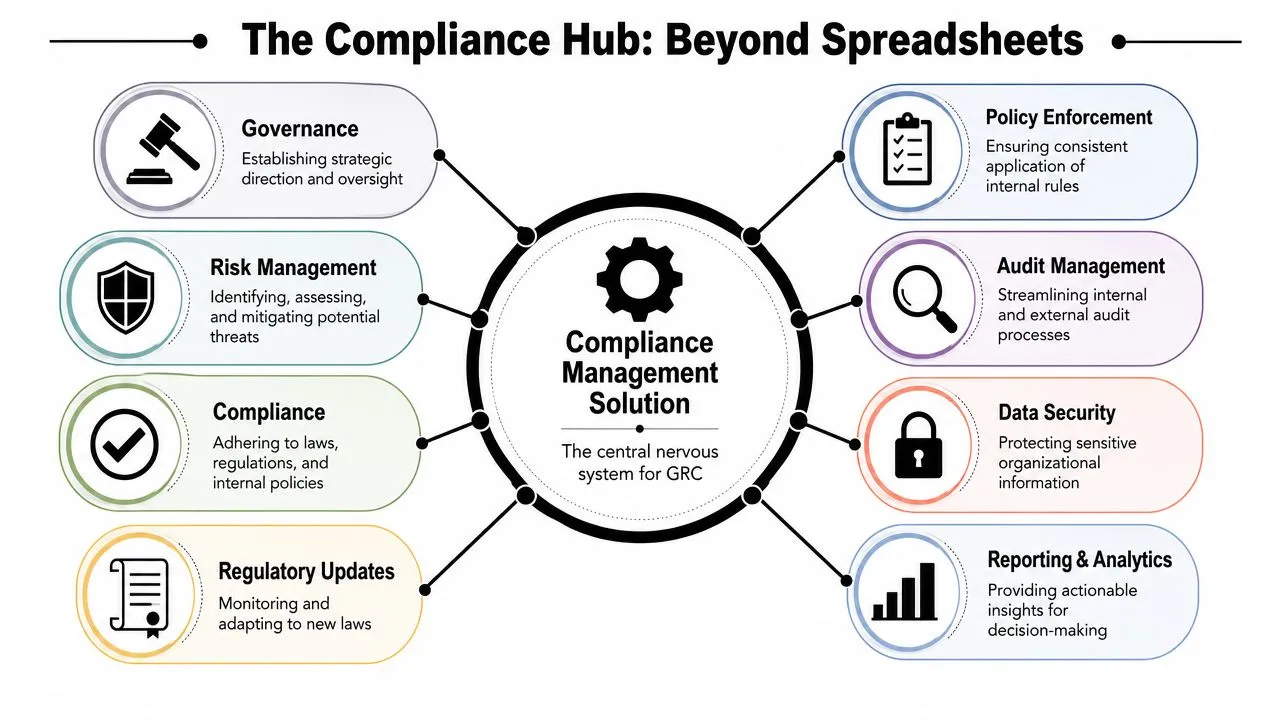
Modern compliance management solutions work as the control hub for governance, risk, and compliance. They tie requirements, policies, controls, evidence, issues, and audits into one operating model, with live system data attached to each control wherever possible. The shift matters because a control is only useful if the platform can show its current state, its owner, and the evidence trail behind it.
What changes when the hub is real
In older environments, policy sits in one repository, asset data in another, tickets in a separate system, and evidence in folders named for the last audit. Teams spend audit season rebuilding relationships they already know should exist. A real hub keeps those relationships intact all year and ties them back to the source systems security and IT already use.
That usually means the platform maintains persistent links between:
- Requirements and controls, so one control can satisfy multiple frameworks without duplicate testing
- Controls and owners, so accountability survives org changes and staff turnover
- Evidence and source systems, so proof comes from identity, cloud, SIEM, XDR, ticketing, and endpoint platforms instead of manual uploads
- Findings and remediation work, so exceptions become tracked tasks with status, deadlines, and audit history
This is the trade-off buyers need to evaluate carefully. Some tools go deep on policy management and audit workflows but stay weak on operational integrations. Others connect well to security tooling but need more maturity in control mapping and exception handling. A market overview like this GRC tools comparison for security and compliance teams can help frame the options, but the true test is whether the product can sit in the middle of daily security operations without creating more manual work.
Why document repositories stall out
A document repository can hold evidence. It cannot prove that a control still works.
That distinction shows up fast in live environments. A screenshot of MFA settings might satisfy an auditor once. It does not tell a CISO whether the policy stayed enforced after an admin change, whether service accounts were excluded, or whether enforcement covers the right user groups. A hub connected to identity systems, security telemetry, and ticketing data can answer those questions with current evidence and history.
Industry guidance from audit and advisory firms has made the same point for years. Continuous controls monitoring and automated evidence collection reduce the time teams spend assembling documentation because evidence is gathered as part of operations, not reconstructed after the fact. KPMG describes this shift in its overview of continuous controls monitoring and automation in compliance programs.
Practical rule: If a platform cannot show where evidence came from, when it was collected, whether it is still current, and which control it supports, it is a repository, not a compliance hub.
The business case behind the architecture
The business case is operational. Security teams already collect high-value data in SIEM, XDR, cloud security, IAM, EDR, and ITSM platforms. A compliance hub uses that data twice. First for defense and operations, then for evidence and control validation. That reduces duplicate work, shortens audit prep, and gives risk leaders a better view of control health between formal assessments.
There is a trade-off. More integration takes more design discipline up front. Teams need clean ownership, stable control mappings, and agreement on which systems are authoritative. But once that foundation is in place, audit readiness becomes an output of day-to-day operations rather than a separate project that drags engineers away from security work.
How Modern Solutions Automate Compliance Workflows
Monday morning, the auditor asks for proof that MFA, log retention, and privileged access reviews were working last month, not just configured today. Teams that still rely on screenshots, exported CSVs, and ticket comments turn that request into a fire drill. Teams with a unified compliance platform answer from live system evidence that has been collected and mapped continuously.
That difference is what automation changes. The goal is not faster report writing. The goal is to make audit evidence a byproduct of security operations.
Evidence collection from live systems
Modern platforms start with the systems that already hold operational truth. SIEM, XDR, IAM, cloud security tools, EDR, HR systems, and ITSM platforms all produce evidence that can support one or more controls. The platform ingests that data through APIs, agents, and event streams, preserves source context, and ties it to a specific control, owner, and timeframe.
A screenshot shows a moment. A direct pull from a live system shows state over time.
That distinction matters in practice. If an analyst still has to export a report from a cloud console, rename the file, upload it, and explain what control it supports, the expensive part of compliance work is still manual. A platform connected to centralized log management for compliance evidence can pull retention settings, alert coverage, and activity records from the logging layer without that extra handling.
Control testing inside the workflow
Collection alone does not solve the problem. Evidence has to be evaluated against control logic while it is still current.
If MFA is a requirement, the platform should validate identity-provider data and flag gaps by group, role, or application. If endpoint protection is required, it should check EDR status and policy coverage against the assets in scope. If incident response controls depend on ticket closure and escalation paths, it should correlate alerts, case records, and workflow timestamps rather than accept a file upload as proof.
In mature implementations, the workflow looks like this:
- Pull evidence from systems of record on a schedule or continuously
- Evaluate control conditions against current data
- Map one result to all relevant frameworks and policies
- Open remediation tasks when evidence is missing, stale, or failed
- Refresh audit views automatically as control status changes
Operational trade-offs become apparent. More integrations produce better evidence quality, but they also force decisions about data ownership, normalization, and exception handling. If the IAM system says MFA is enabled and the application team says the service account is exempt, the platform needs a clear exception model or the control will generate noise and lose credibility.
One evidence stream, multiple control outcomes
Efficiency gain comes from reuse. One validated event stream from IAM or SIEM can support several controls across SOC 2, ISO 27001, PCI DSS, or an internal policy set. Security teams should not collect separate proof for each framework when the underlying control is the same.
Analysts at Sprinto describe this benefit in their explanation of automated compliance evidence collection. They note that automation can cut a large share of the documentation and follow-up work that usually consumes audit preparation. That matches what I see in practice. The time savings come from eliminating repeated evidence requests, not from making spreadsheets prettier.
The same principle applies to transaction-level evidence in regulated workflows.
A workflow is mature when a failed control creates remediation work automatically, assigns it to the right owner, and records the fix without another email chain.
Reporting becomes a byproduct of control operations
Once evidence collection and testing run inside normal security workflows, reporting stops being the main job. Dashboards, assessor views, and framework summaries reflect current control health because the underlying systems keep feeding the platform. Auditors still ask for explanations, exceptions, and ownership history, but the team no longer starts from a blank page every quarter.
That is the operational shift CISOs should care about. Compliance stops competing with security work and starts using the same data, the same systems, and the same workflow discipline.
Key Features and Integrations to Evaluate
Most compliance platforms look similar in a demo. They all show control libraries, status indicators, task workflows, and reports. The key difference appears when you ask how the system gets evidence, how it correlates that evidence, and how much manual handling remains after go-live.
The integrations that change the outcome
Compliance software creates the most value when it’s fully integrated with security systems such as SIEM, IAM, and cloud infrastructure because those connections let the platform correlate events, ownership, and evidence automatically instead of relying on manual exports, as outlined in Cynomi’s overview of compliance management software solutions.
That means your evaluation should start with data paths, not dashboard design.
| Feature / Integration | Why It’s Critical | Example Use Case |
|---|---|---|
| SIEM or XDR integration | Connects detections, alerts, and log evidence to control validation | Show that security monitoring and incident evidence support logging and response controls |
| IAM integration | Validates MFA, access reviews, role changes, and privileged account controls | Prove joiner-mover-leaver controls and privileged access restrictions |
| Cloud platform integration | Pulls configuration states and resource metadata from the environment itself | Validate encryption, logging, and public exposure settings in cloud workloads |
| HR system integration | Confirms onboarding, offboarding, training assignment, and ownership changes | Tie terminated users to account deprovisioning evidence |
| Ticketing integration | Links exceptions and remediation to accountable work items | Show an audit trail from finding to resolution |
| Asset and endpoint data | Connects policy requirements to actual device posture | Demonstrate that managed devices meet endpoint protection controls |
| Immutable audit trail | Preserves who changed what, when, and why | Answer auditor questions without rebuilding history |
| Multi-framework mapping | Reuses one validated control across several frameworks | Map one access control to ISO 27001, HIPAA, and SOC 2 requirements |
Nice to have versus must have
A polished UI is nice to have. So are prebuilt templates and export-friendly reports. The must-haves are deeper:
- Source-system evidence collection so proof isn’t manually curated
- Bidirectional workflow links with ticketing or case systems
- Identity-aware ownership so controls don’t lose accountability
- Security stack integration so control testing reflects live events
- Framework mapping logic that avoids duplicating effort
If your team handles payment systems or transactional logs, specialized enrichment can also matter.
Questions that expose weak products
Ask vendors to show these things live:
- How does evidence enter the platform? Through API, log ingestion, agent, or file upload?
- What breaks if a connector fails? You need visible evidence staleness, not silent gaps.
- Can control failures be tied to security telemetry? If yes, the platform is operational. If not, it’s mostly administrative.
- Where is the underlying log context? A control view without event detail creates blind spots.
For teams already centralizing telemetry, a platform connected to centralized log management is far more useful than a standalone compliance portal because it keeps evidence tied to the operational record.
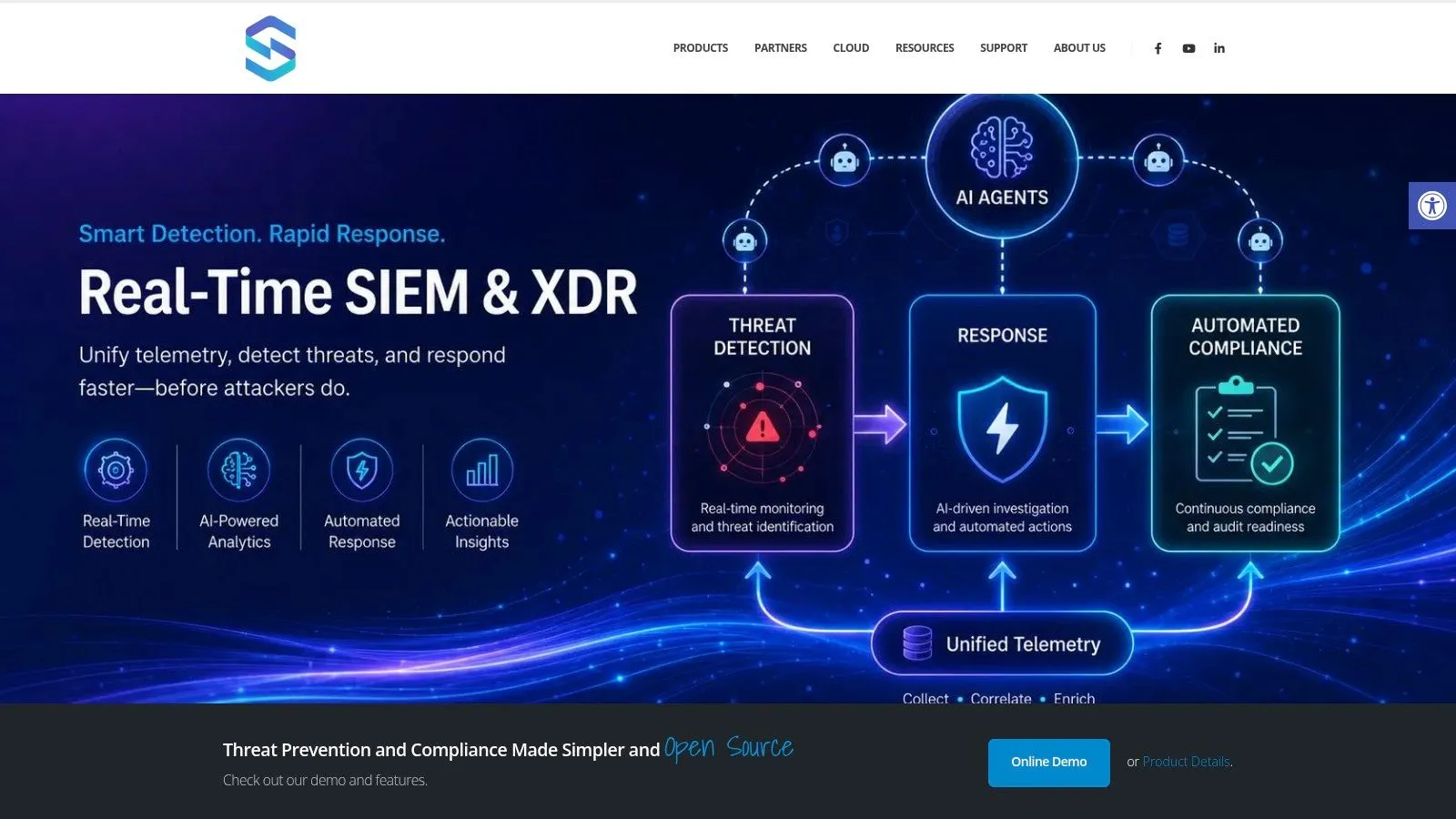
One example in this category is UTMStack, which combines SIEM/XDR and compliance workflows so detections, logs, and mapped control evidence can live in the same environment. That’s a meaningful design choice for hybrid teams that don’t want another silo.
A Practical Roadmap for Selecting and Implementing Your Solution
The selection mistake I see most often is buying for presentation and implementing for survival. The demo emphasizes reports. Actual work starts when you try to connect cloud logs, IAM events, HR ownership data, endpoint status, and legacy records into one control model.
Start with the implementation path, not the license tier.
Phase one and two define whether the project survives
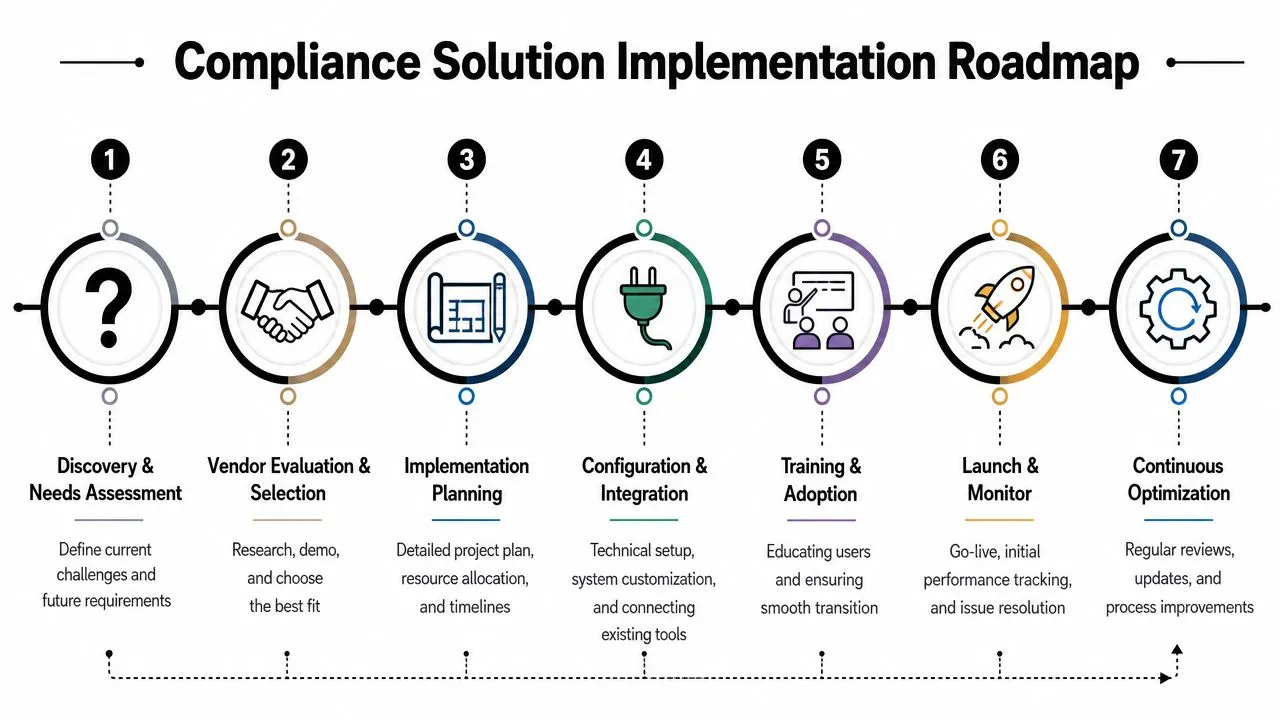
The first phase is discovery and scoping. Inventory the frameworks you report against, the internal controls you already operate, and the systems that can produce evidence. This sounds basic, but many teams skip it and discover late that a “simple” HIPAA or ISO rollout depends on HR data, ticket states, identity groups, and third-party attestations.
The second phase is integration prioritization. Connect the systems that answer the most audit questions first. Usually that’s identity, cloud, logging, endpoint, and ticketing. Leave lower-value edge cases for later unless they support a critical control.
Build workflows before you build dashboards
Many buyers struggle after purchase because the hard part isn’t generating reports. It’s reducing administrative overhead in a mixed environment and integrating diverse evidence sources for continuous validation. ANSI’s announcement around its cloud compliance platform highlights this operational problem in its discussion of reducing administrative overhead and staying current with obligations.
This short walkthrough is worth watching before rollout because it helps teams think about workflow fit, not just platform fit.

After core integrations, define playbooks for recurring work:
- Evidence freshness rules for how often each control needs live validation
- Exception workflows for temporary noncompliance and documented risk acceptance
- Remediation routing so findings become tickets with owners and due states
- Escalation paths when a control repeatedly fails or evidence stops flowing
Buy the product for the evidence model. Implement it through the operating model.
Adoption is part of implementation
Train auditors, compliance leads, identity admins, cloud teams, and SOC analysts on the same control language. If each team uses different names for the same control, the platform will inherit your confusion. For organizations focused on regulated healthcare environments, HIPAA compliance automation workflows are a useful reference point because they show how evidence collection and security operations can be tied together instead of managed separately.
Continuous optimization comes last, but it never stops. Connectors change. Control owners leave. Frameworks evolve. Good implementations assume drift and plan for it.
How to Measure the ROI of Your Compliance Platform
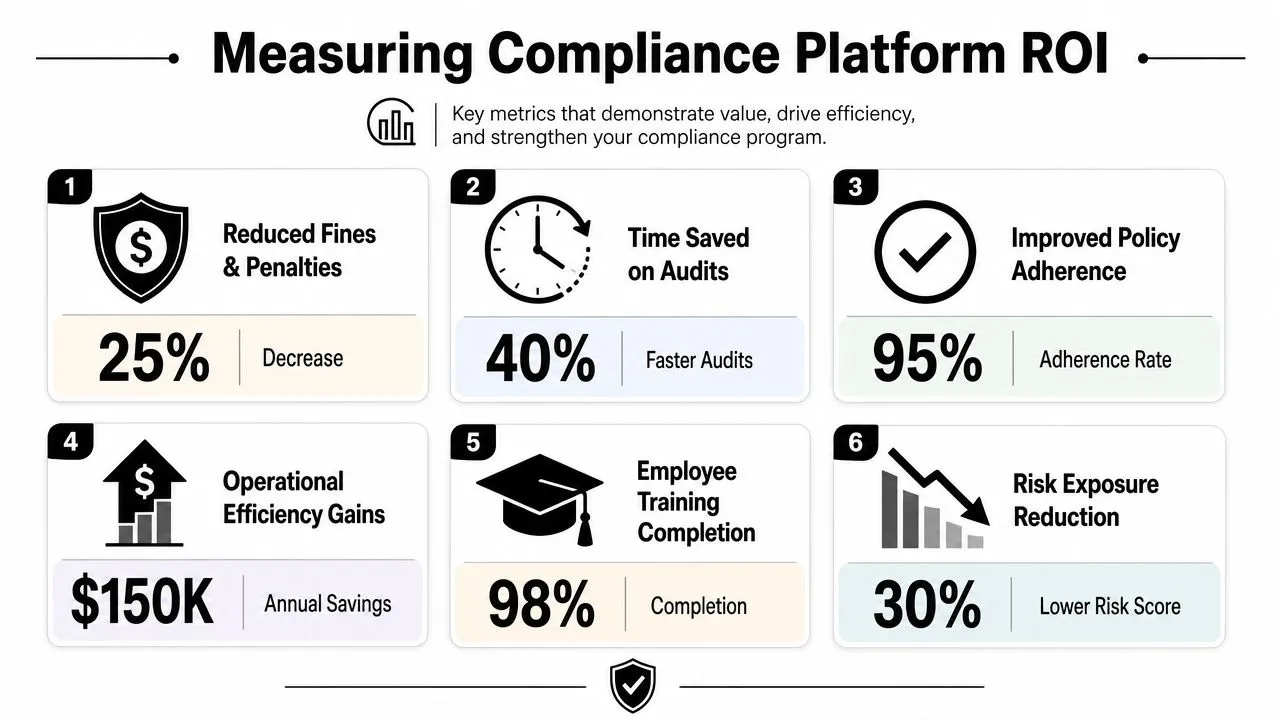
If you need budget for compliance management solutions, “better visibility” won’t carry the case on its own. Leaders need proof that the platform reduces labor, shortens audit cycles, and improves control reliability.
The market signal is already there. One forecast projects the global quality and compliance management solution market at USD 31.9 billion in 2025, rising to USD 77.6 billion by 2035, with a 9.3% CAGR, according to Future Market Insights’ market forecast. That kind of investment means buyers are expected to show operational return, not just policy coverage.
The metrics that matter
Use a before-and-after view tied to actual process work:
- Audit preparation effort measured in staff hours spent collecting, formatting, and validating evidence
- Time to produce an audit-ready package from request to delivery
- Control automation coverage measured as the share of controls backed by direct system evidence instead of manual uploads
- Exception resolution speed based on how quickly findings move from detection to documented closure
- Evidence freshness based on how much of your control set is current without human intervention
- Cross-framework evidence reuse based on whether one validated control supports multiple obligations
What not to overvalue
Don’t overweight dashboard usage, report export counts, or the number of controls imported on day one. Those are activity signals, not business outcomes.
A platform has ROI when it removes recurring work from senior staff and replaces static proof with repeatable evidence collection.
The strongest business cases tie platform value to three things: fewer hours spent on audit prep, lower friction between security and compliance teams, and less uncertainty about whether controls are operating.
Common Pitfalls in Compliance Management and How to Avoid Them
The first pitfall is the reporting-only trap. Teams buy a platform for status views and board-friendly exports, then leave evidence collection outside the tool. The dashboard looks organized, but staff still chase proof manually. Avoid this by requiring source-system integrations for your highest-risk controls before you call the project complete.
The second is integration ignorance. Buyers underestimate the work required to normalize data from legacy systems, cloud services, ticketing platforms, and custom workflows. That doesn’t mean you need every connector on day one. It means you should scope integration effort as part of product selection, not as a surprise after signing.
Three habits that keep the platform useful
- Treat evidence pipelines as production dependencies. Monitor failed connectors, stale data, and broken mappings the same way you monitor other critical services.
- Review control logic regularly. A control that was valid last year may no longer reflect the system, the framework, or the business process.
- Keep security and compliance in the same workflow. If the SOC sees an issue but compliance can’t consume that signal, you’ll rebuild silos inside a modern tool.
The last pitfall is the set-it-and-forget-it mindset. Compliance management solutions aren’t static libraries. They need upkeep as teams, systems, and obligations change. The organizations that get value from them don’t treat implementation as the finish line. They treat it as the point where compliance finally joins daily operations.
If your team wants one place to connect security telemetry, automate evidence collection, and support compliance workflows across hybrid environments, UTMStack is worth evaluating. It combines SIEM, XDR, log management, and compliance capabilities in a unified platform, which is often a better fit than adding another standalone reporting tool to an already fragmented stack.