
You’re probably living this already. Your SIEM is collecting more logs than anyone can read, your endpoint tool is firing alerts that look urgent until they aren’t, and someone on the leadership team keeps asking whether the organization is “covered” without defining what covered means.
That’s the pressure behind cybersecurity threat detection in 2026. Teams don’t need another disconnected console. They need a way to prove that the environment is visible, that suspicious behavior is correlated into incidents, and that the SOC can turn those incidents into response actions and audit evidence without rebuilding the same story three times.
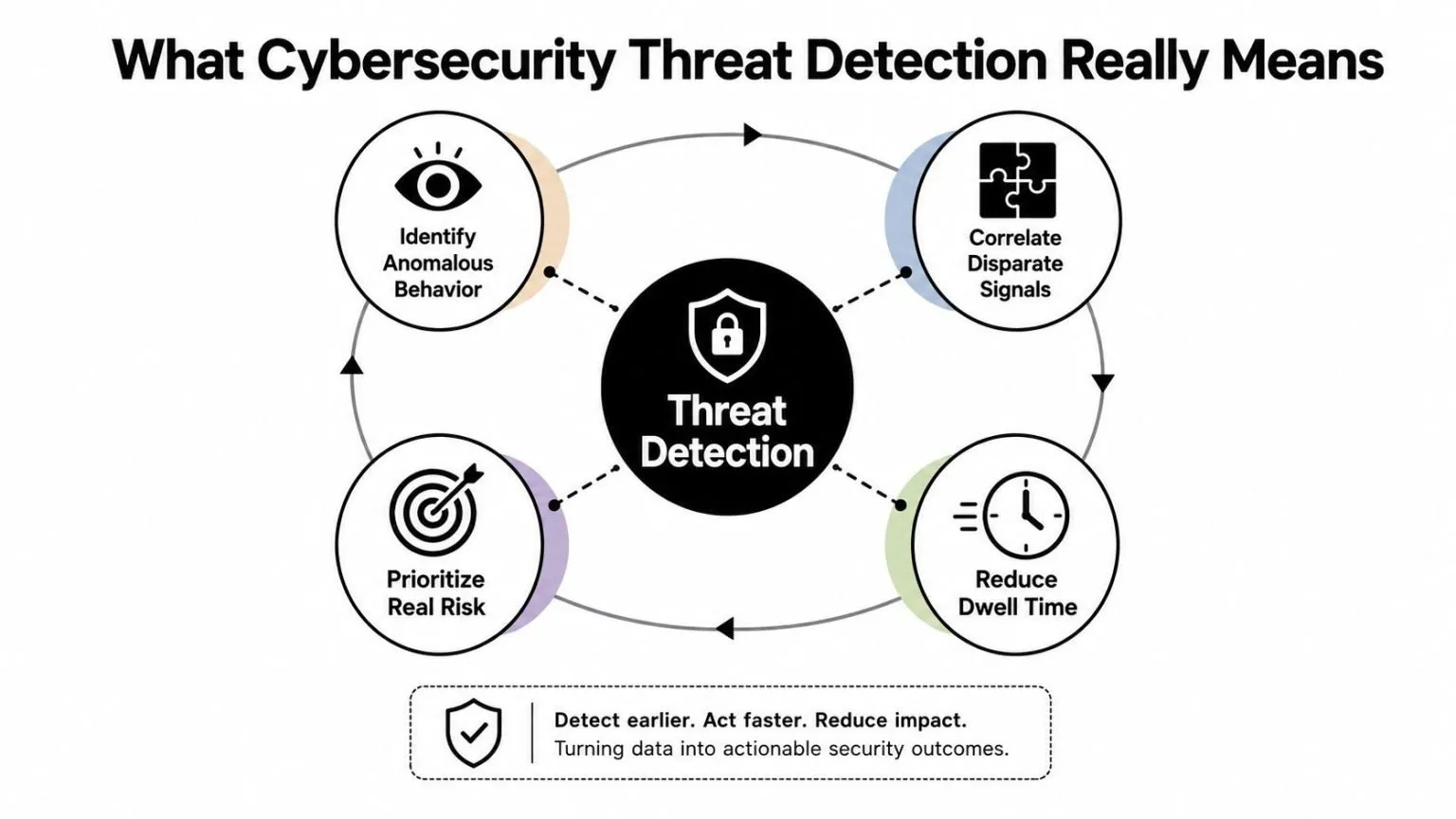
What Cybersecurity Threat Detection Really Means
A Tier 1 analyst starts a shift and sees three things that look unrelated. An employee signs in from a new location. Minutes later, that same identity hits a file share it rarely touches. Then a workstation launches a script interpreter from a document. None of those events alone proves compromise. Together, they may describe account misuse, staging, or early data theft.
That is cybersecurity threat detection in plain terms. It isn’t just “catch malware.” It’s the discipline of finding attacker behavior across endpoint, network, identity, server, cloud, and application activity, then turning that evidence into something a human can act on.
Modern teams feel this scale every day. Microsoft’s 2025 Digital Defense Report says Microsoft processes 100 trillion security signals daily, analyzes 38 million identity risk detections in an average day, and blocks 4.5 million net new malware files every day, with over 52% of cyberattacks with known motivations driven by extortion and ransomware. That’s why mature programs don’t anchor detection only on file signatures anymore. They watch for identity abuse, unusual behavior, and signs of data movement.
The three outcomes that matter
Good detection programs serve three practical goals:
- Reduce dwell time: Find malicious activity before the attacker can settle in and expand access.
- Limit blast radius: Surface incidents early enough that responders can isolate a host, disable an account, or block follow-on actions.
- Produce evidence: Keep the raw events, correlation logic, and investigation trail needed for internal review and audits.
A lot of readers get stuck on products here. They ask whether they need SIEM, EDR, XDR, SOAR, NDR, or all of them. The better question is whether the SOC can collect broad telemetry, correlate it, and present one incident timeline instead of scattered alerts. If you need a quick refresher on how the team itself is organized, this overview of a SOC in cybersecurity is useful context.
Practical rule: A detection that only says “something happened” creates work. A detection that ties identity, process, and network evidence into one incident creates decisions.
For smaller regional teams, that design problem isn’t abstract. A local guide on threat detection for Indiana businesses is a good example of how coverage questions show up in real operating environments, especially where lean IT teams need security visibility without a giant SOC.
Core Detection Techniques and When Each One Shines
A good SOC does not pick one detection style and hope it covers everything. It builds coverage across several techniques, then correlates their output so one weak signal can be checked against another.
That matters because the volume is not low or steady. Fortinet’s 2025 Global Threat Analysis shows detections reaching 1.16 trillion in 2025 versus 993 billion in 2024, a 16.71% year-over-year increase, with FortiGuard Labs observing about 36,000 scans per second worldwide. At that pace, a SOC needs layered detection that separates routine background noise from chains of behavior worth investigating.
Signature detection
Signature rules are the sharpest tool for known-bad activity. They work well when the pattern is already understood and the artifact is stable.
A few examples:
- A malware hash that matches a known family
- A command line pattern tied to a common downloader
- A network IDS rule that matches a well-understood exploit attempt
The advantage is precision. The trade-off is simple. If the attacker changes the file, command, or packet shape, the signature may miss it. Signature logic is strongest for repeatable threats, and weaker when the adversary can alter the surface details without changing the intent.
Anomaly and behavioral detection
Behavioral detection asks whether an action is unusual for a user, host, service account, or workload. It is most useful when the artifact itself looks normal, but the sequence around it does not.
A common case is an office document launching PowerShell, followed by a network connection that workstation does not usually make. Another is a successful sign-in from a new geography followed by bulk access to files the user normally ignores. behavior anomaly detection helps the SOC catch activity that does not match a static blacklist, especially when the attacker is using legitimate tools or valid credentials.
Signatures answer “have we seen this exact thing before?” Behavioral analytics answer “does this action fit what this asset or identity usually does?”
The trade-off is noise. Behavioral rules can be sensitive to business change, travel, patching, or new automation, so the SOC has to tune baselines with care and keep an eye on false positives.
Endpoint-focused detection
EDR and XDR telemetry gives analysts the process tree, parent-child relationships, file writes, registry changes, service creation, and script execution details that generic logs often miss.
That depth matters after an attacker gets a foothold. If someone uses a legitimate admin tool for lateral movement, endpoint telemetry may show the spawning process, the token context, and the persistence step that followed. A firewall log alone usually will not. Endpoint data also makes investigations easier to explain later, because responders can show what executed, what changed, and what launched next inside one incident view.
Threat intelligence matching
Threat intelligence adds outside context to internal activity. Useful indicators include file hashes, malicious IPs, domains, registry keys, and packet-level details. By itself, intelligence matching can be noisy, because many indicators age out quickly or show up in benign traffic. Combined with endpoint or identity signals, it becomes operational.
A practical mental model looks like this:
| Detection style | Best at catching | Common weakness |
|---|---|---|
| Signature | Known malware and repeatable patterns | Novel or modified threats |
| Behavioral | Suspicious use of legitimate tools | Drift and false positives |
| Endpoint telemetry | Deep host-level execution context | Gaps if agents are missing |
| Threat intelligence | Known-bad infrastructure and artifacts | Short-lived indicators and context-free hits |
The mistake is treating these as competing schools. A working SOC uses them together inside one workflow, so alerts, investigation evidence, and response actions stay connected. The signature catches commodity malware. The behavioral rule catches a login that does not fit. The endpoint trace shows what launched. The intelligence feed tells you whether the destination has a malicious history. When those signals land in the same platform, SIEM, XDR, SOAR, and compliance evidence can support one incident path instead of separate queues.
Telemetry Sources and Ingestion Pipelines
Detection quality starts before the first rule ever runs. If the SOC can’t collect and normalize the right evidence, correlation won’t save it later.
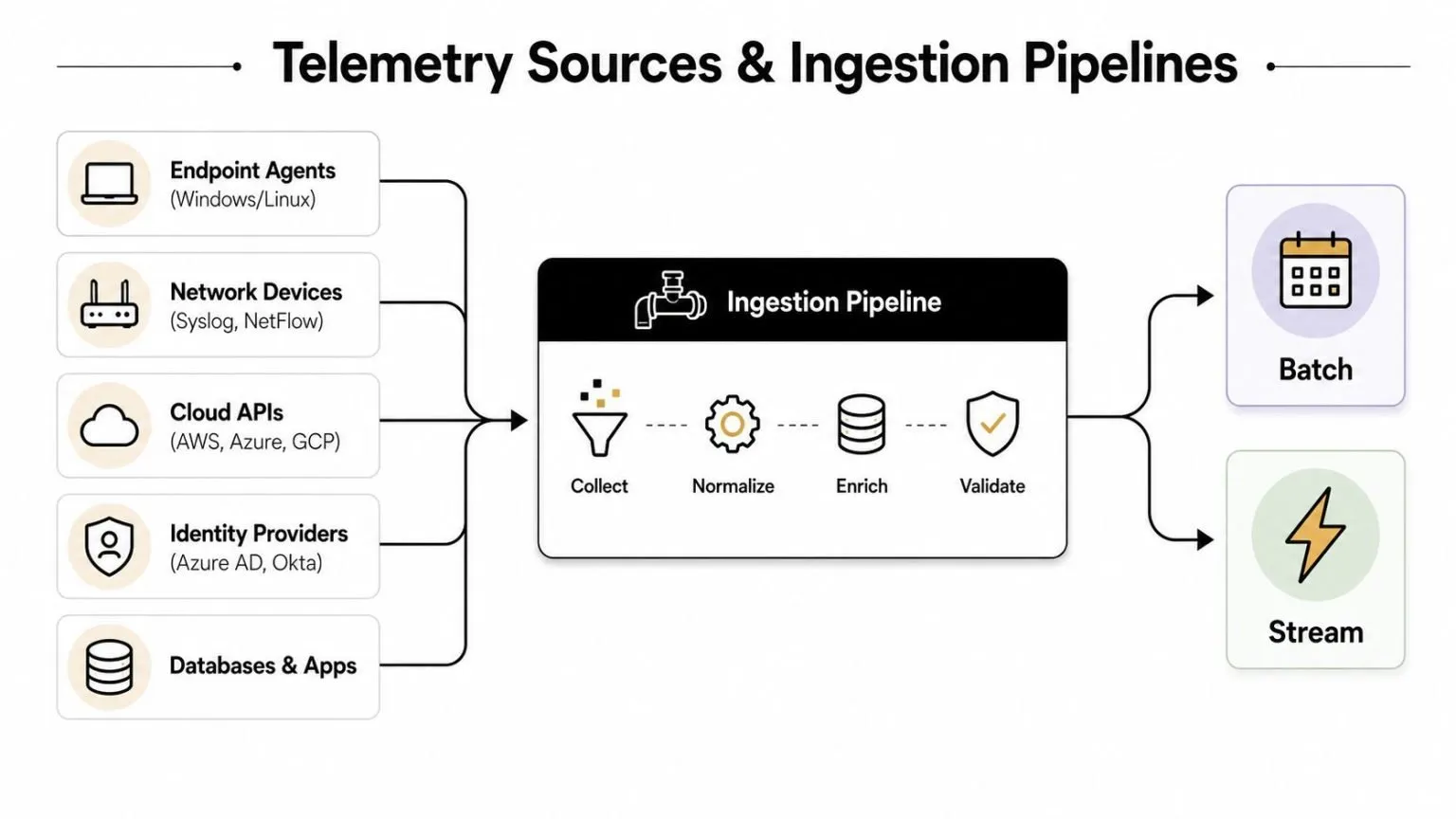
The raw material usually comes from several places at once:
- Endpoint agents: Process execution, file modifications, persistence changes, local privilege activity
- Network devices: Syslog, flow data, connection metadata, proxy events
- Identity providers: Authentication events, MFA challenges, group changes, risky sign-ins
- Cloud APIs: Control-plane activity, workload events, storage access, configuration changes
- Applications and databases: Access logs, administrative actions, unusual data reads, failed requests
Teams often underestimate how much engineering sits between “we have logs” and “we can detect.” A collector has to parse different log shapes, normalize field names, preserve timestamps, and attach context such as hostname, user, business owner, or asset criticality. That’s the point of centralized log management. It gives the SOC one place to ingest, transform, and retain evidence before correlation logic tries to interpret it.
Where blind spots usually appear
A 2022 IEEE review of enterprise monitoring blind spots found seven recurring gaps: encryption, cloud, data volume, shadow IT, scattered identities, multihomed devices, and nonenterprise IT. Those are familiar failure points in real deployments.
Here’s how they show up operationally:
- Encryption: Security devices can see connections but not always the content, so endpoint and identity context become more important.
- Shadow IT: A team spins up a SaaS app or cloud asset outside the standard onboarding path, and the SOC never gets the logs.
- Scattered identities: Users authenticate across multiple directories and cloud services, but the events never land in one timeline.
- Nonenterprise IT: Contractors, unmanaged devices, or side systems interact with core apps but don’t report consistent telemetry.
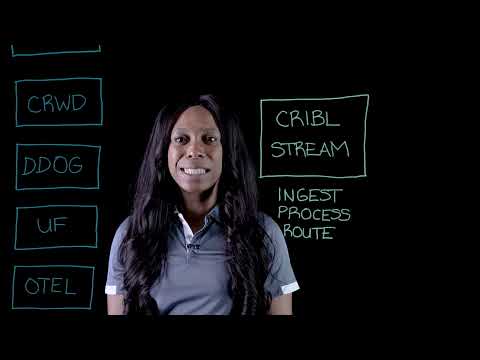
A short walkthrough helps make the pipeline concrete:
Agent versus agentless is a coverage trade-off
Agent-based collection usually gives richer host visibility. Agentless approaches are easier to deploy for cloud APIs, network appliances, and third-party services. Most mature pipelines use both.
If an asset can’t produce usable logs, the SOC doesn’t have a detection problem yet. It has a visibility problem.
Single-signal detections fail because modern intrusions spread across systems. A sign-in event, a process launch, and a storage access call may each look routine in isolation. Correlated into one timeline, they tell a very different story.
Detection Engineering and Rule Tuning That Actually Reduces Noise
A SOC doesn’t get calmer by adding more rules. It gets calmer by writing rules that match attacker behavior, enrich context, and suppress noise without hiding risk.
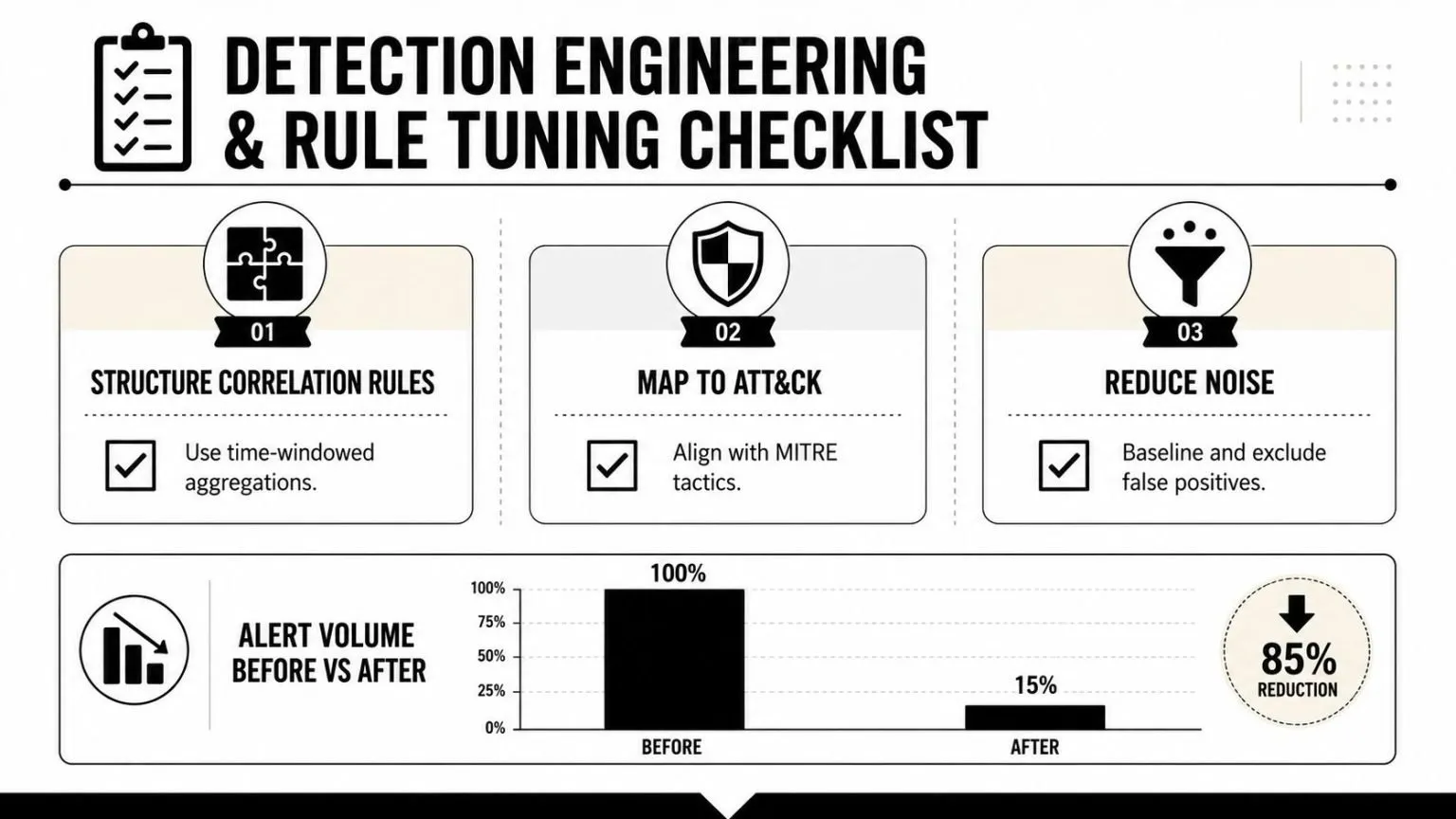
The foundation for that work is observable behavior. The most useful detections aren’t random strings of conditions. They map to adversary techniques that defenders can see in logs. Research discussing CISA and MITRE ATT&CK emphasizes that detection works best when analytics map to observable adversary techniques that can be used to prioritize detections and close visibility gaps through ATT&CK-based logic.
What a correlation rule should actually do
A useful rule answers four questions:
- What behavior matters
- On which assets or identities
- Within what time window
- With what context attached
Take a simple example. A suspicious process starts on a workstation. Within a short window, that host makes an unusual outbound DNS request. Then the same host installs a new service. Any one of those can happen during normal administration. Together, they deserve analyst attention.
That’s why correlation depth matters more than raw rule count.
Tuning methods that work in practice
A noisy detection set usually improves through a few disciplined changes:
- Suppress known-good activity: Exclude approved software deployment tools, maintenance windows, and well-understood admin workflows.
- Tune by baseline: Compare a user or host against its own recent pattern instead of a generic global threshold.
- Use parent-child logic: Let one event create a low-severity signal, then escalate only when a follow-on action appears.
- Enrich before alerting: Attach user role, asset criticality, business unit, and recent related alerts before the case reaches an analyst.
One industry KPI reference on security metrics defines MTTD as the average time from compromise to detection and flags an alert fatigue ratio above 60% as a sign that analysts are overwhelmed and may miss real threats. That’s the operational consequence of poor tuning. Analysts stop trusting the queue.
Why smaller detection sets often perform better
There’s a temptation to brag about the number of rules in a platform. That usually misses the point. A smaller set of high-confidence detections, mapped to important ATT&CK techniques and reviewed against real alert outcomes, tends to outperform a giant library that nobody maintains.
Field advice: Tune against incidents, not aesthetics. If a rule doesn’t help the analyst decide faster, rewrite it or retire it.
Large language models can help here, but only as assistants. They’re useful for summarizing related alerts, proposing rule refinements, or helping analysts compare noisy variants of the same pattern. They still need human review, especially when the rule might suppress something important.
Alert Triage, SOAR Automation, and the Metrics That Matter
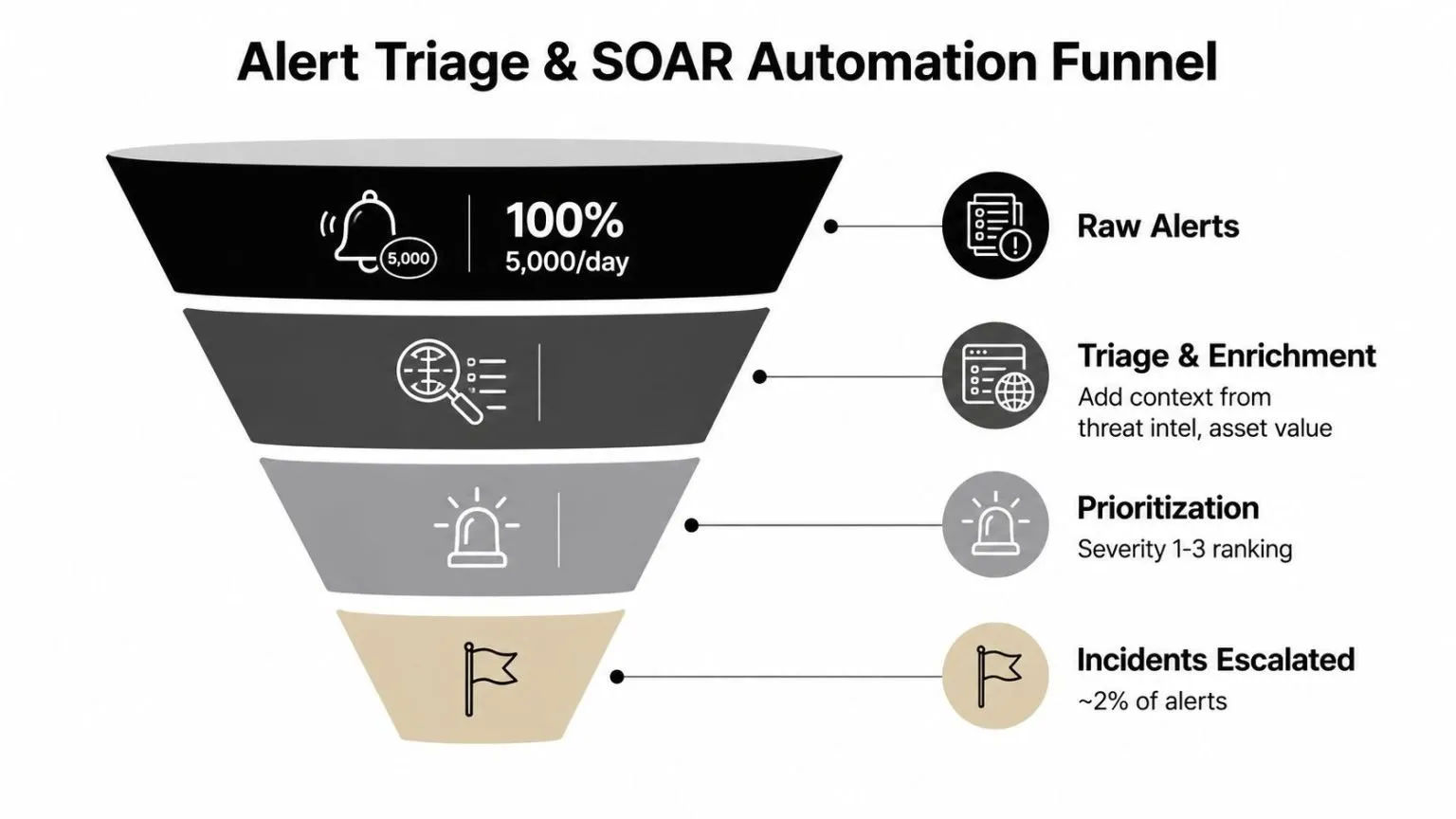
Detection becomes real work the moment an alert enters the queue. At that point, the SOC has to answer three questions quickly: Is it credible, how serious is it, and what happens next?
Triage is context assembly
Analysts rarely decide from the raw alert alone. They need enrichment around it:
- Identity context: Is this a privileged account, service account, contractor, or normal employee user?
- Asset context: Is the host a developer laptop, a domain controller, a finance server, or a lab box?
- Threat context: Do related indicators appear elsewhere in the estate, and has the same pattern fired recently?
- Business context: Would isolation interrupt clinical operations, a manufacturing line, or payroll processing?
That enrichment step is where many teams feel the pain of separate tools. One console has endpoint details, another has authentication logs, and a third stores cases. A unified workflow matters because the analyst shouldn’t have to reconstruct the timeline by hand.
SOAR should automate repetition, not judgment
Good SOAR playbooks don’t replace the SOC. They remove the repetitive steps that burn time.
Common playbooks include:
- Host containment: Isolate a device after a high-confidence endpoint detection
- Account actions: Disable or challenge an account after suspicious sign-in and privilege change activity
- Evidence collection: Pull related logs, endpoint artifacts, and case metadata into one investigation record
- Notification routing: Open the right ticket and notify the asset owner or on-call responder
The dividing line is simple. Machines handle repeatable execution. Humans handle ambiguity, business impact, and exceptions.
A mature SOC doesn’t automate because automation sounds advanced. It automates because analysts shouldn’t spend their best time copying evidence between screens.
The metrics worth watching
Operational metrics should tell you whether the system is helping defenders move faster and miss less.
A practical set includes:
- MTTD: How long compromise sits before the SOC detects it
- MTTR: How long the team takes to contain or remediate after detection
- Alert fatigue: Whether the queue is drowning analysts in low-value work
- Escalation quality: Whether the incidents reaching upper tiers contain enough evidence to act immediately
The key is to measure the whole loop, not just alert output. A platform that creates more alerts without better triage, automation, and case evidence is adding labor, not resilience.
Compliance, Reporting, and Audit-Ready Evidence
Security teams often treat compliance as a parallel lane. In practice, the same detection pipeline that helps the SOC investigate incidents is also what lets the organization prove control operation during audits.
Compliance-focused detection guidance makes that point directly: HIPAA, PCI, GLBA, CMMC, ISO 27001, and SOC 2 depend on evidence collection, access monitoring, and log retention workflows to prove detection, investigation, and response activity during audits.
What that means day to day
A compliance-aware detection program translates framework language into concrete evidence streams:
| Framework area | Detection evidence the SOC should retain |
|---|---|
| Access monitoring | Failed logins, privilege changes, risky authentication patterns |
| Administrative activity | Actions by privileged users, service account use, policy changes |
| File and data activity | Sensitive file access, unusual reads, transfer events, integrity checks |
| Incident handling | Case history, analyst notes, timeline of actions, containment records |
| Log retention | Raw events, normalized logs, search history, rule outcomes |
Many organizations struggle. They may have a SIEM that generates alerts, but they can’t easily show which control a detection supports, what evidence was reviewed, or how the investigation concluded.
Compliance-blind detection creates rework
If the SOC runs independently from compliance, the same event gets handled three times. An analyst investigates it. A compliance officer later asks for proof. An auditor then asks for retention and case records in yet another format.
A stronger model maps detections to control objectives from the start. Failed-login monitoring supports access controls. Privileged account auditing supports governance requirements. File activity monitoring supports integrity and data protection controls.
That changes the role of the SOC. It becomes not just a detection center, but an evidence-producing function the business can defend in front of auditors, customers, and regulators.
Implementation Checklist for a Unified Detection Platform
If you’re building or rebuilding a detection program, start with workflow design, not product logos. The sequence matters more than the marketing category.
Build the collection layer first
Get the evidence into one place before you try to perfect analytics.
- Deploy collectors and agents: Cover endpoints, network devices, identity systems, cloud services, and critical applications.
- Normalize fields early: Standardize usernames, hostnames, timestamps, event categories, and severity tags.
- Tag business context: Add owner, department, criticality, and compliance scope to each source where possible.
If you skip this, every later detection becomes harder to tune.
Then build correlation around risk paths
Start with the behaviors you most need to catch. Credential misuse, suspicious execution, privilege abuse, lateral movement, persistence, and unusual data access are usually higher value than importing a giant generic content pack.
A practical rollout often looks like this:
- Map priority detections to ATT&CK: Focus on techniques relevant to your environment and threat model.
- Integrate threat intelligence: Use it as context, not as your only detection logic.
- Create response playbooks: Automate the first actions for the most common, highest-confidence incidents.
- Wire evidence to compliance controls: Make sure each key detection can support an audit story later.
Collapse the workflow where it makes sense
A unified platform can help. Instead of stitching together separate SIEM, XDR, and SOAR products, some teams use one stack that ingests logs, correlates events, runs playbooks, and stores case evidence together. UTMStack is one example in that category. It combines open-source SIEM, SOAR, and XDR functions with log management, vulnerability scanning, access rights auditing, endpoint protection, file tracking, and compliance workflows for frameworks such as CMMC, HIPAA, SOC 2, ISO 27001, PCI, GDPR, and GLBA.
That matters because detection design is really a workflow problem. When telemetry, correlation, case handling, and audit evidence live in separate systems, the SOC loses time on handoffs. When they live in one operational path, the team can move from signal to incident to response without rebuilding context.
Choose the architecture that helps analysts answer one question fast: what happened, how sure are we, and what action should we take now?
A practical readiness checklist
Before you call the program mature, verify these points:
- Coverage is measurable: You know which assets, identities, cloud services, and apps generate usable logs.
- Rules are engineered: Detections are mapped to behaviors and reviewed against outcomes.
- Triage is enriched: Analysts see identity, asset, and threat context in the same case.
- Automation is targeted: Repetitive response steps are scripted, but human decisions stay human.
- Compliance is built in: The system retains the evidence needed to prove monitoring and response activity.
A lot of confusion around cybersecurity threat detection disappears once you stop treating it as a tool-buying exercise. It’s a coverage-and-correlation discipline. The tools matter. The workflow matters more.
UTMStack gives security teams one place to collect logs, correlate endpoint, network, cloud, and identity activity, automate response playbooks, and keep the evidence needed for HIPAA, PCI, CMMC, ISO 27001, GLBA, and SOC 2 workflows. If you’re trying to reduce noise while unifying SIEM, XDR, and SOAR operations, visit UTMStack and evaluate whether a single-stack approach fits your SOC design.