
A critical alert enters the SOC queue during the overnight shift. By morning, the dashboard shows an acceptable headline MTTR because the incident was closed quickly after an analyst finally picked it up. The timeline tells a different story: the alert sat unassigned for nine hours because severity routing sent it to the wrong queue. The team optimized the visible number while leaving the dangerous delay untouched.
That pattern is common in SIEM and XDR environments. Security leaders ask how to improve MTTR, then tune rules, buy automation, or add analysts without first proving where the clock is running. Measurement quality comes before response optimization. If detection, acknowledgment, triage, containment, and recovery aren’t timestamped separately, an improved average can be nothing more than a reporting artifact.
Why MTTR Is the Metric That Actually Matters in Security Operations
In security operations, MTTR usually represents the elapsed time between detecting an incident and completing a defined containment, remediation, or recovery action. The exact boundary must be agreed in advance, but the operational question is consistent: how long did the organization remain exposed or impaired after the signal became actionable?
A security vendor defines MTTR as total repair time divided by the number of repairs, making it a straightforward benchmark for tracking change over time. In cybersecurity, the metric spans more than the final fix. It can include triage, investigation, containment, eradication, and recovery, as described in this security operations overview of MTTD and MTTR.
MTTR is not the same as every response metric
Mean time to detect, or MTTD, measures how long it takes to discover suspicious activity. Dwell time describes the period an attacker remains active before detection or disruption. Time to close often measures ticket closure, which may include documentation and follow-up work after the immediate threat is contained.
MTTR connects those operational details to business risk because it covers the response window in which a threat can spread, credentials can be abused, or a compromised endpoint can remain active. A low time-to-close doesn’t prove that containment was fast. A low MTTR doesn’t prove that detection was timely. Each number answers a different question.
Practical rule: Never accept a lower aggregate MTTR as proof of improvement until you can show which lifecycle stage became faster.
The most useful view is a stage-level timeline. If alerts are detected quickly but acknowledged slowly, fix routing and ownership. If acknowledgment is fast but investigation drags, improve enrichment and correlation. If containment is delayed after the decision is made, focus on EDR, identity, network, or SOAR execution.
Why automation changes the metric
A review of hybrid-cloud incident response found that automating triage and containment improved response efficiency by approximately 50%. A separate empirical case study reported mean time to respond falling from about 45 minutes to under 10 minutes, while mean time to detect dropped from over 20 minutes to under 4 minutes after automation was introduced, as documented in the same research reference.
Those results don’t mean every SOC will see the same outcome. They show where improvement typically lies: reducing manual handoffs, removing repetitive analyst work, and executing known response steps consistently. MTTR is cumulative, so the fastest path to improvement is rarely asking analysts to work faster. It’s removing the waiting that surrounds their work.
Defining MTTR the Right Way Before You Try to Improve It
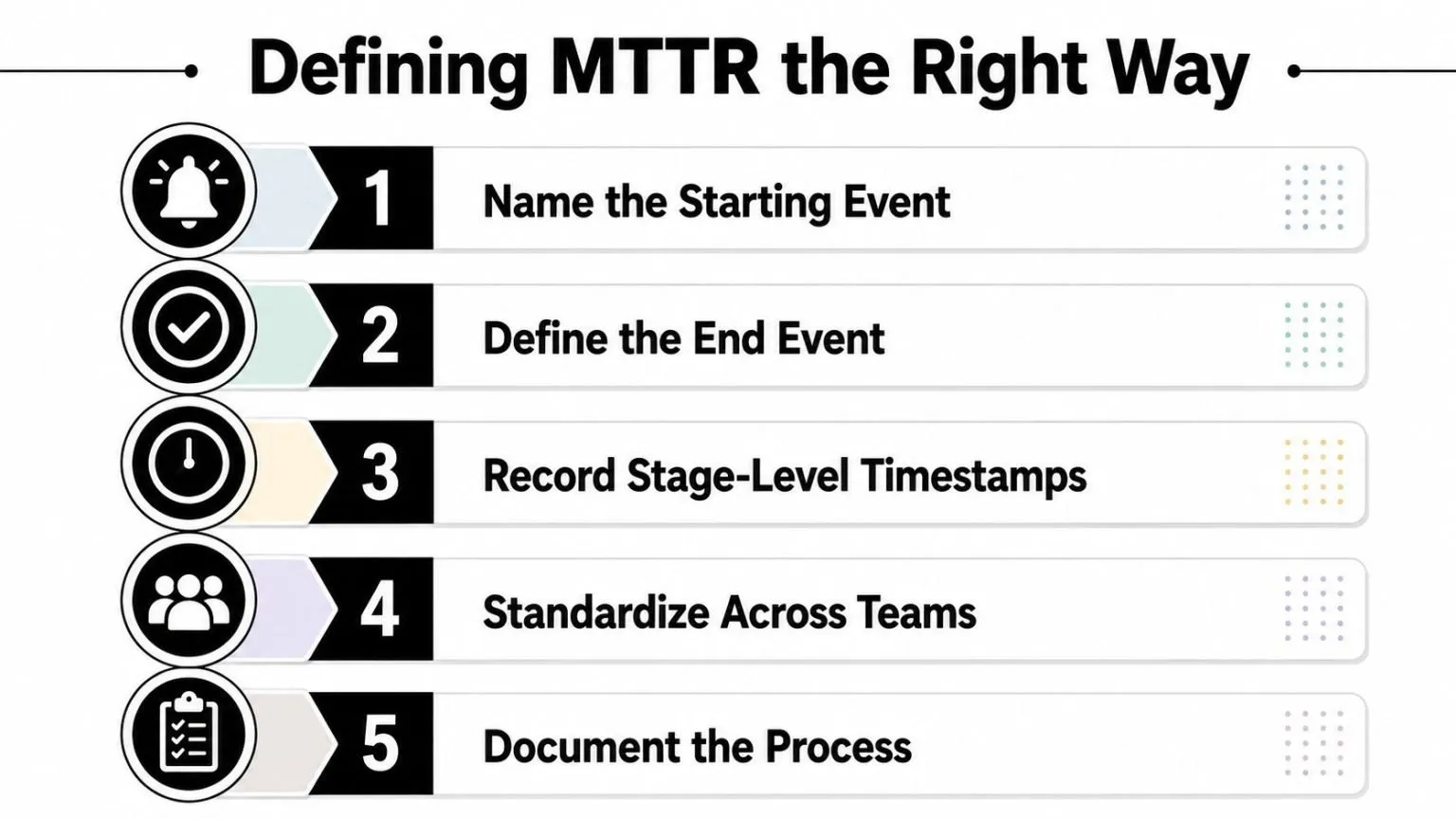
Before changing a correlation rule or deploying a playbook, write down exactly when the MTTR clock starts and stops. One team may start at the first SIEM signal, while another starts when an alert has enough context for triage. Those measurements aren’t comparable, even if both teams call them MTTR.
A reliable definition needs stable timestamps for impact start, alert acknowledgment, first mitigation, service restoration, and postmortem completion. Guidance on improving MTTR recommends standardizing timestamps, keeping the definition unchanged, and analyzing the metric by severity, service, and time of day rather than relying on one aggregate value (stage-level MTTR measurement guidance).
Freeze the measurement contract
Use this checklist before an optimization sprint:
- Name the starting event: Decide whether the clock begins at the first detection signal, the creation of a triage-ready incident, or confirmed user impact.
- Define the end event: Choose containment, eradication, service recovery, or verified resolution. Don’t use ticket closure by default.
- Assign timestamp owners: Identify which system records each event, such as the SIEM for alert creation, the case system for acknowledgment, and EDR for host isolation.
- Resolve duplicates consistently: Decide whether grouped alerts share one incident clock and how duplicate signals affect the incident record.
- Separate human-time from system-time: Distinguish analyst waiting, automated execution, vendor delay, and scheduled recovery work.
Clock skew between a SIEM, ticketing system, and EDR can make an incident appear to move backward in time. Normalize timestamps to a common standard and preserve the original event time alongside ingestion time.
Auto-closed alerts deserve special scrutiny. A rule that closes an event automatically shouldn’t create a zero-minute response unless the organization can prove that the closure represented a validated outcome. Otherwise, the metric rewards disappearance from the queue rather than risk reduction.
Instrument the lifecycle, not just the ticket
Treat this as instrumentation work. Every incident should expose a sequence such as alert fired, alert acknowledged, triage completed, containment completed, eradication completed, and recovery verified. The organization can then calculate the overall metric and identify the stage that consumed it.
The 2026 reliability guidance emphasizes that inconsistent meanings of “repair” and inconsistent timestamps make MTTR comparisons misleading, particularly when incident data is fragmented across tools (reliability measurement guidance). Until those definitions are stable, optimization results aren’t trustworthy.
Tuning Detection So Alerts Are Worth Responding To
Detection tuning reduces MTTR by shrinking the queue-to-handoff delay. It doesn’t make an analyst type faster. It prevents low-confidence events from competing with incidents that require immediate action.
The first lever is correlation density. A single suspicious sign-in may be weak, but a sign-in anomaly combined with impossible travel, privilege escalation, and endpoint execution can produce a more useful incident. Correlation rules should group related evidence around a campaign or attack path, not generate a separate case for every event.
IOC ingestion matters too, but freshness and context matter more than volume. Threat intelligence should enrich an alert with confidence, source, age, and relevance to the affected asset. A stale indicator can waste the same analyst time as a false positive.
Compress the longest queue
Suppression logic should remove known-good noise without hiding meaningful changes. Scanner traffic from an approved source can be suppressed by ASN or another controlled identifier, but the exception needs ownership and review. Severity routing must also reflect asset criticality. An alert on a development laptop shouldn’t preempt a comparable event involving a domain controller.
A practical grouping example is collapsing 40 Office 365 phishing alerts into one incident, which keeps the analyst focused on the campaign, affected users, and containment decisions rather than duplicate investigation. That figure and example are part of the operating scenario here, not a measured industry benchmark.
| Tuning Lever | Stage Compressed | Typical Time Saved |
|---|---|---|
| Correlation rules | Event review to incident creation | Qualitative reduction in duplicate investigation |
| IOC enrichment | Alert review to triage decision | Faster confidence assessment |
| Known-good suppression | Queue wait to analyst assignment | Fewer alerts competing for attention |
| Asset-aware severity | Assignment to ownership | Faster prioritization |
| Campaign grouping | Triage to investigation | Fewer repeated pivots |
The guide to reducing false positives in SIEM systems is useful when reviewing suppression and alert-fatigue controls. The trade-off is straightforward: aggressive suppression improves queue health but can hide a real attack if exceptions aren’t scoped, logged, and periodically tested.
Detection tuning fails when teams judge success by alert volume alone. Track whether high-severity incidents reach the correct owner, whether analysts dismiss fewer events as benign, and whether the time from alert creation to triage completion falls for the same severity and service cohort.
Designing a Triage Workflow That Removes Handoffs
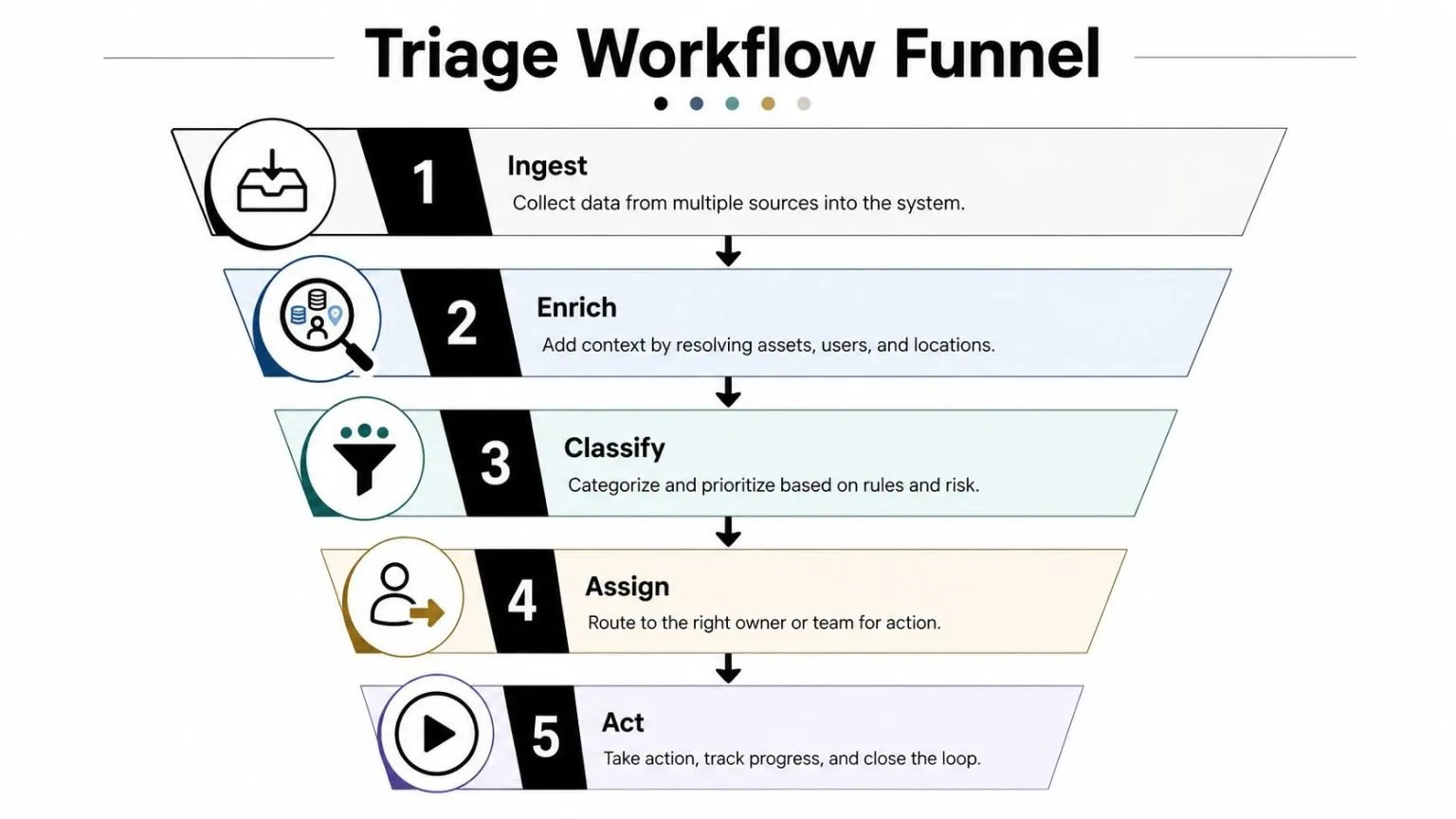
A dependable triage funnel has five stages: ingest, enrich, classify, assign, and act. The order matters. Routing an un-enriched alert to an analyst creates a handoff, then forces that analyst to gather the context needed to decide where the alert belongs.
Every alert should trigger enrichment before human review where the integrations support it. Pull asset criticality, identity context, recent ticket history, and geographic or IP reputation into the incident record. Add endpoint process history, recent administrative activity, and related detections when the signal involves a host or account.
Build ownership around services
Ownership should follow the service or asset owner, not the analyst rotation. A severity tier can determine urgency, but it shouldn’t be the only routing key. The system needs to know who owns endpoint response, identity, cloud infrastructure, and the affected business service.
Consider a Severity 1 ransomware-suspect alert. The workflow should:
- Ingest the correlated SIEM or XDR detection.
- Enrich it with endpoint process data, asset criticality, user identity, and recent administrative logons.
- Classify the event using the detection confidence and business impact.
- Assign it to the on-call endpoint lead, while notifying incident command when required.
- Act by attaching a pre-filled case containing the suspect host, user, evidence, and recommended isolation command.
The analyst shouldn’t have to ask, “Who owns this domain?” in a chat channel. That question signals missing service ownership data, not a lack of analyst commitment.

Avoid premature downgrades
Severity downgrades performed before enrichment completes create hidden delay. An analyst may lower priority because the initial alert looks weak, then discover later that the account had privileged access or the host supported a critical service.
The better sequence is enrichment first, classification second, assignment third. Before the workflow, analysts manually collect context and negotiate ownership. After the workflow, the case arrives with evidence, a responsible team, and a controlled next action. That is where the time disappears, in the handoffs between decisions, not only in the decisions themselves.
Using SOAR Playbooks to Automate the First 15 Minutes
SOAR should buy back the first 15 minutes of an investigation, not pretend that analysts are unnecessary. The best playbooks handle repetitive evidence collection and low-risk actions while leaving judgment-heavy decisions with a responder.
Take a phishing-email alert. In a manual path, the analyst reviews the email, inspects headers, detonates the attachment in a sandbox, looks up the user, and creates a ticket. In this operating comparison, that path takes 18 to 22 minutes. A playbook can complete the enrichment and leave the analyst with 90 seconds of human review, provided the required integrations are available.
| Step | Manual Time (min) | SOAR Time (min) | Automation Type |
|---|---|---|---|
| Email triage | 3 to 4 | Automated | Alert parsing |
| Header analysis | 3 to 4 | Automated | Message enrichment |
| Sandbox detonation | 5 to 7 | Automated | File analysis |
| User lookup | 2 to 3 | Automated | IAM enrichment |
| Ticket creation | 2 to 4 | Automated | Case creation |
| Human decision | 3 to 4 | 1.5 | Approval and review |
These are workflow design figures for the comparison, not an industry benchmark. The point is to identify which activities belong in automation and which require a security decision.
Automate evidence before intervention
The highest-value actions usually include:
- Automated enrichment: Query EDR, IAM, and threat-intelligence sources before review.
- Identity and asset lookup: Add ownership, privilege, location, and recent activity to the case.
- Sandbox analysis: Detonate suspicious files or URLs where the environment supports safe analysis.
- Containment calls: Isolate a host, disable an account, or block an indicator when confidence and policy permit.
- Case preparation: Create a ticket with evidence, affected entities, recommended action, and audit history.
Teams evaluating security orchestration tools should test execution, not just workflow diagrams. A playbook that enriches an alert but can’t reach the EDR or identity control plane may look complete while leaving the actual containment step manual.
Guardrails are mandatory. Define confidence thresholds for automatic containment, require human approval for destructive actions, and include rollback procedures if isolation, account disablement, or blocking affects a legitimate business process. Automation theater occurs when a playbook is polished in a demo but lacks permissions, integrations, failure handling, or usable evidence.
Consolidating Tools to Cut Context Switching
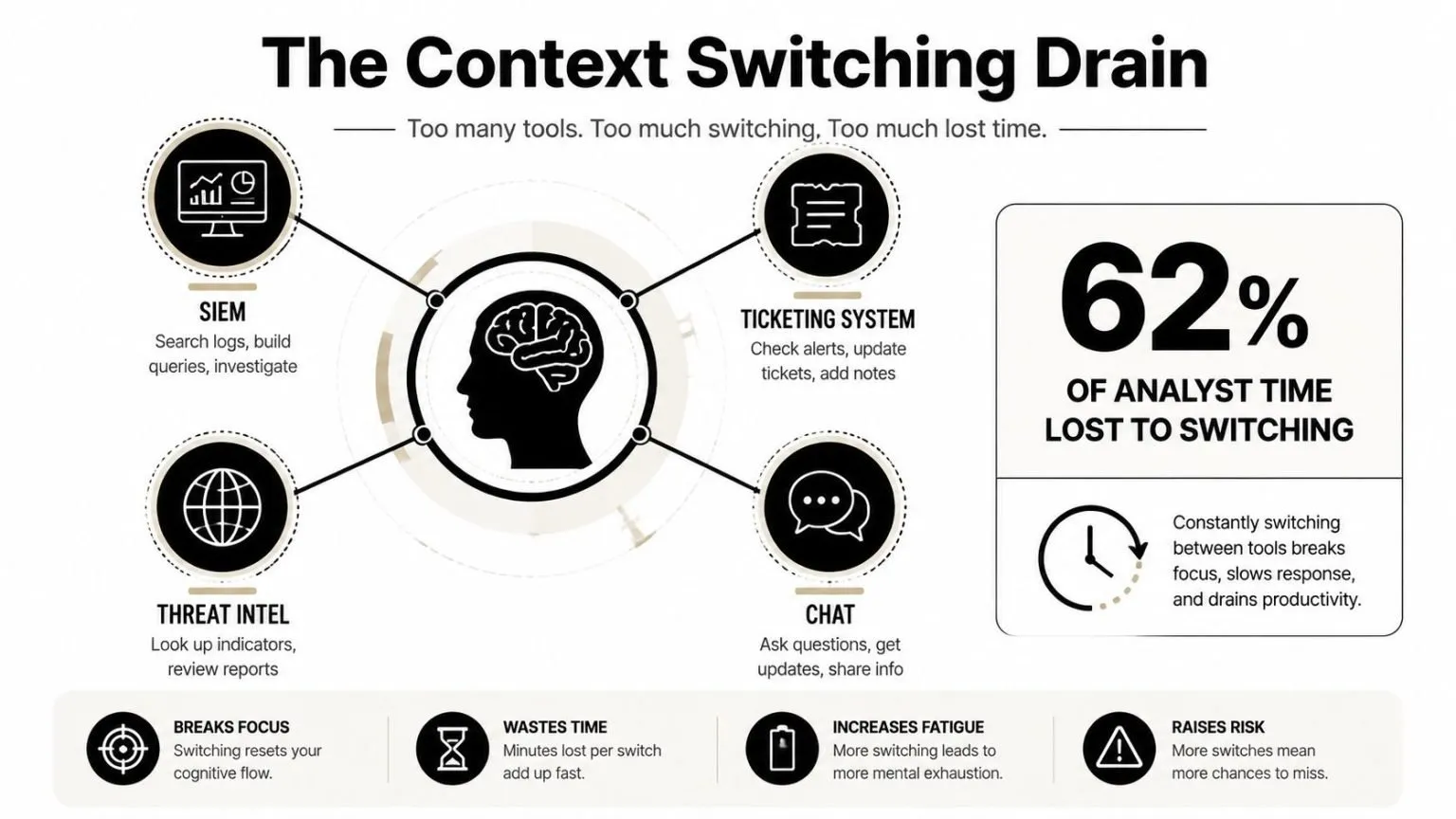
Once detection and triage are reasonably tuned, context switching becomes a major MTTR drag. An analyst may move from the SIEM to EDR, then to an identity console, threat-intelligence portal, ticketing system, and chat. Each pivot interrupts reasoning and creates another opportunity to lose the incident thread.
One operating model estimates roughly 23 seconds of refocus time per pivot, with a queue of 40 alerts producing more than 15 minutes of switching overhead in a shift (tool-consolidation and MTTR guidance). Those figures describe the cost model, not a universal SOC result, but they show why adding analyst speed isn’t the only answer.
Choose the right consolidation path
Start with a unified case workspace that embeds investigation pivots. The analyst should reach endpoint process trees, identity activity, reputation data, and related cases from the incident record rather than searching across disconnected consoles.
A practical sequence looks like this:
- Unify the case view: Make the incident record the operational home for evidence, decisions, and actions.
- Connect EDR and identity: Add one-click pivots for process activity, logons, privilege, and account state.
- Embed threat intelligence: Show reputation and indicator context inside the alert view.
- Retire redundant portals: Remove standalone tools when their useful functions are available through the operational workspace.
The trade-off depends on architecture. A heavy single-vendor XDR stack can exchange flexibility for speed. A best-of-breed stack preserves choice but needs a strong integration layer. SIEM-native case management is a middle path, especially when the SIEM already owns correlation and evidence retention.
Measure the change with alerts handled per analyst per shift, pivots per alert, and median time from alert open to the first enrichment click. If those measures don’t improve, a new dashboard hasn’t solved the workflow problem.
Measuring What Changed and Proving MTTR Actually Moved
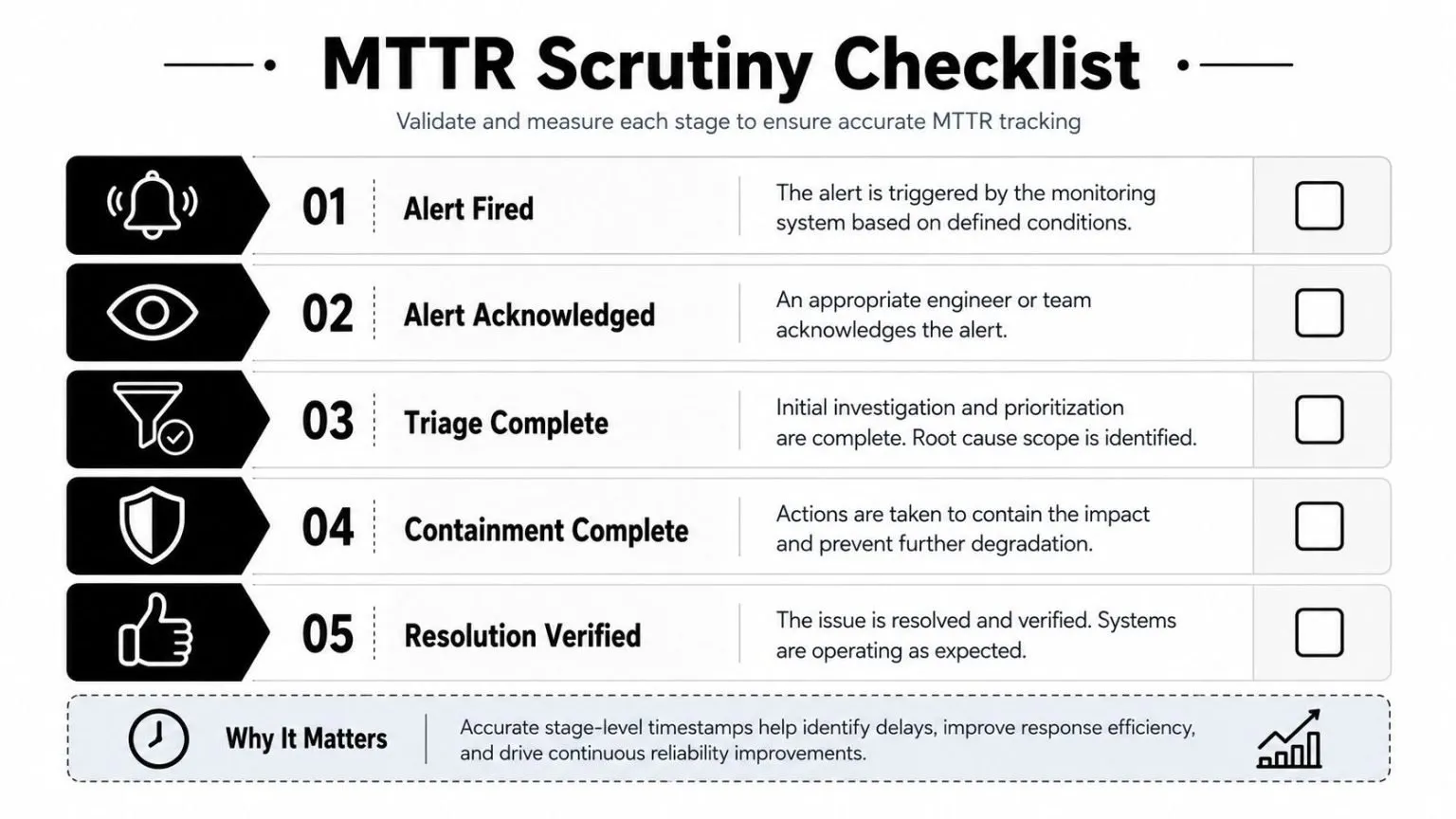
MTTR claims should survive a skeptical review. Require every alert or incident record to carry the same lifecycle timestamps:
- Alert fired: The detection signal entered the operational system.
- Alert acknowledged: A responder accepted ownership.
- Triage complete: The responder reached an initial classification and action decision.
- Containment complete: The defined containment action finished.
- Eradication complete: Malicious persistence or artifacts were removed where applicable.
- Recovery complete: The affected service, host, or account returned to an approved state.
The metric calculation can remain simple, total resolution time divided by the number of incidents, but the supporting records must show where that total came from. A separate empirical evaluation reported a 44.7% reduction in mean time to resolution, from 85 minutes to 47 minutes, with setup-assisted handling. The same evaluation reported a 42% drop in incident escalations and a 46.4% decrease in cross-team dependencies (empirical incident-response evaluation).
Use a KPI matrix instead of one average
| Lifecycle Stage | Operational Target | Leading Indicator |
|---|---|---|
| Alert acknowledgment | p90 under 5 minutes | Ownership and routing coverage |
| Triage completion | Defined by severity policy | Enrichment completeness |
| Containment completion | Defined by response playbook | Successful action execution |
| Eradication completion | Verified before closure | Artifact and persistence checks |
| Recovery verification | Evidence-based closure | Health or control validation |
The acknowledgment example, p90 under 5 minutes, is a control target for this framework, not a universal benchmark. It measures whether routing and ownership work consistently. It shouldn’t be used to reward individual heroics while the queue structure remains broken.
Slice every KPI by Sev1, Sev2, and Sev3, service, and time-of-day band. Overnight performance can distort a daytime SOC average, while one service with poor ownership can make the whole organization appear slow. Also separate automated execution time from human waiting time. A playbook that runs quickly won’t help if approval requests sit unanswered.
Freeze the comparison
Use a 30/60/90 review cadence. At each review, compare the same incident cohort, preserve a frozen control set of detection rules, and record changes to routing, integrations, playbooks, and staffing. Without a control set, a team can tune detection, change the incident mix, and credit the resulting average to automation.
The practitioner checklist is short:
- Instrument timestamps: Capture every lifecycle stage in a consistent system.
- Freeze the cohort: Compare like-for-like incidents and preserve the baseline rules.
- Slice the data: Break results down by severity, service, and shift.
- Publish variance weekly: Show stage-level movement, not only the overall mean.
- Challenge small changes: Treat any quarter-over-quarter drop under 10% as noise rather than progress unless the stage-level evidence shows otherwise.
Automation and integration can produce meaningful gains when they remove handoffs. Independent XDR research reports that data integration can reduce MTTR by 59% compared with siloed security tools. The number matters only when your own timestamps show the same mechanism, such as faster enrichment, fewer escalations, or shorter containment execution.
For teams building that measurement and response layer, UTMStack provides centralized incident management, SIEM, SOAR, and XDR capabilities, including correlated detection, automated enrichment, and response playbooks for actions such as host isolation and account control. Visit UTMStack to assess whether its open-source architecture and compliance workflows fit your environment, then test it against a frozen incident cohort and your stage-level MTTR baseline.