
You’re usually not thinking about retention when the week starts. You’re thinking about alert noise, an audit request from compliance, and a storage bill that keeps climbing because logs are piling up in your SIEM, EDR, or XDR stack.
Then someone asks a simple question, and the answer isn’t simple at all. Which logs must be kept, for how long, and where do you stop using hot storage and start preserving evidence for HIPAA?
Introduction to HIPAA Log Retention Requirements
A healthcare security team can run clean detection rules all year and still fail an audit if its evidence trail is thin. That’s the trap with HIPAA log retention requirements, because the issue isn’t just whether events were captured, it’s whether the organization can still prove what happened after the investigation window has passed.
HIPAA’s retention model splits the problem in two. Compliance documentation follows the federal Security Rule baseline, while medical-record retention follows state law, not HIPAA itself, and that difference trips up a lot of teams that manage logs through SIEM and XDR platforms. When policy, audit evidence, and system activity all live in separate places, retention has to be designed as an evidence system, not a storage afterthought.
Practical rule: if a log supports your proof of access control, investigation history, or policy enforcement, treat it like compliance evidence, not just telemetry.
The goal here is simple. Use HIPAA’s six-year floor as the anchor, then shape hot, warm, and cold log tiers around real investigation needs, legal holds, and secure destruction. That gives you a retention model that’s defensible in audits and workable for security operations.
Understanding the Key Concepts
Documentation and records are not the same thing
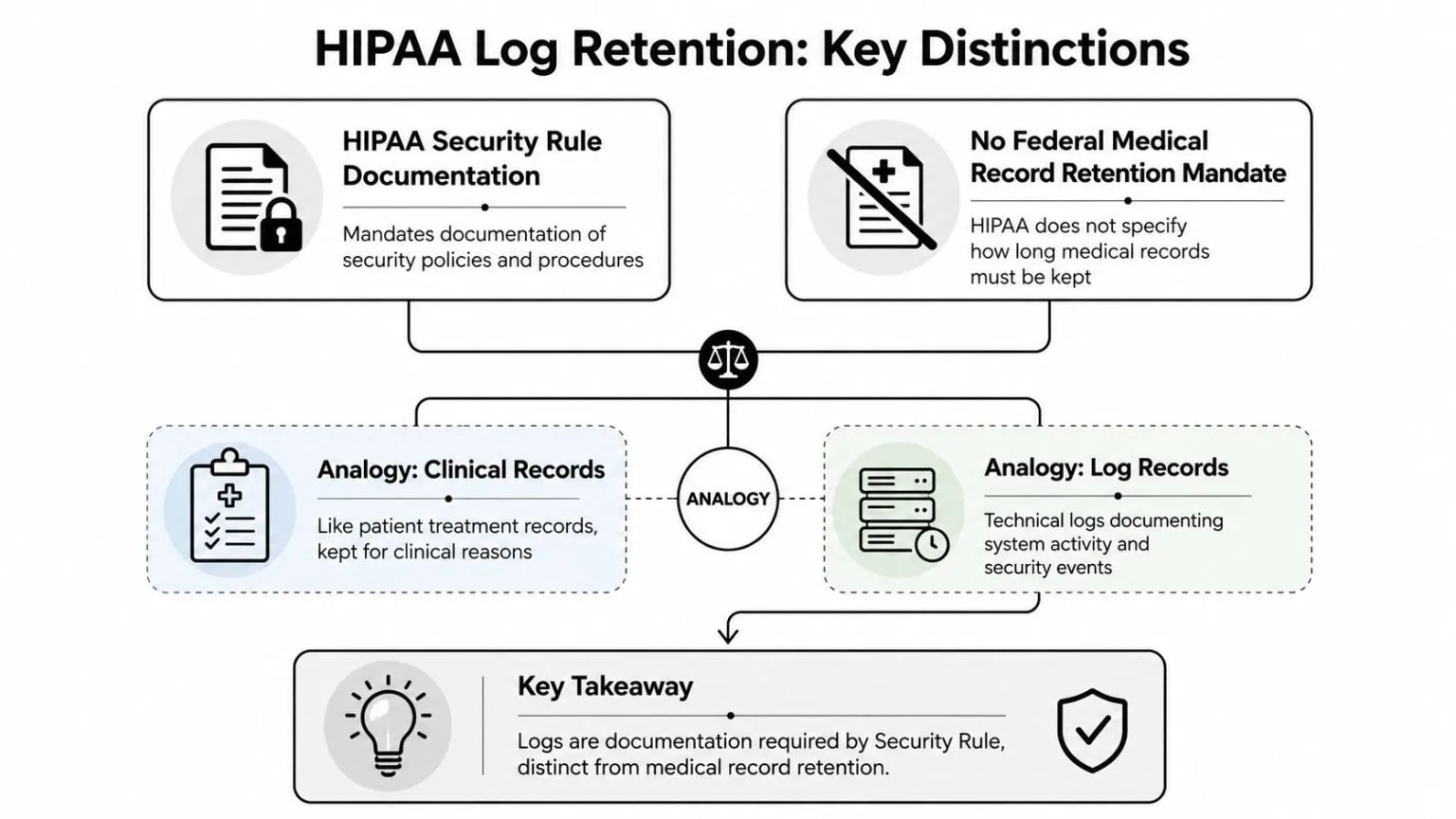
HIPAA’s Security Rule documentation has its own lifecycle. Under the federal rule, covered entities and business associates keep required Security Rule documentation for six years from creation or from the date it was last in effect, whichever is later, but HIPAA does not set a federal medical-record retention period. HHS says state law governs how long patient records themselves must be kept, while HIPAA governs compliance documentation, so the two clocks can move differently.
That split matters in practice. Think of patient records as the chart on the floor of a clinic, while audit logs are the camera footage and visitor ledger that prove who came in, what they touched, and when. The chart exists for care, but the logs exist to prove control.
The distinction is why teams get stuck when they try to use one retention policy for everything. A clinician may need a record for care continuity, but a security architect needs the log archive to survive a breach inquiry or an access review years later.
State law can push retention higher
If state law is stricter, HIPAA doesn’t override it. One compliance reference lists log examples that often need tracking, including user logins, database changes, new-user creation, access-level changes, file access, OS logins, firewall logs, and anti-malware logs, and says the stricter standard wins when state law requires more retention. That means your policy needs a jurisdiction check before you lock in deletion timelines.
A risk-based retention model usually starts with three buckets. Hot storage supports rapid review, warm storage supports trend analysis and investigation, and cold storage preserves the evidence archive. The exact windows vary by log value and volume, but the logic stays the same, keep the searchable window short enough to control cost, then preserve the compliance archive long enough to satisfy the six-year floor and any stricter state rule.
For a broader HIPAA program view, the evidence chain also needs to align with your control mapping and policy inventory, not just your log platform. A useful reference point is the organization’s own HIPAA control baseline, which can be documented alongside logging and access review procedures in the same compliance register. See the internal guide on HIPAA compliance requirements for a control-oriented view of the broader program.
Build around purpose, not just storage tiers
The cleanest way to avoid confusion is to classify logs by purpose. Some logs exist for incident response, some for auditability, and some for forensic reconstruction after the fact. Once you separate those purposes, the retention window becomes a policy decision instead of a guess.
Logs don’t all age the same way. High-value evidence needs long-term preservation, while high-volume telemetry can move to archive quickly after it stops being operationally useful.
Key HIPAA Documentation and Audit Control Requirements
HIPAA’s core retention rule is a 6-year minimum. Under 45 CFR § 164.316(b)(2)(i), covered entities and business associates must keep required Security Rule documentation for six years from the date of creation or the date it was last in effect, whichever is later, and that later-effective-date detail matters when policies are revised midstream. A policy updated in year three can push the retention clock beyond six years from the original draft, because the latest effective date controls.
That rule sits on top of the audit control requirement in the Security Rule. In plain terms, your environment needs to record and examine activity in systems that contain or use ePHI, and your documentation has to show that the control exists and was reviewed. The evidence set usually includes policies, procedures, risk assessments, audit logs, and system activity reports, because those are the artifacts auditors use to verify that access controls aren’t just theoretical.
Versioning changes the retention start date
Policy versioning is where many teams make mistakes. If you can’t show when a policy was created, revised, and approved, you can’t confidently say when the six-year clock started. That’s why clear timestamps, change notes, and approval history are part of retention design, not just documentation hygiene.
The same logic applies to evidence of review. If your team reviews access logs but never records the review outcome, you’ve got activity, not proof. A dated review note that references the policy version in effect gives the auditor a clean chain from control to evidence.
Audit controls need mapped evidence
The practical move is to map each control to the logs that prove it. For example, access logging supports user accountability, system activity reports support change review, and alert review notes support monitoring discipline. When those pieces live in separate tools, the retention policy should still bind them together as one evidence trail.
Operational takeaway: if a log or report helps prove HIPAA control operation, keep it under the same retention governance as the policy it supports.
The strongest programs make review findings part of the retained record. That turns a simple log archive into a documented control history, which is much easier to defend than an unlabeled bucket of files.
Log Types and Retention Timelines
Different logs have different jobs
HIPAA evidence doesn’t come from one log type. Access logs show who opened data, audit logs show what the system recorded, system logs reveal operating changes, application logs capture workflow activity, network flow records show movement across the environment, and security event logs flag suspicious behavior. Each one has a different investigative value, so each one deserves a different storage strategy.
High-value authentication and access logs often need the longest searchable life, because investigators reach for them first during account abuse or disclosure reviews. Network-flow and telemetry-style records can be far noisier, so they’re often more useful in the near term and then less useful once the incident window closes.
Use a hot, warm, cold model
A technically sound architecture usually separates hot searchable retention from cold compliance retention. Industry guidance recommends 60 to 90 days of indexed logs for rapid triage, 12 to 24 months of searchable logs for trend analysis, and then tamper-resistant archiving for up to the 6-year HIPAA documentation window. Another technical compliance source frames the same idea with a narrower operational lens, recommending 90 to 180 days of summarized or indexed network-flow records online while full-fidelity archives are preserved to six years.
That split works because not every log needs to stay immediately searchable forever. Security teams need a short online window for daily operations, but compliance teams need a durable archive when OCR, legal counsel, or internal investigators ask for proof long after the event.
Here’s a practical matrix you can adapt for policy drafting.
| Log Type | Hot Retention | Warm Retention | Cold Archive |
|---|---|---|---|
| Access logs | Searchable for rapid review | Searchable for trend analysis | Preserve to the HIPAA documentation window |
| Audit logs | Searchable for investigations | Searchable for control review | Preserve to the HIPAA documentation window |
| System logs | Short indexed window for triage | Retain if tied to changes or incidents | Preserve essential records in archive |
| Application logs | Keep recent events searchable | Retain for workflow tracing | Archive records tied to compliance evidence |
| Network flow records | Short indexed window for incident response | Keep summarized or searchable copies for analysis | Archive full-fidelity evidence as needed |
| Security event logs | Fast-access window for active response | Retain for anomaly analysis | Preserve tamper-resistant copies for audits |
Match retention to investigation value
The retention choice should follow how often the log helps answer a question. If analysts use it daily, keep it searchable longer. If it mostly matters during audits or after a breach, move it to archive sooner.
For teams running centralized logging in a SIEM, the storage layer should support that tiering cleanly. The log-management workflow in centralized log management is the right design pattern to borrow here, because retention becomes a policy layer instead of a manual cleanup task.
Legal Holds and Secure Storage Practices
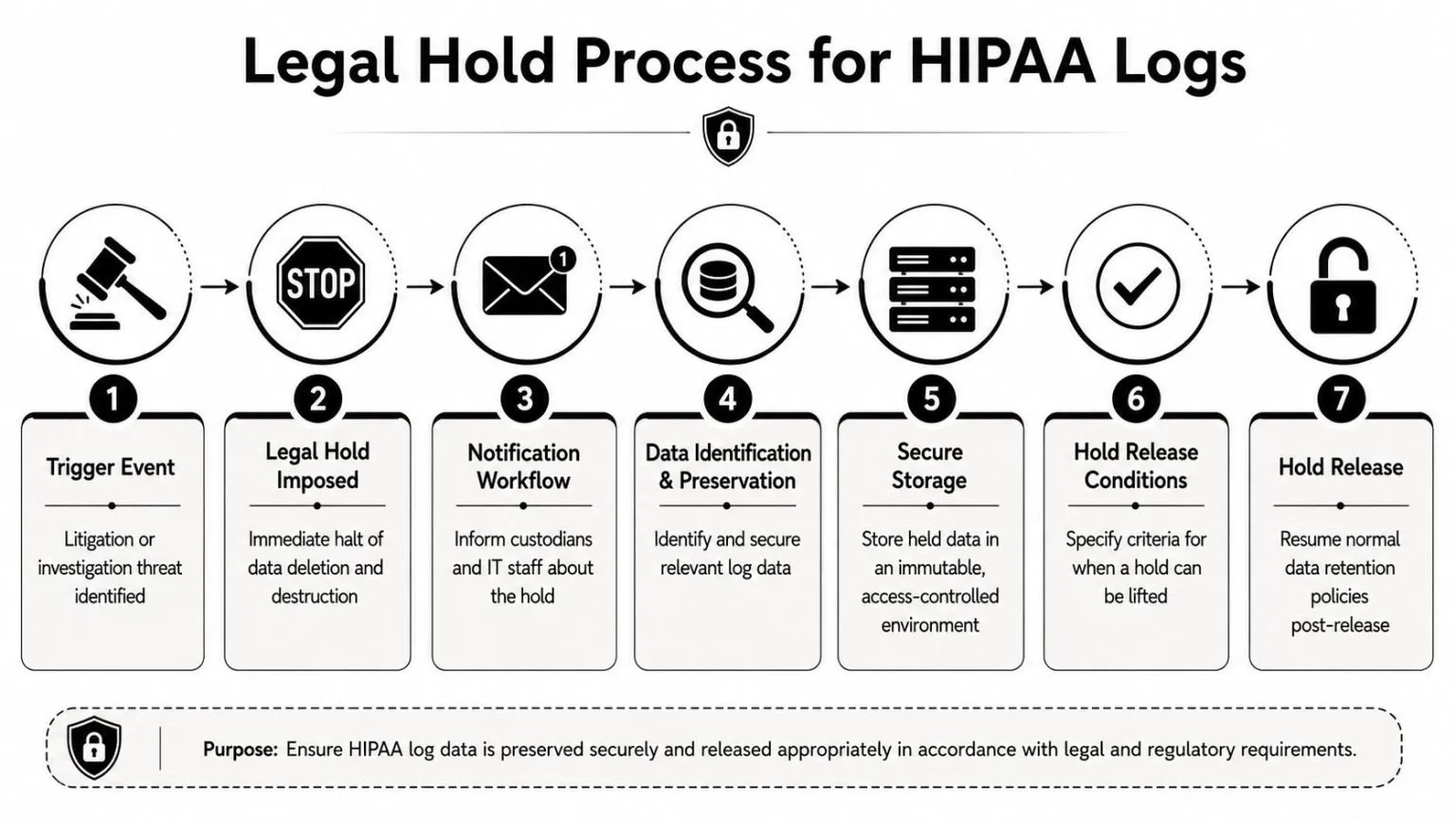
A legal hold changes the retention game immediately. If litigation, a regulator inquiry, or an internal investigation starts, deletion stops for the affected records, even if normal retention would otherwise allow purge. That hold needs a trigger, an owner, a notification path, and a release condition, or it turns into an informal pause that nobody can defend later.
Build the hold workflow before you need it
The trigger can be a notice from counsel, a breach investigation, or an escalation from the security team. Once that trigger fires, custodians and IT staff need to know what data is in scope, where it lives, and who has authority to freeze deletion. When the matter ends, the release should be documented just as clearly as the hold itself.
Make archives tamper-evident
Secure storage has to protect integrity, not just availability. WORM storage helps because it prevents silent edits, and cryptographic hashing gives you a way to detect tampering if someone tries to alter a retained file. Immutable cloud storage or an on-prem archive can both work if access controls are tight and deletion is governed.
Chain-of-custody documentation matters as much as the storage medium. If a held log is exported, copied, or restored, record who handled it, when it moved, and where it landed. That record is part of the evidence.
Another useful complement is a plain-language standard for destruction after retention expires. The requirements for data destruction guidance is a helpful reference for shaping that last mile, because compliance isn’t complete until obsolete copies are removed.
Hold what you must preserve, destroy what you no longer need, and keep a record of both decisions.
That hybrid model lines up with HHS’s view that organizations may need searchable recent logs, immutable archives, and secure destruction after the retention period when state law, incident response, or newer storage practice demands it. The operational trick is to keep those three stages distinct in policy and tooling.
Implementing Retention Policies with UTMStack
Start with ingestion. HIPAA evidence only works if the platform collects what matters from endpoints, network devices, and cloud services through agents, APIs, and syslog feeds. In a SIEM or XDR setup, the first job is to make sure the sources are normalized enough that access, audit, and system events can be searched consistently.
Configure tiers and controls in the platform
Once ingestion is stable, define retention tiers in the log-management module. Recent logs belong in the searchable tier for triage and investigations, older logs move to archive, and deletion should be automatic once the policy window closes and no hold applies. If the platform supports immutable storage controls, turn them on for the compliance archive.
UTMStack is one option here because it combines log management, SIEM-style correlation, and compliance workflows in a single stack. That matters in healthcare environments where the same evidence has to support detection, review, and audit reporting without forcing analysts to jump between disjointed tools.
Tie policy to correlation and reporting
Retention policy enforcement shouldn’t live in isolation from detection logic. Correlation rules should flag suspicious access patterns, but they should also surface log-policy deviations, missing sources, or broken retention tags. If the platform can show which evidence maps to which HIPAA control, compliance review becomes much faster.
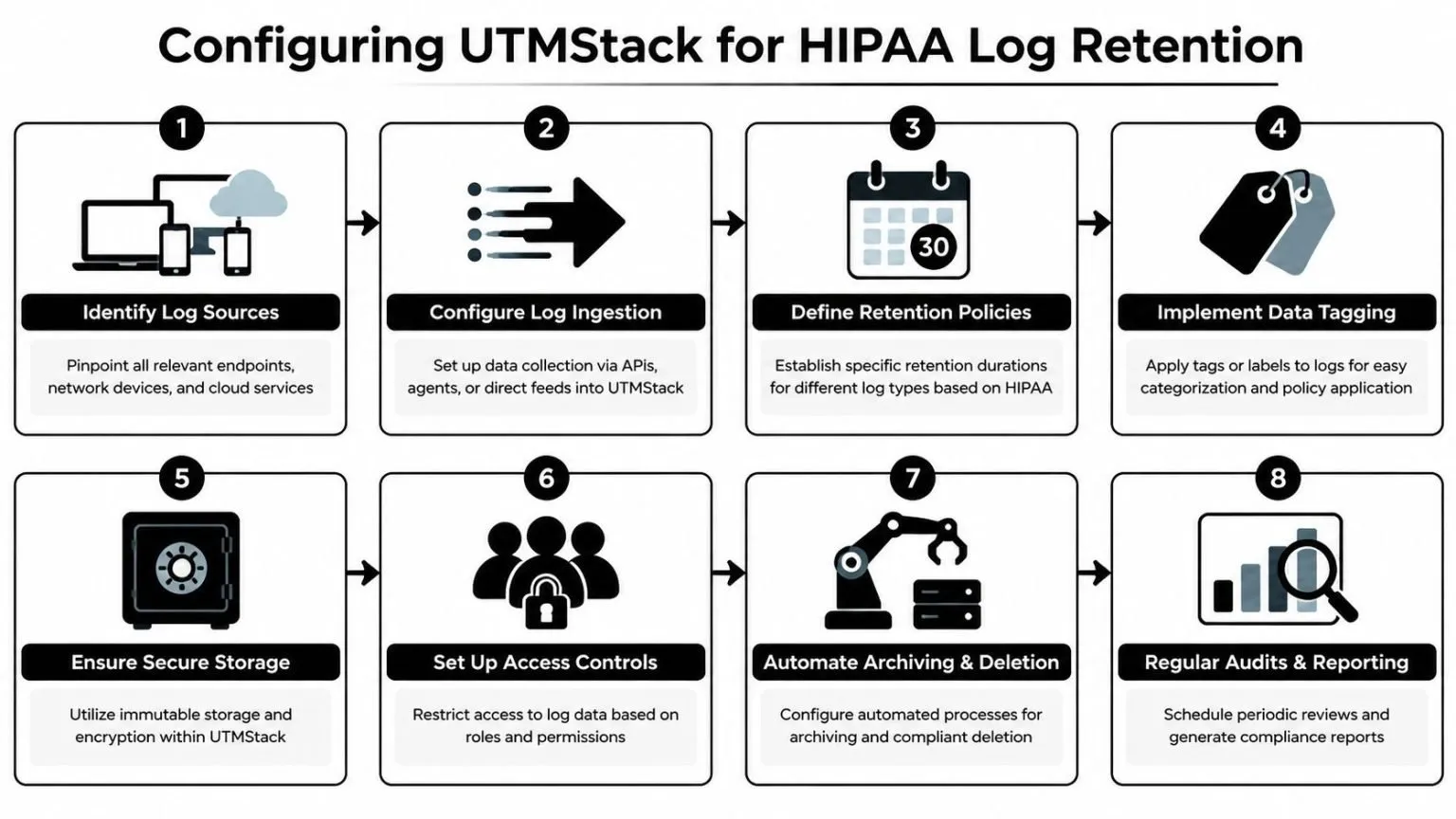
A mature workflow also schedules policy reviews and generates compliance reports on a recurring basis. The important part isn’t just the report, it’s the ability to prove that retention rules, archive status, and access reviews were checked against the current policy.
Major healthcare compliance guidance treats audit and access logs as evidence needed to prove HIPAA compliance, and many organizations keep them for at least six years even when operational SIEM copies are stored for shorter periods, which is why the archive tier has to be deliberate. The internal view on log management and correlation in SIEM is useful if you’re aligning retention with detection engineering.
Good retention policy design doesn’t fight the SOC. It gives the SOC a short searchable window and gives compliance a durable archive.
Conclusion and Next Steps
HIPAA log retention starts with one hard number, the six-year federal baseline for Security Rule documentation, but the overall program is wider than that. The best designs split logs into hot, warm, and cold tiers, preserve evidence in tamper-resistant archives, and pause deletion when a legal hold kicks in.
If you’re responsible for the policy, check three things first. Confirm which logs support HIPAA evidence, verify whether state law is stricter, and make sure your archive can prove integrity over time. Then test whether your current SIEM, XDR, or log platform can enforce those rules instead of just storing data.
A strong next move is to draft or update your retention matrix, assign hold ownership, and run a mock audit against the evidence trail. If your current process can’t answer who accessed what, when the policy changed, or when archive deletion is allowed, the gap is already visible.
UTMStack gives security teams a way to collect logs, correlate events, and manage retention in one place, which makes HIPAA evidence easier to preserve and review. If you’re building a defensible log-retention program, visit UTMStack to evaluate how its open-source SIEM, SOAR, and XDR modules can fit your compliance workflow.