
Cybersecurity leaders don’t need another reminder that threats are growing. They need a framework that matches how attacks happen now. The urgency is hard to ignore when the threat detection system market is projected to grow from $13.4 billion in 2024 to over $54 billion by 2034, while global cyberattacks average 1,968 incidents per week and cybercrime is projected to cost the world $23 trillion in 2027, according to Statista’s threat detection market analysis.
What changes the conversation in 2026 isn’t just more tooling. It’s the need to unify security operations, response automation, and compliance evidence in one operating model. CISOs are trying to defend hybrid estates, manage identity-heavy attack paths, satisfy HIPAA, GLBA, PCI, CMMC, and ISO 27001 obligations, and still give analysts a workflow they can effectively run every day.
The practical question is no longer whether you have SIEM, EDR, XDR, malware research feeds, CVE context, or compliance mappings. The question is whether those parts work together well enough to support consistent threat detection and prevention.
The Escalating Need for Unified Threat Management
Security teams rarely fail because they lack tools. They fail because each tool answers only part of the incident.
One console shows endpoint activity. Another holds cloud alerts. Identity data sits with the IAM team. Compliance evidence lives in tickets, screenshots, and spreadsheets that appear right before an audit. In a hybrid environment, that split creates delay at the exact point where speed and context matter most.
The market has responded to that pressure, and the growth figures cited earlier reflect it. Organizations are spending more on detection because attackers move across identity, endpoints, SaaS, and cloud workloads faster than siloed teams can investigate. The business impact is broader than incident response alone. A missed sequence can become a data exposure, an outage, a reporting problem, or all three.
Unified threat management matters because attacks do not follow org charts or product boundaries. A suspicious sign-in can lead to token abuse in a SaaS app, unusual mailbox access, data movement, and then a compliance problem because the team cannot show a clean timeline of who accessed what. Security leaders that want a sound operating model usually start by defining risk tolerance and priorities, often using broader frameworks such as TekRecruiter’s cyber risk expertise, then map those decisions into detection, response, and evidence collection.
A unified, open-source platform changes the economics of this work. It puts telemetry, correlation, response workflows, and audit artifacts in one operating layer instead of spreading them across disconnected products. That does not remove the need for specialized controls. It does reduce the cost of context switching, duplicate integrations, and parallel reporting processes owned by different teams.
The practical gains are specific:
- Shared visibility: Endpoint, identity, network, cloud, and application events land in one place for investigation.
- Cross-domain correlation: Analysts can connect low-signal events that look harmless in isolation but indicate account misuse or lateral movement when viewed together.
- Repeatable response: Common cases such as impossible travel, malware on a managed host, or privileged account misuse can follow defined playbooks.
- Built-in evidence collection: The same workflow that supports triage can preserve logs, decisions, and timestamps for internal review and external audits.
There is a trade-off. Centralization can create noise if teams ingest everything without a data model, detection standards, and ownership. Open-source platforms help control cost and reduce vendor lock-in, but they still require engineering discipline. Normalization, rule tuning, retention design, and access control decide whether the platform becomes a working security layer or just another data sink.
One rule holds up in practice. If a control helps an analyst investigate but cannot support an audit, or satisfies an audit but gives defenders no usable signal, the program is carrying unnecessary overhead.
Teams that need a common vocabulary before changing architecture should align on key unified threat management terms. Clear terminology keeps vendor packaging from driving design decisions that should be based on risk, operations, and compliance needs.
Detection Versus Prevention A Fundamental Distinction
Security programs get weaker when teams treat detection and prevention as interchangeable. They’re related, but they solve different problems.
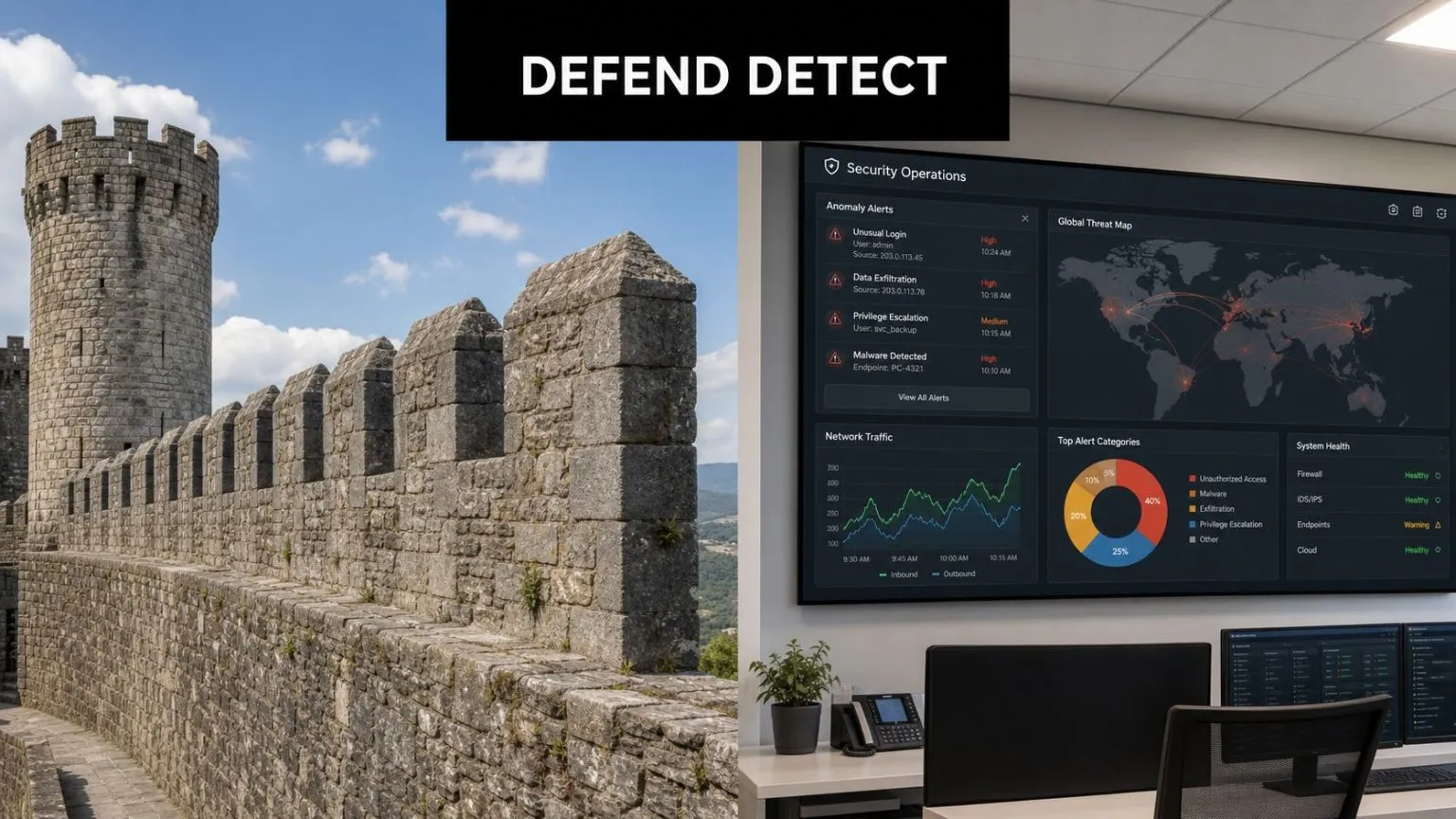
Prevention is the wall, gate, and lock. It tries to stop malicious activity before it succeeds. Think firewall policy, MFA, allowlisting, email filtering, endpoint hardening, and access controls. Detection is the patrol inside the fortress. It looks for signs that someone got in anyway, or that a trusted user is doing something they shouldn’t.
Why prevention alone fails
Prevention controls are still necessary. No serious architect argues otherwise. But prevention has blind spots that get larger in cloud-first environments.
An access policy can be correct and still allow abuse of a valid account. An endpoint control can be healthy and still miss a sequence that uses native administration tools. An email gateway can block obvious phishing and still let through a message that leads to token abuse through a trusted workflow.
That’s why mature teams stop asking which side matters more and start asking where each one breaks. Prevention reduces attack surface and blocks commodity noise. Detection catches the paths that still exist after the controls are in place.
Why detection now has to be behavioral
The old model leaned heavily on known bad files, static IOCs, and signature matches. That isn’t enough against current attacker behavior. CrowdStrike’s 2026 reporting found that 82% of detections were malware-free, with attackers increasingly using valid credentials and trusted SaaS integrations, which pushes defenders toward behavioral anomaly detection rather than static IOC matching, as summarized in this SentinelOne review of malware statistics.
That single shift changes program design in a few important ways:
| Security objective | Prevention-heavy approach | Detection-heavy approach |
|---|---|---|
| Stop known malicious files | Signature scans and filtering | Process behavior and execution analytics |
| Protect identities | Password policy and MFA | Impossible travel, token misuse, odd privilege use |
| Secure SaaS | App approval and settings | Baseline deviations, impossible workflows, unusual API activity |
| Contain abuse | Manual analyst action | Automated isolation, revocation, or quarantine |
The strongest programs assume some approved tools, identities, and integrations will be abused. They design detections around misuse, not just around malware.
What works in practice
The practical design pattern is layered defense with explicit handoff points:
- Use prevention to reduce noise. Block what you can cheaply and reliably.
- Use detection to find what looks legitimate on the surface. Focus on behavior, sequence, and context.
- Use response to contain fast. Good detection without containment still leaves room for lateral movement.
What doesn’t work is investing heavily in prevention and treating detection as a reporting feature. By the time a CISO sees the results of that mistake, the issue usually isn’t that a tool failed. It’s that the security model assumed blocked meant safe.
Core Architectures SIEM XDR and SOAR Explained
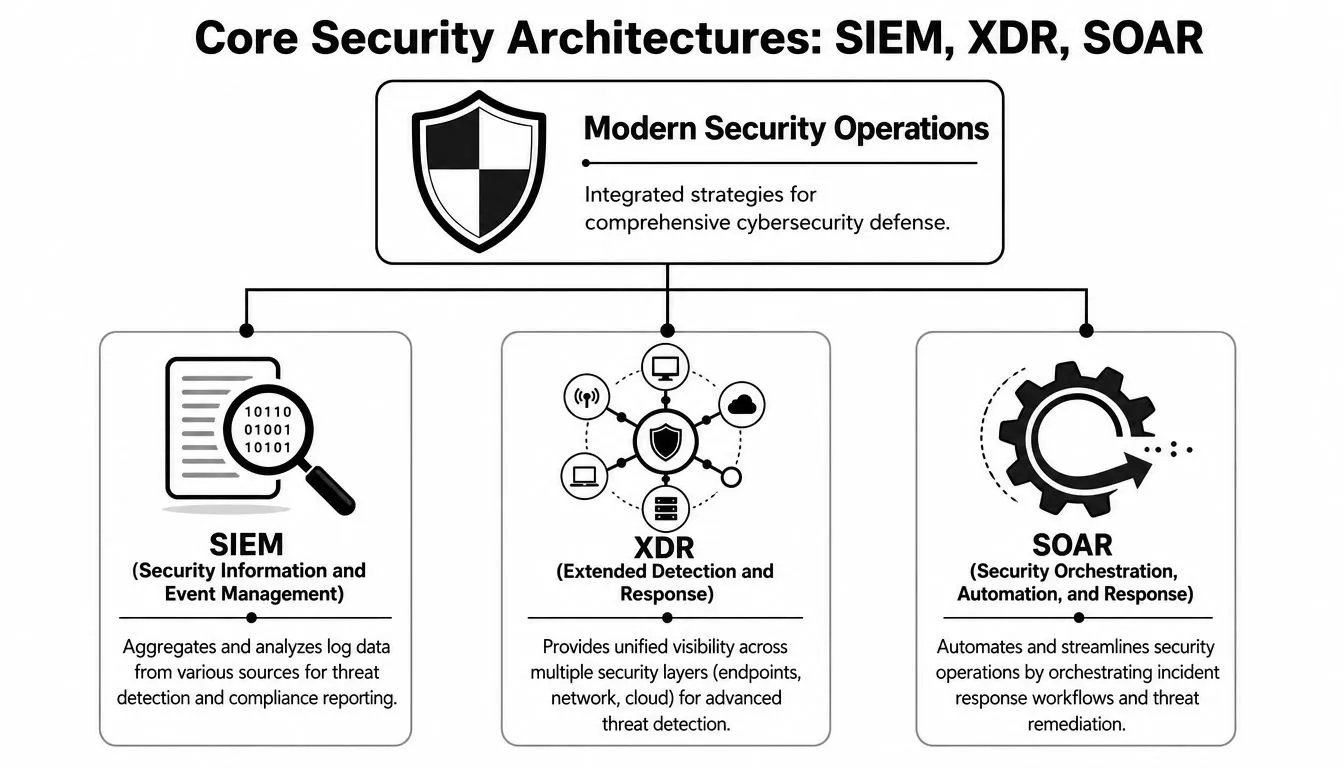
A lot of security buying confusion comes from treating SIEM, XDR, and SOAR like competing categories. In real operations, they’re different layers of the same system.
What SIEM does well
SIEM is still the backbone for centralized log management, event normalization, correlation, and auditability. It’s where security teams pull together authentication logs, firewall records, cloud events, vulnerability findings, and application activity. It’s also where compliance teams go when they need traceability.
SIEM is strongest when the organization needs breadth. If the question is, “Can we search across all critical systems and reconstruct what happened?” SIEM is usually the answer. The trade-off is that SIEM can become expensive and noisy if ingestion discipline is poor and detections are badly tuned.
Where XDR adds depth
XDR extends detection and response across multiple domains with tighter operational context. In practice, that often means better linkage between endpoint activity, identity events, cloud telemetry, and sometimes network observations.
XDR tends to reduce analyst friction because it presents a threat story instead of forcing manual stitching. It’s useful when the team needs to understand a campaign across control planes, not just review isolated logs. The trade-off is coverage breadth. Some XDR products are broad, some are still endpoint-centric with extra connectors around the edges.
A useful way to think about the split is simple:
- SIEM answers: What happened across the estate?
- XDR answers: What attack story is unfolding across related controls?
- SOAR answers: What should the system do next?
For teams comparing operating models, this overview of security incident and event management systems is a good companion to architecture reviews because it frames where collection, analysis, and response responsibilities sit.
Why SOAR matters after detection
SOAR becomes valuable the moment a team can describe the same incident steps over and over. If analysts always enrich an alert with identity context, check threat intelligence, pull host details, notify the owner, and quarantine a mailbox, that should become a workflow.
SOAR isn’t just about speed. It’s about consistency. A well-built playbook reduces analyst variance, preserves evidence, and keeps basic containment from depending on whoever happens to be on shift.
Architect’s view: Automation pays off fastest on repetitive, high-confidence actions. It fails when teams automate decisions they haven’t standardized first.
How the stack fits together
The healthiest operating model combines the three:
| Layer | Primary purpose | Typical output |
|---|---|---|
| SIEM | Collect and correlate telemetry | Alerts, searches, evidence, dashboards |
| XDR | Link activity across controls | Incident context, attack chain visibility |
| SOAR | Orchestrate response steps | Tickets, enrichments, containment actions |
An open-source platform can reduce the friction between those layers if it handles ingestion, correlation, response, and compliance evidence in one place. UTMStack is one example in that category. It combines SIEM, SOAR, and XDR functions for hybrid environments and is often evaluated by teams that want one operating surface instead of multiple disconnected consoles. For readers weighing the overlap between these categories, this SIEM vs XDR comparison is useful because it highlights where the technologies complement each other rather than compete.
Detection Engineering and Threat Intelligence
Detection quality doesn’t come from buying a platform. It comes from engineering. That means choosing the right telemetry, writing rules that survive imperfect data, mapping logic to attacker behavior, and tuning continuously.
Start with telemetry you can trust
Most broken detection programs don’t fail because analysts are weak. They fail because telemetry is incomplete, delayed, duplicated, or inconsistent. A good engineering workflow begins by deciding what has to be visible across endpoints, identities, cloud services, SaaS applications, firewalls, and vulnerability data.
The hard part isn’t collecting everything. It’s collecting what supports a detection hypothesis. If you want to detect suspicious privilege escalation, you need identity changes, successful and failed authentication context, host process events, and enough asset metadata to understand whether the behavior is expected.
There’s also an operational gap many teams underestimate: proving the telemetry source itself is healthy. Public guidance often skips over the issue of verified EDR deployment health, even though security leaders regularly need to prove agents are deployed, policy-compliant, and functioning across the estate. That gap matters because silent coverage failures create false confidence long before they create alerts.
Write rules that survive real-world data
Correlation rules often fail for boring reasons. Missing fields. Unexpected data types. Overly broad regex. Static values where dynamic correlation is needed. Good rule design assumes event pipelines are messy.
UTMStack’s rule guidance is practical here. Effective SIEM correlation rules should use CEL expressions that handle missing fields with safe() and has(), while limiting dataTypes to what the rule needs for better performance and accuracy in hybrid environments, as described in UTMStack’s correlation rule implementation documentation.
A few design habits consistently help:
- Handle nulls first: Build conditions that won’t collapse when an expected field is absent.
- Limit scope: Restrict data sources and event types so the rule evaluates the minimum necessary volume.
- Correlate on dynamic values: Tie related events to user, host, process, or token context instead of static strings.
- Set time windows deliberately: Short enough to avoid noise, long enough to catch multi-step activity.
Tune detections like a product
Detection engineering is iterative work. A rule should move through hypothesis, draft, testing, deployment, review, and refinement. If the team writes rules once and never reopens them, false positives accumulate and analysts stop trusting the queue.
Best practice is to unit test conditions against events that should fire, events that shouldn’t, and edge cases before wider deployment. Deduplication also matters. Rules that repeatedly fire on the same condition train analysts to ignore useful signals.
Good detections aren’t the ones that trigger most often. They’re the ones analysts still trust after months in production.
Threat intelligence improves this process when it informs logic rather than decorates it. The useful question isn’t “What new IOC did we ingest?” It’s “What attacker behavior should change in our rules because of what we learned?”
Behavioral analytics also matters more now because teams need to detect deviations from normal workflows, not just match known-bad artifacts. That becomes especially important with insider risk, where security teams often need not just anomaly scoring but a human-readable explanation of why a pattern is suspicious. For practitioners building that capability, this detection engineering resource is a practical place to start because it keeps the focus on implementation rather than theory.
Automated Response and Security Playbooks
The best detection in the world still leaves you exposed if every response starts with a human opening five tabs and copying details into a ticket. Security playbooks exist to remove that lag.

A ransomware alert that doesn’t wait for a meeting
A practical playbook starts with a narrow scenario. Say an endpoint alert indicates suspicious encryption behavior, a user account has unusual access activity, and the host recently reached out to an unfamiliar external service. The system shouldn’t just generate a case and wait.
A mature workflow can enrich the alert, pull host context, check whether the device is managed, collect recent user activity, and isolate the endpoint if confidence is high. It can also notify the owner, open an incident, and preserve artifacts for later review.
That sequence matters because ransomware containment is a race against lateral movement and business interruption, not a documentation exercise.
Where automation helps and where it hurts
The strongest automation targets repetitive steps with clear decision thresholds:
- Email threats: Search for similar messages, quarantine confirmed malicious mail, and notify affected users.
- Identity abuse: Disable sessions, require reauthentication, or flag privileged accounts for immediate review.
- Endpoint containment: Isolate hosts, suspend risky processes, and trigger evidence collection.
- Cloud misuse: Revoke tokens, disable suspicious integrations, and create a follow-up investigation case.
Automation becomes dangerous when confidence is low and blast radius is high. Revoking the wrong executive account during quarter close or isolating a critical production host without guardrails can create its own incident.
A useful pattern is tiered response. Low-risk actions run automatically. Medium-risk actions require analyst approval. High-risk actions require change control or a named approver.
This walkthrough helps show how orchestration fits into real response workflows:

What a playbook should always include
A solid playbook needs more than action steps. It should define:
- Trigger conditions so the workflow doesn’t run on weak signals.
- Enrichment steps to add user, asset, and threat context.
- Containment logic with clear confidence thresholds.
- Evidence capture for later forensics and compliance review.
- Escalation paths when the workflow can’t finish safely on its own.
The goal isn’t to remove analysts. It’s to reserve analyst time for decisions that require judgment.
Measuring Success with MTTD MTTR and False Positives
Security leaders often ask whether the program is improving, but many teams still answer with volume metrics. More alerts, more logs, and more tickets don’t prove better threat detection and prevention. They often prove the opposite.
What the metrics really mean
MTTD measures how long it takes to detect suspicious or malicious activity. MTTR measures how long it takes to contain, remediate, or otherwise respond once the issue is identified. Together, they tell a business story. The longer both remain high, the more time attackers have to persist, expand access, and create operational fallout.
False positives belong in the same conversation because they distort both metrics. If the queue is full of weak detections, analysts triage slower, real incidents wait longer, and leadership gets a misleading view of control effectiveness.
The tuning loop that mature teams use
Good teams don’t just watch dashboard lines. They review detections in families and decide whether the rule still earns analyst attention. UTMStack’s guidance is unusually concrete here: mature security teams review 20 to 30 recent alerts from one detection family on a fixed cadence and classify the rule as Keep as-is, Refine, or Retire or replace, as outlined in UTMStack’s real-time threat detection guidance.
That process works because it forces the right questions:
| Review question | Why it matters |
|---|---|
| Did the alert identify attacker behavior early enough? | Measures operational usefulness, not just correctness |
| How long did triage take? | Exposes enrichment and workflow gaps |
| Why was the case closed? | Reveals false positives and logic drift |
| Was the context good enough to act? | Tests whether telemetry is supporting response |
Operational advice: Don’t tune single alerts in isolation. Tune alert families. Patterns show up there much faster.
What CISOs should ask for
A useful executive review doesn’t need dozens of charts. It needs evidence that the team is reducing investigation delay and improving signal quality.
Ask for:
- Trend direction for MTTD and MTTR
- Top noisy detection families and what changed
- Rules retired because they no longer mapped to meaningful attacker behavior
- Cases where automation shortened containment
- Gaps where telemetry or ownership still slows response
That set of questions shifts the conversation away from raw volume and toward measurable control quality.
Unifying Security Operations and Compliance Management
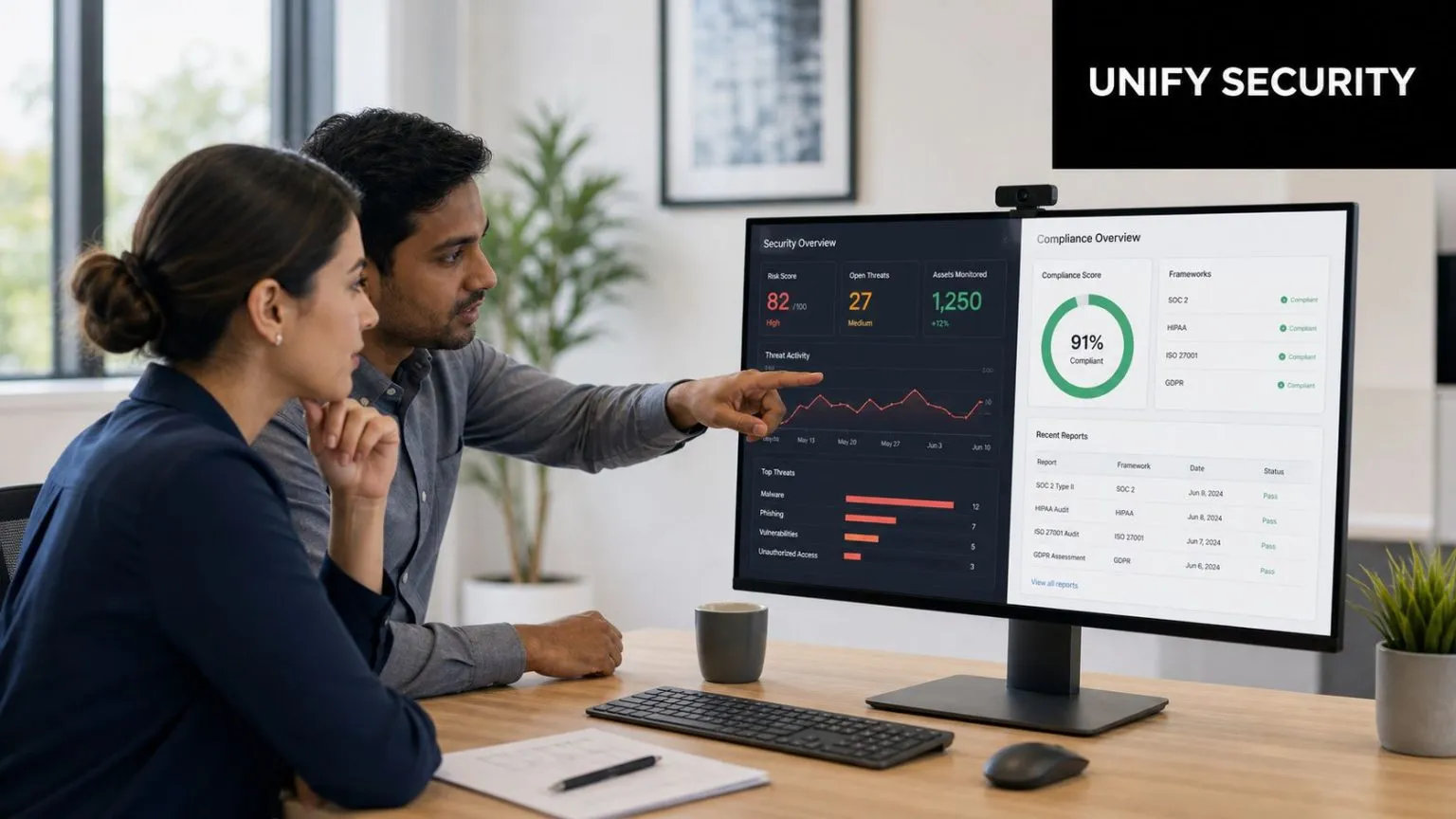
Security operations and compliance teams often work from the same data while acting like they run different programs. The SOC wants high-fidelity detection and rapid containment. Compliance wants evidence, traceability, control mapping, and repeatable proof. A unified platform removes that split because the same event stream can support both outcomes.
Why technical detections matter to auditors
Auditors don’t just want screenshots of dashboards. They want to know which control detected what, why it matters, what evidence was preserved, and how the organization maps technical logic to the framework language it claims to follow.
That mapping has to be explicit. For frameworks such as HIPAA, CMMC, and ISO 27001, SIEM correlation rules should reference MITRE ATT&CK technique IDs and CVE numbers so auditors can trace detections to adversary behaviors and compliance requirements, as explained in UTMStack’s SIEM correlation rule guidance.
That sounds administrative, but it materially improves operations too. When a rule states the behavior detected, the ATT&CK technique involved, relevant CVEs, known limitations, and related rules, analysts get better context and compliance teams get cleaner evidence.
The practical bridge between SOC and compliance
In mature environments, every part of the response lifecycle can support both teams:
- Log ingestion provides evidence of control coverage and user activity.
- Correlation rules show how the organization detects risky behavior.
- Playbooks prove response procedures are defined and repeatable.
- Case records show timestamps, ownership, disposition, and remediation.
- Rule metadata links technical detections to framework controls and threat models.
Siloed tooling hurts most. If detections live in one system, response notes in another, and audit evidence in a separate repository, the organization ends up translating the same incident three times.
A workable implementation model
For a CISO or architect trying to operationalize this, the sequence should be straightforward:
- Ingest the systems that matter first
Start with identity providers, endpoints, critical SaaS platforms, firewalls, cloud audit logs, and vulnerability sources. Don’t chase total coverage before you have reliable coverage. - Normalize around detection use cases
Build collections and parsing around concrete use cases such as suspicious authentication, privilege misuse, lateral movement, sensitive data access, and high-risk configuration change. - Attach compliance context to the rules
Add ATT&CK references, CVEs where applicable, rule descriptions, known false-positive conditions, and related controls so the logic is useful to both analysts and auditors. - Automate evidence capture
Preserve alert history, response actions, approvals, and case notes by default. If evidence relies on manual screenshots, it won’t survive pressure. - Review detections and controls together
Bring security operations and compliance owners into the same review cycle. Noise in the SOC and ambiguity in audit evidence often come from the same poorly defined rule.
Security teams shouldn’t maintain one language for defenders and another for auditors. The control should explain itself.
Why open-source unification is attractive
An open-source platform is especially useful here because it gives teams more control over data handling, rule logic, integrations, and reporting workflows. That matters for MSPs, MSSPs, healthcare organizations, finance teams, and government contractors that need flexibility without accepting a black-box operating model.
It also changes procurement logic. Instead of buying one product for SIEM, another for SOAR, another for endpoint visibility, and another layer for compliance reporting, teams can evaluate whether a unified stack can reduce data movement, reduce duplicated engineering, and make ownership clearer across the program.
The end state is simple to describe even if it takes work to build: one detection pipeline, one response workflow, and one evidence trail that supports both security operations and regulated audits.
Teams that want a unified approach can evaluate UTMStack as an open-source platform for SIEM, SOAR, XDR, and compliance management in hybrid environments. The practical value is in consolidating telemetry, correlation, response playbooks, and audit evidence so security and compliance teams aren’t rebuilding the same story in separate systems.