
Threat intelligence is evidence-based knowledge about existing or emerging cyber threats, built from context, mechanisms, indicators, implications, and action-oriented advice rather than raw data alone. In practice, it’s the structured process that turns scattered logs, malware artifacts, actor behavior, and external reporting into decisions your security team can act on before the next alert turns into an incident.
Security teams asking what is threat intelligence are already feeling the problem. The SIEM is ingesting logs. The EDR is firing detections. The XDR console is full of events. Compliance teams still need evidence for HIPAA, PCI, GLBA, CMMC, or ISO 27001, and the SOC is still asking the same question over and over: which alerts matter?
That gap between data and decision is where threat intelligence earns its place. A mature program doesn’t just collect indicators. It helps analysts understand which attacker behaviors are relevant, which exposures map to business risk, which detections should be tuned, and which events should trigger automated response. In an integrated SIEM, SOAR, and XDR stack, threat intelligence becomes operational. It drives correlation rules, enriches investigations, supports response playbooks, and gives compliance reporting enough context to be defensible in an audit.
From Reactive Alerts to Proactive Defense
A reactive SOC usually looks busy but blind. Analysts triage one alert at a time, hunt for missing context in separate tools, and escalate incidents based on severity labels that often say more about the product than the business impact.
That model breaks fast in modern environments. Cloud logs, endpoint telemetry, identity events, firewall records, and vulnerability findings all arrive at different speeds and in different formats. Without context, the team spends time asking whether an alert is meaningful instead of deciding what to do next.
According to a 2023 Gartner-based definition summarized by CrowdStrike, threat intelligence is “evidence-based knowledge (e.g., context, mechanisms, indicators, implications, and action-oriented advice) about existing or emerging menaces or hazards to assets.” That matters because it separates intelligence from raw feed data. A list of suspicious file hashes isn’t enough. A useful intelligence product explains what the indicator relates to, how the attack works, why it matters in your environment, and what controls should change.
What changes when context is present
When threat intelligence is working, the SOC stops treating every alert as an isolated event.
Instead, teams can answer questions like these faster:
- Relevance to assets: Does this behavior target workloads, identities, or data stores we operate?
- Attacker behavior: Is this tied to a known tactic, technique, or procedure that should influence correlation logic?
- Priority: Should the incident queue reflect exploitability, exposure, or business impact first?
- Action: Do we enrich, contain, block, isolate, escalate, or just document?
Practical rule: If intelligence doesn’t change a detection, a triage decision, a response playbook, or a reporting outcome, it’s still just data.
This is also where threat intelligence intersects with vulnerability management. Security teams often struggle because patch backlogs and exposure lists are larger than available time. A useful companion discipline is prioritizing security fixes with risk scores, which helps translate broad technical findings into business-driven remediation order.
For teams trying to connect intelligence directly to operations, real-time correlation matters. An integrated platform for real-time threat detection gives threat indicators, event patterns, and analyst rules a place to meet in production instead of living as separate spreadsheets and browser tabs.
What doesn’t work
Several patterns fail repeatedly in the field:
- Feed hoarding: More feeds don’t automatically improve detection quality.
- No business scoping: Intelligence teams that don’t align to crown-jewel assets produce interesting reports, not useful outputs.
- Manual-only enrichment: Analysts can’t keep copy-pasting hashes, URLs, and actor notes into every case.
- Compliance isolation: If TI never feeds audit evidence, regulated teams lose a major part of its value.
Threat intelligence is operational discipline. When done well, it gives analysts signal, detection engineers better logic, and compliance teams evidence with context.
The Four Levels of Threat Intelligence
Threat intelligence isn’t one thing. It has layers, and each layer serves a different decision-maker. If you mix them together, executives get raw indicators they can’t use, while analysts get generic strategic summaries that don’t help them close incidents.
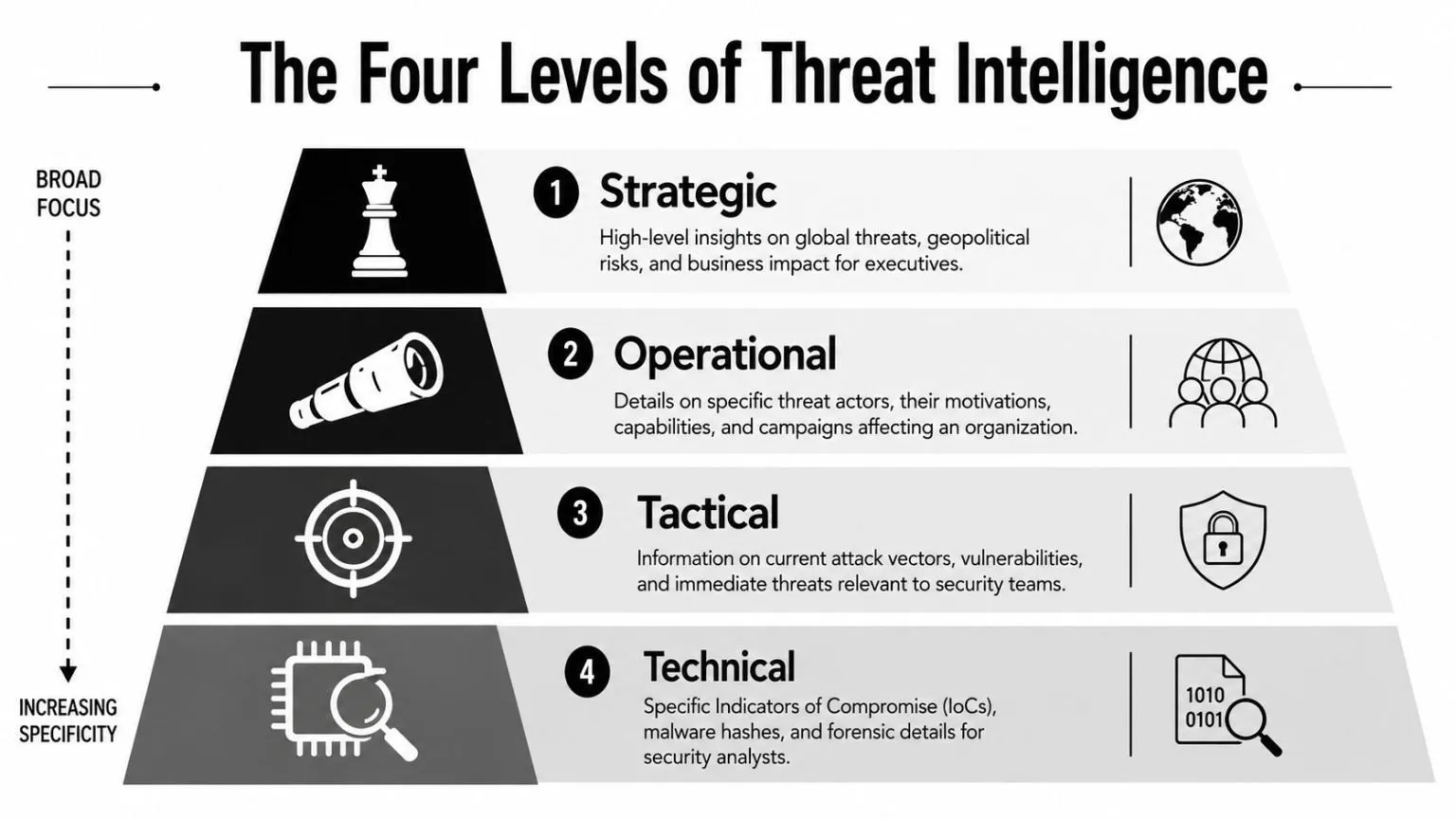
A practical way to think about the stack is this: the higher you go, the broader the audience and the longer the decision horizon. The lower you go, the more specific the data and the more immediate the operational use.
| Intelligence Type | Audience | Purpose | Example |
|---|---|---|---|
| Strategic | CISO, board, risk leaders | Guide security investment and business risk decisions | Assessment of threats most relevant to a regulated healthcare provider |
| Operational | Incident response, threat hunting leads | Understand campaigns, actor motives, and likely next steps | Analysis of a phishing campaign targeting finance staff |
| Tactical | Detection engineers, SOC leads | Improve defensive controls around attacker behavior | Mapping detections to attacker TTPs for credential abuse |
| Technical | SOC analysts, SIEM engineers | Trigger detections and enrich investigations | Malicious file hashes, URLs, or other observed artifacts |
Strategic intelligence
Strategic intelligence is written for leaders who decide budget, policy, staffing, and risk posture. It should explain which threat trends matter to the organization’s sector, where exposure is increasing, and which control gaps deserve investment.
This level isn’t about dumping malware samples into a board deck. It’s about decision support. In a PCI or HIPAA environment, strategic intelligence can shape where logging depth, endpoint coverage, identity controls, and third-party monitoring need to improve.
Operational intelligence
Operational intelligence sits closer to active adversary activity. It focuses on campaigns, threat actor motivations, targeting patterns, and attack progression.
Incident responders use this layer when they need to know what an intrusion is likely to become, not just what already happened. Threat hunters also depend on it to frame hypotheses around persistence, credential access, lateral movement, or data staging. Teams doing threat hunting techniques in 2026 need this layer because it helps turn broad suspicion into concrete hunting paths.
Operational intelligence is where a collection of related events starts to look like a campaign instead of a random cluster of alerts.
Tactical intelligence
Tactical intelligence helps defenders understand how attackers operate. It often centers on TTPs, attacker tradecraft, and defensive implications.
This is the layer detection engineers use to answer questions like: Should we alert on this PowerShell behavior? Which authentication anomalies belong in a correlation rule? What endpoint telemetry should be retained because it supports a specific technique?
Tactical intelligence is durable enough to shape detections, but specific enough to change engineering choices.
Technical intelligence
Technical intelligence is the most concrete layer. It includes indicators and forensic artifacts that systems can parse directly. Microsoft notes that for SIEM solutions such as Microsoft Sentinel, the most common form of CTI is threat indicators, also known as IOCs or indicators of attack, which associate observed artifacts such as URLs, file hashes, or IP addresses with known threat activity in its Sentinel threat intelligence overview.
Many programs start with this approach, and that’s fine. But technical intelligence alone has limits. Indicators expire, infrastructure rotates, and static matches miss behavior that a TTP-based rule would catch.
A mature program needs all four levels. Strategic shapes priorities. Operational frames the threat. Tactical tunes the defense. Technical powers the machines.
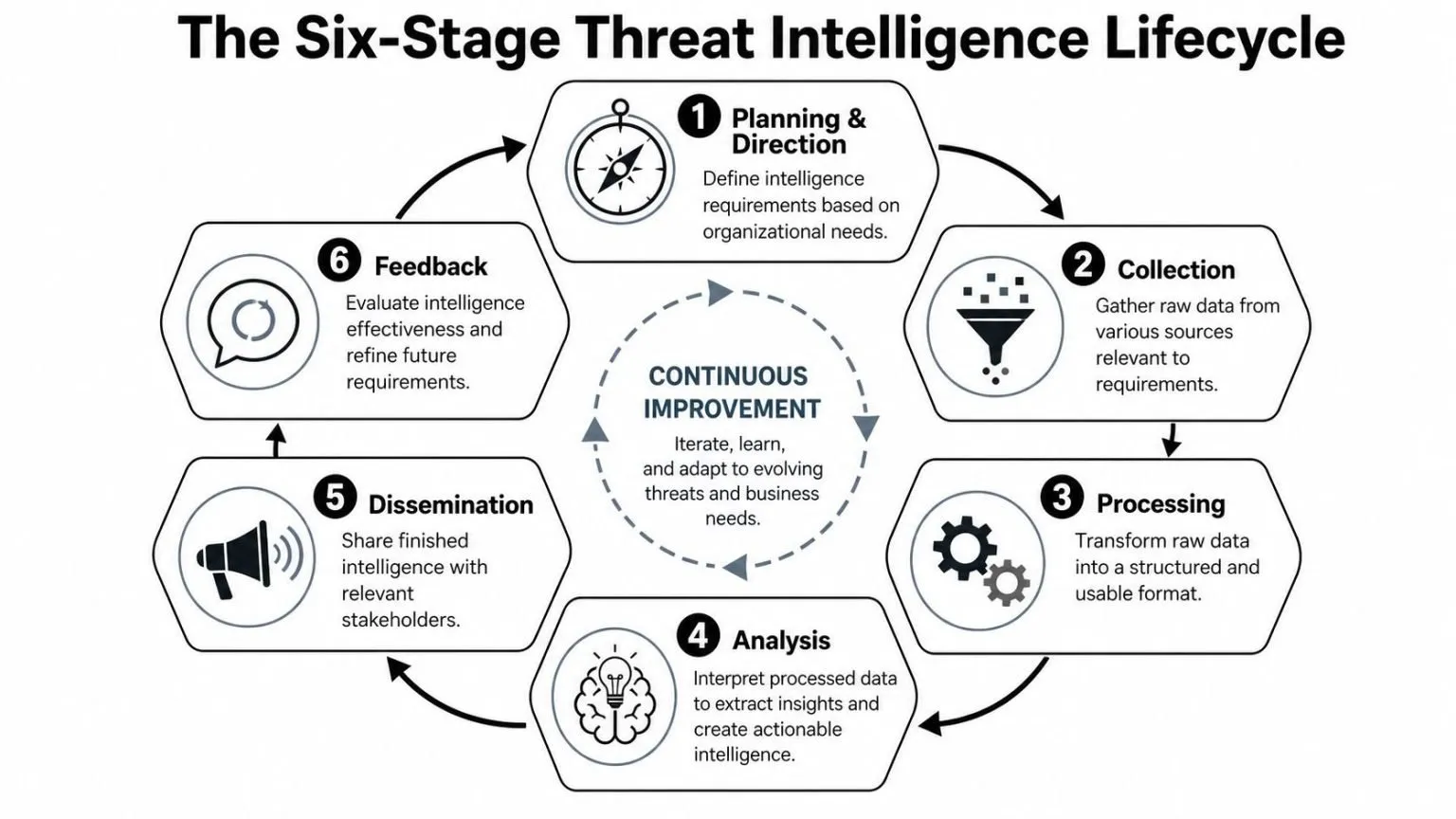
The Six-Stage Threat Intelligence Lifecycle
Threat intelligence doesn’t appear fully formed because someone subscribed to a feed. It comes from a repeatable workflow that turns raw collection into outputs analysts and leaders can use.
Why the lifecycle matters
The discipline wasn’t always this formal. The FIRST CTI curriculum introduction notes that the formalization of threat intelligence definitions in 2014 by groups such as the Bank of England Cyber Working Group marked a significant milestone, establishing it as a distinct professional discipline with a structured process rather than an ad hoc analytical activity.
That history matters because many organizations still run TI as ad hoc collection. Someone saves links, copies indicators into a spreadsheet, and sends occasional emails to the SOC. That isn’t a program. It doesn’t scale, and it doesn’t produce consistent outputs for SIEM rules, XDR enrichment, or audit evidence.
The six stages in practice
The classic lifecycle has six stages. Each one has an operational purpose.
- Planning and direction
Start with intelligence requirements. Which business services matter most? Which regulatory obligations create logging and evidence needs? Which attack paths worry you most right now? Good planning prevents the common mistake of collecting everything and using almost nothing. - Collection
Gather raw material from internal and external sources. Internal sources include endpoint logs, authentication events, case data, and alerts that may indicate a breach. External sources can include OSINT, vendor reporting, malware analysis, and monitoring of actor tactics. Collection should follow requirements, not curiosity. - Processing
Raw data has to become usable. Normalize fields, deduplicate records, parse observables, and map artifacts into a structure the SIEM, SOAR, or TIP can consume. If your engineering team skips this step, analysts inherit the mess.
The fastest way to lose trust in a TI program is to push unvetted observables directly into production detections.
- Analysis
This is where intelligence becomes intelligence. Analysts connect attacker behavior, infrastructure, timing, victimology, and business relevance. Useful outputs explain not just what was seen, but why it matters and which actions should follow. - Dissemination
Deliver the finished product to the right audience in the right format. Executives need risk framing. SOC teams need enriched alerts, watchlists, and updated detections. Compliance teams need reporting that ties observed threats and responses back to control objectives. - Feedback
Close the loop. Ask whether the intelligence changed a detection, improved triage, or helped an audit. If not, the next cycle should adjust requirements, source quality, or dissemination method.
A functioning lifecycle behaves less like a research library and more like a production system. Inputs are selected deliberately, transformed carefully, and delivered in formats that operations teams can consume without extra translation.
Activating Intelligence in Your SIEM SOAR and XDR
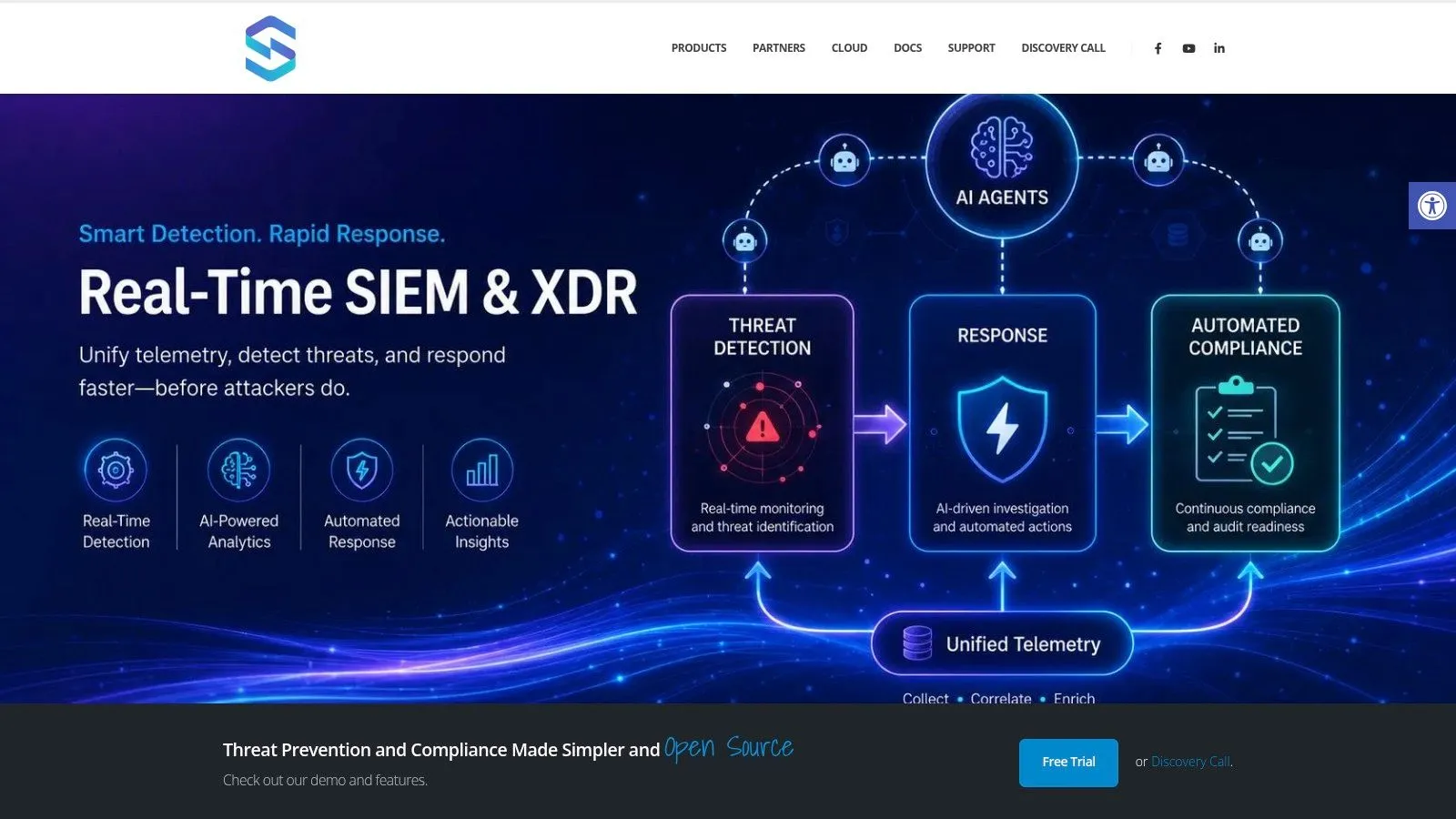
Threat intelligence starts paying off when it stops living in reports and starts shaping live detections. In an integrated security stack, intelligence becomes input for correlation rules, enrichment for investigations, and a trigger for automated action.
Where intelligence enters detection engineering
Gartner’s definition is directly relevant here because SIEM systems use threat intelligence to create rules around attacker tactics, techniques, and procedures alongside known indicators of compromise, as summarized in Exabeam’s explanation of threat intelligence in SIEM.
That shows up in operations in two main ways:
- Indicator-driven detections use concrete observables such as suspicious URLs, file hashes, or other artifacts that can be matched against incoming telemetry.
- Behavior-driven detections use intelligence about attacker tradecraft to build rules around sequences, anomalies, and control bypass attempts.
The first model is straightforward and fast to deploy. The second model is harder to engineer but usually more resilient when adversaries rotate infrastructure.
A mature SOC uses both. If your SIEM only matches static indicators, it will miss attacks that reuse methods but not the same infrastructure. If it only models behavior, you may miss easy high-confidence hits that a curated IOC set would have caught immediately.
For teams evaluating platforms that combine these workflows, threat detection and response solutions should be judged on practical mechanics: ingestion, normalization, real-time correlation, case management, and whether analysts can tune logic without opening three separate products. One example is UTMStack, an open-source SIEM, SOAR, and XDR platform that correlates telemetry and intelligence in a unified workflow.
How SOAR and XDR turn context into action
Once intelligence has enriched an alert, SOAR should decide whether the case qualifies for automation. That doesn’t mean every hit should trigger containment. It means the workflow should know when context is strong enough to reduce hesitation.
Common examples include:
- Endpoint containment: Isolate a host when an observed artifact aligns with a trusted malicious indicator and endpoint behavior supports the finding.
- Network blocking: Push a control change when multiple sources confirm hostile infrastructure tied to current activity.
- Identity response: Force credential reset or session review when observed behavior maps to known credential abuse patterns.
- Compliance evidence capture: Preserve alert context, analyst disposition, and response actions for frameworks such as HIPAA or PCI.
XDR adds another layer by stitching endpoint, identity, network, and cloud signals into one investigation. Analysts no longer have to jump across tools to understand whether a suspicious file event, a login anomaly, and outbound network activity are related.
Here’s where seeing the workflow helps:

Analyst habit that works: Treat intelligence as a scoring input for decisions, not as a substitute for validation. High-confidence context should speed triage, not eliminate it.
What usually fails is over-automation with weak inputs. If you ingest noisy intelligence and wire it directly into blocking actions, you create outages, analyst distrust, and rollback work. Good programs validate sources, assign confidence, and separate enrichment-only feeds from automation-eligible feeds.
Measuring the ROI of a Threat Intelligence Program
Security leaders don’t need another abstract argument for better context. They need to know whether a threat intelligence program improves operations, sharpens risk decisions, and supports audit readiness.

What value looks like for security leaders
For a CISO, ROI often shows up as better prioritization. Instead of spreading money evenly across tools, the organization can align logging, detection engineering, and response workflows to the threats most relevant to its assets and industry.
For SOC managers, the value is more immediate. AWS notes in its threat intelligence overview that integrating CTI into security architecture reduces mean time to respond (MTTR) by enabling faster detection and stronger response actions through correlation of data points such as attacker intent and infrastructure. That statement fits what experienced teams usually see on the ground: the analyst who starts with context closes a case faster than the analyst who starts from scratch.
For compliance leads, the payoff is defensible reporting. Intelligence-backed alerts can show why a case was escalated, which artifacts were relevant, and which control actions were taken. That context matters during audits because “an alert fired” is weaker evidence than “an alert fired, was enriched, investigated, and mapped to a documented response process.”
Metrics that actually help
Not every metric is worth tracking. Count what changes decisions or labor.
A practical scorecard often includes:
- Detection usefulness: How many alerts triggered by intelligence were confirmed, escalated, or tuned out after review.
- Triage efficiency: Whether analysts reached disposition faster when alerts arrived pre-enriched.
- Rule quality: Which correlation rules improved after adding TTP context instead of relying only on static indicators.
- Response consistency: Whether playbooks executed more reliably when cases carried intelligence confidence and enrichment.
- Audit readiness: Whether incident records now contain enough context to support HIPAA, PCI, GLBA, or ISO control narratives.
If your only KPI is how many feeds you ingest, you’re measuring input volume, not security value.
MSPs and MSSPs have an extra angle. Threat intelligence helps them package proactive monitoring, higher-fidelity detections, and better compliance reporting as a managed service outcome rather than a bundle of disconnected alerts.
How to Build Your Threat Intelligence Program
Building a TI program from scratch doesn’t require a giant team. It requires discipline. The biggest early mistake is buying feeds before defining use cases.
Start with requirements, not feeds
Begin with a short list of intelligence requirements tied to business risk. Ask which applications, identities, regulated data sets, subsidiaries, and third parties matter most. Then map those priorities to operational questions your team needs answered.
A practical starting sequence looks like this:
- Define protected assets: List systems and data sets that would create the biggest operational or compliance problem if compromised.
- Choose initial use cases: Pick a few concrete outcomes such as phishing detection enrichment, ransomware-related endpoint triage, identity abuse detection, or vulnerability prioritization.
- Map consumers: Decide what output each audience needs. Executives want risk statements. Analysts want artifacts and context. Engineers want detection logic.
- Limit source sprawl: Start with a curated set of internal telemetry and a manageable set of external intelligence sources.
- Create disposition rules: Decide what becomes enrichment only, what can influence scoring, and what is trusted enough to inform automated action.
This keeps the program tied to operations. It also prevents the common trap where teams collect broad OSINT but never turn it into detection content or investigation context.
Build the feedback loop into operations
The integration pattern matters as much as source quality. ZeroFox describes an effective model as “bidirectional data flow” where validated intelligence goes to the SIEM for alerting, and SIEM events return to the threat intelligence platform for correlation and enrichment in its discussion of integrating threat intelligence with SIEM.
That idea should shape your architecture from day one. Intelligence shouldn’t move in only one direction.
What this looks like in practice:
- Inbound flow: Curated indicators, actor context, and TTP mappings enrich detections and investigations.
- Outbound flow: Confirmed incidents, false positives, analyst notes, and observed artifacts feed back into the intelligence process.
- Closed-loop tuning: Detection engineers refine rules based on what occurred in production.
- Reporting reuse: The same workflow that enriches a case should also preserve evidence for compliance review.
A few implementation trade-offs are worth stating clearly.
First, open-source and community intelligence can be useful, but only if you validate and normalize it before using it in automated controls. Second, one integrated platform is usually easier to govern than several loosely connected point products, especially when the SOC and compliance teams need the same evidence trail. Third, technical intelligence is the easiest place to start, but the program becomes more durable when tactical and operational outputs begin influencing detection engineering and response playbooks.
The strongest early milestone isn’t “we have a lot of intel.” It’s “our detections, investigations, and reports improved because intelligence changed how we work.”
Conclusion Intelligence Is Your Proactive Edge
Threat intelligence gives security teams something they rarely have enough of: context they can act on. Not generic awareness. Not a pile of disconnected indicators. Useful, evidence-based knowledge that helps the SOC decide what matters, helps engineers tune detections, and helps compliance teams explain what happened and why.
That’s the answer to what is threat intelligence in operational terms. It is the discipline that turns scattered telemetry, actor behavior, indicators, and threat reporting into action across SIEM, SOAR, and XDR workflows.
The four levels matter because different people need different outputs. The lifecycle matters because intelligence quality depends on process, not volume. Activation inside the security stack matters because intelligence only proves its value when it changes detection, response, and reporting.
Organizations that skip this discipline stay reactive. They investigate too much noise, automate the wrong things, and struggle to connect incidents to business risk or compliance evidence.
Organizations that build it well do something different. They prioritize better, detect with more context, respond faster, and document outcomes with less friction. In a modern security program, intelligence isn’t a side feed. It’s the layer that helps every other control make better decisions.
If you’re trying to operationalize threat intelligence in one place, UTMStack is worth evaluating as an open-source SIEM, SOAR, and XDR platform that combines real-time detection, automated response, and compliance workflows in a unified stack.