
Endpoints are the primary targets and entry points for 72% of all cyber attacks. That single fact changes how a CISO should think about the endpoint protection platform. It isn’t just an antivirus refresh or an IT hygiene purchase. It’s the control sitting at the most attacked edge of the business.
In most environments, “endpoint” no longer means only employee laptops. It means Windows and Linux servers, managed and unmanaged mobile devices, virtual desktops, engineering workstations, point-of-sale systems, and the long tail of operational devices that still touch core business processes. If those systems are where users work, data moves, credentials live, and malware lands, they belong in the endpoint security conversation.
A modern endpoint protection platform matters for two reasons that don’t get enough attention. First, it has become part of the underwriting conversation for cyber insurance. Second, its telemetry is far more valuable when it feeds a SIEM, XDR, or SOAR workflow instead of living in a standalone console. That’s where the platform shifts from isolated prevention tool to a core part of security architecture.
Why Endpoint Security Is Your First Line of Defense
When attackers want an initial foothold, they usually go where users and workloads already operate. Email attachments land on endpoints. Browser sessions terminate on endpoints. Stolen credentials get used from endpoints. That practical reality is why the endpoint protection platform sits so early in the kill chain.
An endpoint can be a laptop, server, mobile device, kiosk, or any managed device that runs business activity. In hybrid environments, many of those systems live outside the traditional corporate perimeter for long stretches. Security teams can’t assume network controls will always see the first malicious action.
What the first line of defense actually means
An endpoint protection platform is the preventive layer on the device itself. Its job is to stop common and advanced threats before they execute, spread, or establish persistence. If that sounds basic, it isn’t. Good endpoint prevention reduces noise upstream and keeps the SOC from spending time investigating avoidable infections.
That matters in layered security. Prevention on the host doesn’t replace network monitoring, identity controls, or logging strategy. It gives those layers fewer fires to manage. Teams that want a clear view of how layered controls reinforce each other should understand CEF data protection in the broader context of defense-in-depth.
Practical rule: If a control depends on traffic returning to a central appliance before it can act, assume it will miss part of your endpoint risk.
Where teams get this wrong
The common failure mode is treating endpoint security as a commodity checkbox. Buy an agent, deploy a default policy, and assume “covered” means “protected.” That approach breaks quickly in real environments. Exceptions pile up. Developer endpoints need different controls than finance workstations. Servers need tighter change management than roaming laptops. Executive devices often need stricter isolation, not looser treatment.
A CISO should expect the endpoint program to answer basic questions fast:
- What assets are actually protected: Inventory drift is common, especially after mergers, contractor onboarding, and remote work expansion.
- Which policy applies to which class of device: One flat policy usually creates either operational friction or security gaps.
- How quickly can the team contain a bad endpoint: Prevention matters most when it shortens the path to containment.
The endpoint protection platform earns its place when it enforces policy on the host, not when it reports after the fact.
Deconstructing the Endpoint Protection Platform
Most confusion starts with the name. An endpoint protection platform, or EPP, sounds broad enough to mean everything on the endpoint. It doesn’t. Its center of gravity is still prevention.
Think of EPP as the security guard posted at the building entrance. The guard checks what’s coming in, blocks obvious threats, enforces house rules, and limits what visitors can do once inside. That guard isn’t running the full investigation after a break-in. That’s a different function. But if the guard is weak, the rest of the building spends its time cleaning up preventable incidents.
What an EPP is responsible for
At a practical level, an EPP operates on the endpoint and enforces controls directly on that system. The platform typically handles several jobs at once:
- Malware prevention: Stops known malicious files and suspicious payloads before they run.
- Exploit blocking: Interferes with execution patterns associated with common attack techniques.
- Policy enforcement: Restricts unapproved software behavior, removable media use, or risky local actions.
- Host-level control: Applies protection even when the endpoint is off-network.
Those functions matter because prevention on the endpoint is faster than waiting for an external system to notice something bad already happened. If the process never starts, the incident never becomes a broader response problem.
What an EPP is not
An EPP is not the same thing as legacy antivirus, even though antivirus capabilities are often included. Legacy AV focused heavily on matching files against known signatures. A modern EPP still uses signatures where they help, but it adds more ways to evaluate activity and policy violations on the host.
It’s also not a full investigation platform by itself. A security team can get alerts, quarantine files, and enforce policy through EPP. But if an attacker bypasses prevention and starts moving through identity, cloud, email, and network layers, the standalone EPP console won’t give enough context to reconstruct the full incident.
The strongest endpoint programs don’t ask EPP to do everything. They ask it to do prevention well, then connect it to the rest of the detection and response stack.
Why the distinction matters in procurement
Vendors often blur categories because buyers like single-platform narratives. That’s understandable, but misleading. During evaluation, separate these questions:
| Evaluation point | What to ask |
|---|---|
| Preventive strength | Can it block malware, exploits, and risky behavior on the host? |
| Operational usability | Can admins manage policy cleanly across different device classes? |
| Telemetry value | Can security teams export meaningful events to broader workflows? |
| Response scope | Does it contain the endpoint only, or support broader investigation elsewhere? |
If the team can’t answer those four questions clearly, the product category probably isn’t being discussed clearly either.
EPP vs EDR vs XDR A Clarity Guide
Security buyers still get dragged into category confusion because the labels overlap and vendors collapse them into one story. The cleanest way to think about it is simple. EPP prevents. EDR investigates and responds on the endpoint. XDR correlates across domains. Legacy antivirus is narrower than all three.
Start with the visual comparison.
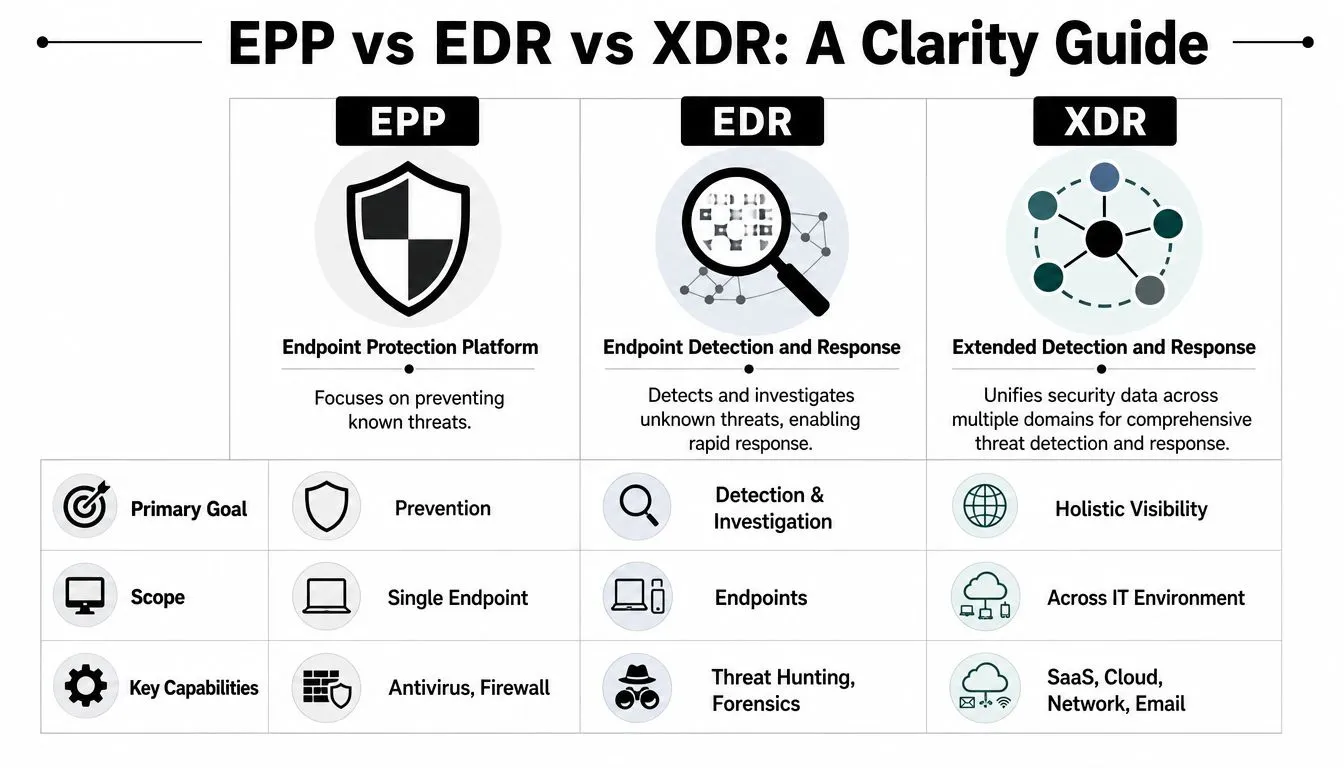
The functional difference that matters
The key mistake is treating EPP and EDR as alternatives. In a mature program, they aren’t. A practical architecture uses the endpoint protection platform to block what it can at the point of execution, then uses EDR to investigate what still gets through or what looks suspicious after execution begins.
The most effective approach for modern hybrid environments is a unified platform where NGAV, intrusion prevention, and data loss prevention work in tandem with EDR telemetry to stop both known and unknown threats, as outlined in ManageEngine’s explanation of endpoint protection platforms.
That idea becomes clearer in a side-by-side table.
| Technology | Primary Focus | Key Capability | Analogy |
|---|---|---|---|
| Antivirus | Known malware blocking | Signature-based scanning | A guard checking a printed list of banned visitors |
| EPP | Prevention on the host | Blocks malware, exploits, and policy violations | A building guard enforcing entry rules and basic safety controls |
| EDR | Detection and response on endpoints | Investigates suspicious activity and supports containment | A detective reconstructing what happened inside the building |
| XDR | Cross-domain correlation | Connects endpoint, cloud, identity, network, and email signals | A command center seeing the entire incident across the city |
The video below gives a useful high-level framing before a team goes deeper into architecture decisions.

How to use each in a real program
This isn’t just naming hygiene. It affects budgeting, staffing, and escalation paths.
- Use antivirus for baseline hygiene: It still has a role, but it isn’t a modern endpoint strategy on its own.
- Use EPP for front-line prevention: This reduces avoidable infections and attack surface on the device.
- Use EDR for host investigation: Analysts need endpoint timelines, process visibility, and containment options when prevention misses.
- Use XDR when incidents cross boundaries: Credential misuse, cloud access, and lateral movement often require broader correlation than endpoint data alone can provide.
Where procurement teams get misled
Some products market “all-in-one” endpoint security, but the underlying capabilities still differ. Ask the vendor to show exactly which controls happen before execution, which telemetry remains available after execution, and what outside data sources the product can correlate natively or through integration.
If the answer to every question is “our AI handles it,” keep digging. Architecture still matters. So does scope.
Inside a Modern EPP Core Components and Detection
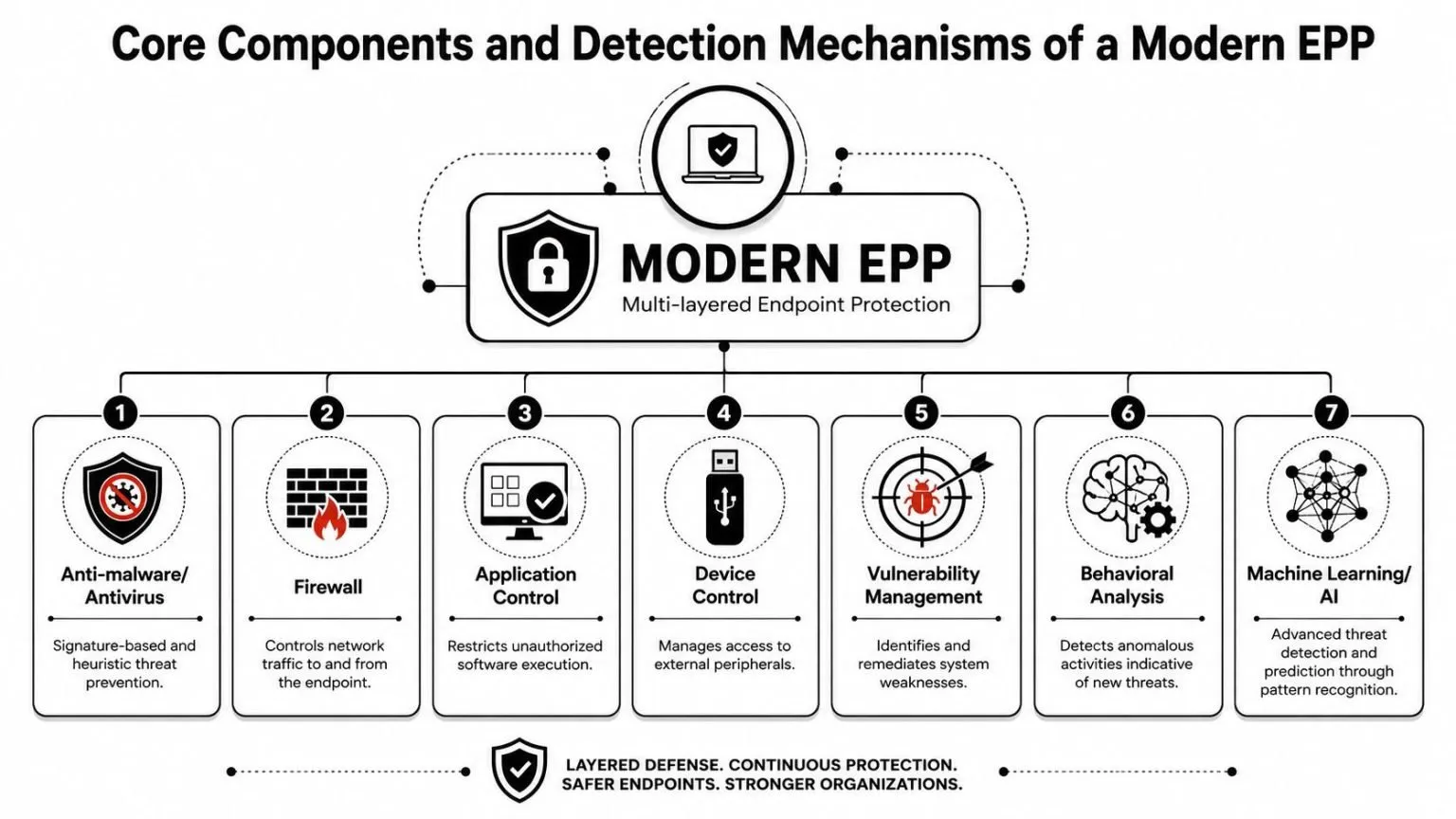
A modern endpoint protection platform doesn’t rely on one detection method. It works because several controls operate together on the endpoint, each covering a different failure mode. Signature matching still matters, but by itself it won’t hold up against fileless attacks, living-off-the-land behavior, or previously unseen payloads.
The best way to evaluate an EPP is to inspect its detection stack, not just its marketing category.
Why signatures alone aren’t enough
Signature-based detection answers a narrow question. Have we seen this exact malicious pattern before? That’s useful for known malware families and commodity threats. It fails when the attacker changes the file, avoids writing to disk, abuses legitimate tools, or executes in memory.
That’s why modern endpoint protection platforms achieve near-100% malware defense through a multi-engine architecture combining signature-based detection with Next-Generation Antivirus powered by artificial intelligence and behavioral analysis, which detects fileless malware and zero-day exploits by monitoring memory anomalies and policy violations, according to the benchmark summary from SecurityBrief.
What sits inside the detection stack
A strong EPP usually combines several layers:
- Signature and heuristic inspection: Fast filtering for known bad files and familiar malicious traits.
- Behavioral analysis: Watches processes, parent-child relationships, script execution, memory behavior, and suspicious system actions.
- Policy-based controls: Blocks execution paths or actions that violate approved device rules.
- Application and device control: Restricts unauthorized binaries, scripts, and peripheral usage.
- Host firewall and exploit protection: Reduces exposure to local network abuse and exploit chains.
No single control is enough. Together, they make the endpoint a harder target and reduce the odds that one evasion technique wins.
Why behavioral monitoring changes the game
Behavioral analysis is the difference between “we know this file” and “we know this action is dangerous.” That matters because many endpoint intrusions don’t look like classic malware at first. They look like PowerShell, script interpreters, office macros, or admin utilities behaving in ways they shouldn’t.
Operational advice: Tune prevention around behaviors attackers need, not only around malware families you’ve already named.
That mindset also improves detection engineering. Teams that build analytics around endpoint behavior, process chains, and policy exceptions get more value from the platform than teams that only monitor malware verdicts. If your SOC is actively refining host-based logic, a disciplined detection engineering program gives that telemetry far more operational value.
Trade-offs security teams should expect
The trade-offs are real. More aggressive prevention can interrupt legitimate admin work, software deployment, and custom tooling. Lighter policy reduces friction, but leaves room for abuse. There isn’t a universal perfect setting.
That’s why mature teams phase controls:
| Control area | Conservative rollout | Mature rollout |
|---|---|---|
| Application control | Audit mode on broad groups | Enforce on high-risk populations and critical assets |
| Script restrictions | Limited blocking with exceptions | Tight policy based on role and signed tooling |
| Device control | Monitor removable media | Restrict by business need and data sensitivity |
The right EPP isn’t only the one with rich engines. It’s the one your team can tune, enforce, and live with.
Integrating EPP with Your SIEM XDR and SOAR
A standalone EPP can stop malware and raise useful host alerts. That’s valuable, but limited. Most serious incidents don’t stay confined to one endpoint or one console. They touch identity, cloud workloads, email, DNS, network traffic, and privileged access. If the endpoint protection platform doesn’t feed broader security operations, you’re forcing analysts to reconstruct incidents by hand.
That is where many programs hit the integration blind spot.
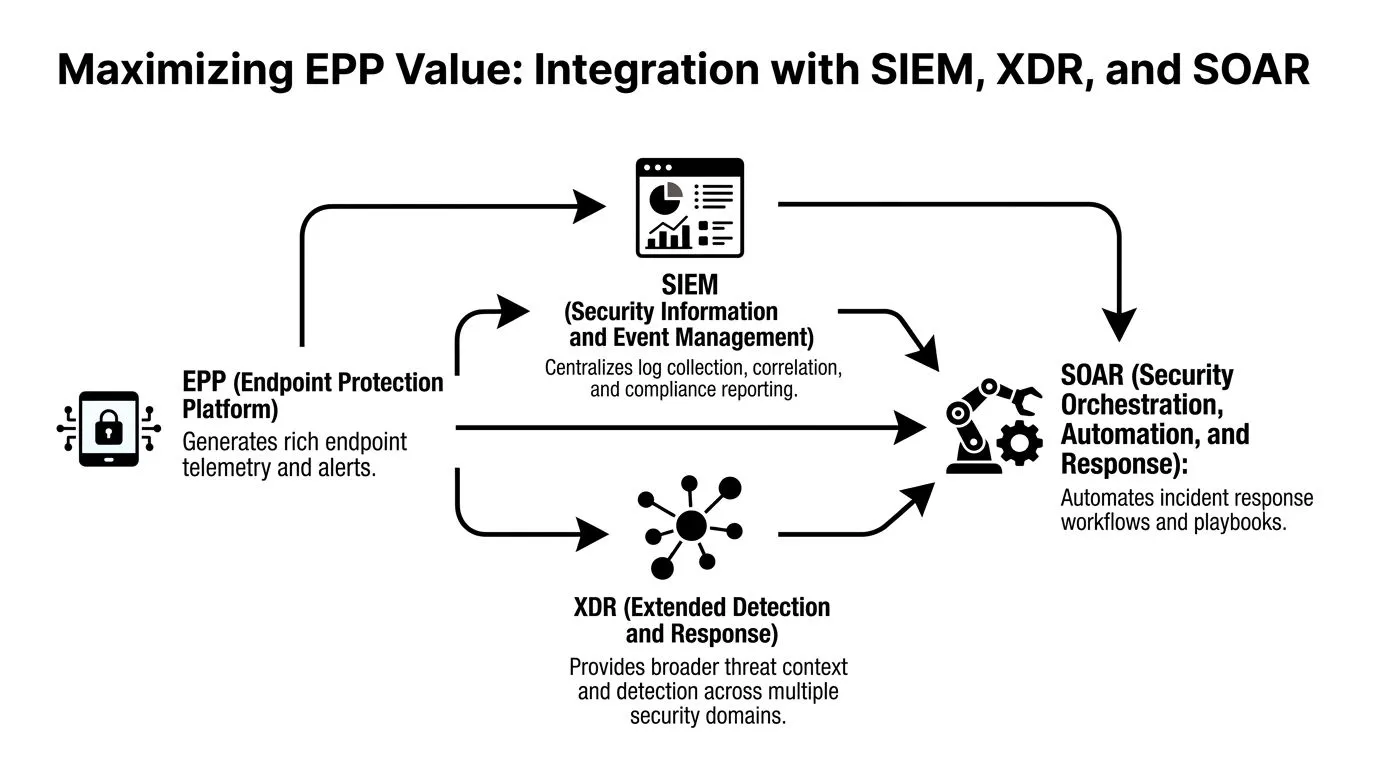
Why isolated EPP creates response drag
The endpoint console can usually tell you that a malicious process launched, a file was quarantined, or a host was isolated. It often can’t tell you whether the same user just authenticated from an unusual location, whether a cloud token was abused minutes later, or whether another host contacted the same destination.
That lack of context isn’t a small operational issue. Organizations using isolated EPPs experience 3x longer mean-time-to-respond because they lack the contextual correlation found in unified XDR or SIEM platforms that ingest EPP logs via Syslog or API.
What good integration looks like
At minimum, a modern endpoint protection platform should export telemetry and alerts to a central analysis plane. In practice, that usually means API collection, Syslog forwarding, vendor connectors, or agent-based ingestion into a SIEM or XDR platform.
Once the data lands centrally, security teams can correlate endpoint events with:
- Identity signals: Suspicious logons, privilege escalation, impossible travel, MFA anomalies.
- Cloud and SaaS logs: Administrative actions, token use, mailbox changes, storage access.
- Network evidence: East-west movement, egress anomalies, protocol misuse, beaconing patterns.
- Automation layers: SOAR playbooks that isolate a host, disable a user, open a case, or enrich the alert.
One platform that fits this model is UTMStack threat detection and response, which ingests endpoint and other security telemetry for correlation, automated response, and compliance workflows. That’s the architectural pattern that matters, regardless of product choice.
Endpoint telemetry becomes far more useful when the SOC can ask, “What else happened around this alert?” instead of “Which console do I open next?”
How to operationalize the connection
Teams often don’t fail because integration is impossible. They fail because they stop at basic forwarding and never operationalize the data. To avoid that, build around a few use cases first.
- Host compromise plus identity risk
Correlate malicious process activity with high-risk authentication behavior from the same user. - Repeated low-severity alerts across hosts
A single blocked script may be noise. The same pattern across many endpoints can indicate campaign activity. - Automated containment with analyst approval
Use SOAR to prepare actions automatically, then allow an analyst to approve host isolation or account disablement.
A SIEM or XDR shouldn’t replace endpoint controls. It should make endpoint telemetry intelligible in the context of the whole incident.
The Business Case EPP for Compliance and Insurability
Security leaders often justify endpoint investments in technical terms. Better malware prevention. Better visibility. Better response options. Those are valid reasons, but they aren’t enough in boardroom or underwriting conversations. The stronger business case is that a well-configured endpoint protection platform supports compliance evidence, reduces avoidable control gaps, and can directly affect whether the organization remains insurable.
That shift matters because insurers and auditors don’t buy the “we have a tool” argument. They care whether the controls are deployed, enforced, and evidenced.
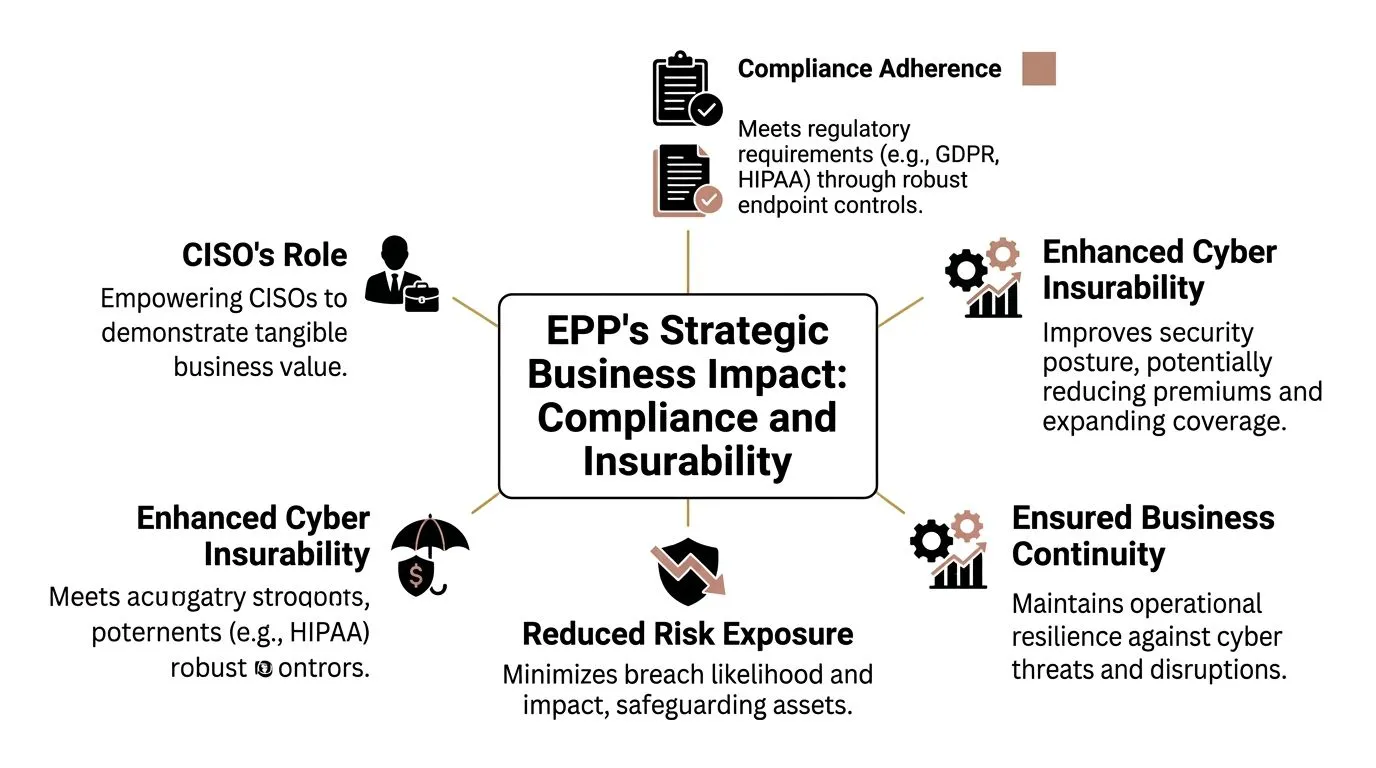
Why underwriters care about endpoint controls
Cyber insurance questionnaires have become much more specific. They don’t just ask whether endpoint protection exists. They ask whether endpoint hardening and response capabilities are in place, whether systems are patched, whether backups are protected, and whether enforcement is consistent across the fleet.
The pressure is explicit. 90% of cyber insurers explicitly mandate EDR capabilities and endpoint hardening as non-negotiable requirements for insurability. That’s not a marketing preference. It’s an underwriting gate.
A weak endpoint program creates two business problems. It raises the risk of actual compromise, and it undermines the organization’s ability to prove reasonable control maturity when coverage is being evaluated or renewed.
Mapping EPP to compliance reality
An endpoint protection platform also supports multiple control families found across regulated industries. The product itself won’t make an organization compliant, but it helps implement and evidence requirements that auditors routinely inspect.
| Framework area | Where EPP contributes |
|---|---|
| HIPAA | Malware prevention, device control, centralized policy enforcement on covered systems |
| PCI DSS | Host protections on in-scope endpoints and tighter control over software behavior |
| CMMC | Endpoint hardening, anti-malware enforcement, and support for monitored response workflows |
| ISO 27001 | Technical enforcement, endpoint monitoring, and auditable control implementation |
| GLBA and SOC 2 | Host-level safeguards, policy consistency, and evidence of operational control |
If the broader security stack includes change evidence and file monitoring, that strengthens the audit trail further. For example, file integrity monitoring can complement endpoint policy and host protection evidence for regulated environments.
What CISOs should present to finance and audit teams
A business-facing explanation should stay concrete:
- Coverage posture: Which endpoint classes are protected and how policy differs by risk tier.
- Control enforcement: Whether malware prevention, device restrictions, and hardening baselines are active.
- Evidence quality: Whether the team can show policy status, exceptions, alerts, and response records.
- Insurance alignment: Whether endpoint controls map cleanly to underwriting questions.
A security control becomes a business control when you can prove it exists, prove it’s enforced, and prove exceptions are governed.
That is the point where endpoint security stops sounding like a tactical purchase and starts reading like governance.
EPP Selection Checklist for CISOs and MSSPs
Buying an endpoint protection platform is rarely just a product decision. It’s an operating model decision. The wrong choice creates alert noise, broken deployment cycles, analyst frustration, and exception sprawl. The right choice fits your device mix, your SOC workflow, and your regulatory environment.
Below is the checklist I use to separate real endpoint platforms from polished demos.
Detection and prevention efficacy
Start here, not with licensing.
- Demand third-party validation: Prioritize independent efficacy testing and peer review over vendor claims. If the evaluation starts with branded slideware instead of externally validated results, stop and reset the process.
- Verify modern prevention methods: The platform should combine signature detection with NGAV-style behavioral analysis. If the product still behaves like old antivirus with a newer console, it won’t keep pace with current attack methods.
- Test fileless and script-based abuse: Ask how it handles in-memory behavior, suspicious scripts, policy violations, and abuse of legitimate admin tools.
- Inspect containment actions: Quarantine is useful. Host isolation, process termination, and policy-based blocking matter more when a device is under active abuse.
A pilot should include real administrative tools, software deployment processes, and developer workflows. Lab-only validation hides operational friction.
Management and operational fit
A capable engine is useless if your team can’t run it cleanly.
Policy design and exception handling
Look closely at how the product handles policy scope. You need differentiated policies for servers, standard users, privileged users, developers, and business-critical assets. If exceptions are handled by ad hoc local overrides, the platform will drift quickly.
Check for these operational basics:
- Role-aware policying: Different device classes should support different control profiles without custom chaos.
- Change discipline: Security teams need to stage, audit, and roll back policy changes safely.
- Exception governance: The platform should document who approved the exception, for what reason, and for how long.
Performance and user impact
The endpoint agent must stay lightweight enough that IT won’t face immediate resistance from users and platform teams. Resource-heavy agents get disabled, bypassed, or politically sidelined.
You should ask:
| Operational question | Why it matters |
|---|---|
| Does the agent impose a low CPU and memory footprint? | Endpoint security that degrades user systems won’t survive long-term |
| Can the console manage all major OS types in one place? | Fragmented management creates blind spots and inconsistent policy |
| Are policies visible in real time? | Security teams need fast confidence during incidents and audits |
Platform and integration requirements
An endpoint platform that can’t integrate cleanly becomes a silo. That hurts both enterprise teams and MSSPs.
Logging, API, and SIEM readiness
Confirm how the product exports telemetry. Good answers include API access, documented connectors, and structured event forwarding. Weak answers rely on CSV exports, manual pulls, or vague roadmap promises.
Look for:
- Usable telemetry: Process, alert, policy, and host state data should be exportable in a format the SIEM can use.
- Correlation readiness: Events should carry enough context to tie back to user, host, action, and outcome.
- SOAR compatibility: The product should support automated containment or orchestration hooks without brittle custom scripting.
Coverage across your actual estate
Many endpoint programs fail at the edges. Not because the product is bad, but because the buying team scoped only the mainstream fleet.
Check support for:
- Servers and workstations: Especially mixed Windows and Linux estates.
- Roaming devices: Laptops that spend long periods off VPN or outside managed network boundaries.
- Privileged and sensitive endpoints: Executive systems, finance devices, admin workstations, and regulated workloads.
- MSSP multi-tenancy needs: If you’re an MSSP, tenant isolation and delegated administration aren’t optional.
Buy for the hard parts of your environment first. The easy desktop fleet doesn’t tell you whether the platform will hold up.
Vendor quality and commercial reality
A technically strong product can still fail if the vendor model doesn’t fit your organization.
Support and deployment maturity
Ask how deployment works at scale, how upgrades are handled, and how support responds during a live incident. If support quality is poor, your team will absorb the cost in lost time and delayed containment.
Evaluate:
- Implementation quality: Does the vendor provide clear deployment guidance and policy baselines?
- Support depth: Can you reach someone who understands endpoint operations, not just licensing?
- Documentation quality: Good documentation shortens rollout time and reduces fragile custom configurations.
Licensing and total cost of ownership
Don’t reduce procurement to per-endpoint price. Total cost of ownership includes admin burden, integration effort, agent conflicts, exception management, and the staffing needed to run the platform.
A cheaper EPP can become the expensive option if it produces poor telemetry, weak policy controls, or constant tuning overhead.
Final decision criteria that actually matter
If I had to reduce selection to a short board-level summary, it would be this:
- Can it prevent effectively on the host?
- Can your team manage it without creating policy chaos?
- Can it feed useful telemetry into your SIEM, XDR, and SOAR workflows?
- Can you show its value to auditors, insurers, and executive leadership?
If the answer to any of those is uncertain, keep evaluating. Endpoint security isn’t the place to buy on branding alone.
If you’re evaluating how endpoint telemetry should feed a broader security and compliance program, UTMStack is one option to review. It combines SIEM, SOAR, and XDR capabilities so teams can ingest endpoint events alongside cloud, network, and identity data, correlate incidents, automate response, and support reporting for frameworks such as HIPAA, GLBA, CMMC, PCI, ISO 27001, and SOC 2.