
Your SOC dashboard is full, your analysts are tired, and your ticket queue keeps growing. One alert says a user clicked a suspicious link. Another shows a connection to an external host. A third flags unusual endpoint behavior. None of them are clearly tied together, and none arrive with enough context to tell you what matters first.
That’s where a threat intelligence feed stops being a nice add-on and starts becoming operationally useful. A feed can tell you whether that domain has been linked to malware delivery, whether a file hash belongs to a known family, or whether a vulnerability is actively being used in the wild. Without that context, teams chase noise. With it, they can triage faster and respond with more confidence.
This matters even more in open-source SIEM and XDR environments, where teams often want flexibility without sacrificing visibility. If you’re tracking external chatter, actor activity, or criminal communities, it also helps to understand adjacent collection sources. For example, teams expanding their external monitoring may want to monitor Telegram’s dark side with Statiko as part of broader intelligence gathering around emerging campaigns and leak activity.
Introduction to Threat Intelligence Feeds
A threat intelligence feed is a stream of external security data that helps your tools recognize known bad infrastructure, malware artifacts, attacker behavior, and sometimes broader campaign context. In plain language, it gives your SIEM, EDR, XDR, firewall, or case management workflow an outside view of what defenders have already seen elsewhere.
That outside view matters because internal telemetry rarely explains itself. A DNS request, a process launch, or a failed login may look ordinary until it matches something already associated with phishing, credential theft, ransomware staging, or exploit delivery. The feed supplies that missing clue.
In day-to-day operations, teams usually don’t struggle with whether they have alerts. They struggle with which alerts deserve attention now. Threat intelligence feeds help answer that by adding reputation, relevance, and urgency to otherwise isolated events.
Practical rule: A feed is useful only when it changes a decision. If it doesn’t alter triage, correlation, blocking, hunting, or patching, it’s just more data.
A good feed program also serves more than the SOC. It can support malware research, CVE prioritization, detection engineering, and compliance reporting tied to frameworks like HIPAA, GLBA, PCI, CMMC, and ISO 27001. Security leaders care because the same intelligence that improves alert handling can also improve risk communication and justify spending choices.
The rest of the work is operational. You need to know what kind of feed you’re ingesting, how to normalize it, how to enrich it, where to correlate it, and how to keep stale indicators from turning into recurring false positives.
Understanding Key Concepts of Threat Intelligence Feeds
The term threat intelligence feed gets used loosely. Some vendors mean a simple list of bad IPs. Others mean a richer stream that includes malware families, actor tags, vulnerability exploitation context, and confidence metadata. If your team doesn’t separate those ideas early, implementation gets messy fast.
The market growth around these products shows how central they’ve become. The threat intelligence feeds market is valued at $7.2 billion in 2025 and is projected to reach $27.9 billion by 2034, with a 14.8% CAGR, according to Market Intelo’s threat intelligence feeds market analysis. That growth tracks with what defenders already feel on the ground. Teams need faster external context inside security operations.
For a concise foundation on the broader discipline behind feeds, UTMStack’s overview of threat intelligence is a useful primer.
What a feed really contains
At the simplest level, a feed starts as collected data from places like honeypots, malware labs, open-source intelligence, dark web monitoring, security vendors, and internal telemetry. That raw material becomes useful when it is turned into security-relevant entities such as:
- Indicators of compromise such as file hashes, URLs, domains, or network artifacts.
- Behavioral clues that point to recurring attacker methods.
- Context fields like confidence, source, malware family, campaign name, or targeted sector.
- Response hints that tell an analyst whether to block, investigate, isolate, or monitor.
It’s a newswire for defenders. Raw events arrive from everywhere. The feed provider or internal intelligence process filters, labels, and distributes what matters.
Why normalization matters before detection
Feeds rarely arrive in one clean format. One source may send JSON. Another may expose TAXII collections. A third may drop flat text or CSV. If your SIEM ingests each source as-is, your rules become brittle because field names, severity labels, timestamps, and object types don’t line up.
Normalization fixes that. It maps different feed structures into a common schema so that correlation logic can behave consistently. Instead of writing separate logic for each source, analysts can ask one question across all of them: did this endpoint, user, process, or network event touch a known malicious indicator?
A feed without normalization forces analysts to interpret source quirks. A normalized feed lets the platform do that work first.
Tactical operational and strategic intelligence
Not every feed serves the same purpose. Security teams often confuse three different layers:
| Intelligence type | What it contains | Best use |
|---|---|---|
| Tactical | Raw IOCs such as hashes, domains, and URLs | Fast matching, blocking, enrichment |
| Operational | Campaign details, malware clusters, TTP context | Triage, hunting, detection tuning |
| Strategic | Business risk, targeting trends, executive context | Investment planning, leadership reporting |
That distinction matters in SIEM and XDR design. Tactical feeds are fast and machine-friendly. Operational feeds help analysts understand why an alert matters. Strategic intelligence helps a CISO explain exposure to the board without drowning them in event data.
Exploring Feed Types and Data Formats
Security teams usually don’t fail because they lack feeds. They fail because they ingest the wrong mix. A raw blacklist may help with immediate matching, but it won’t help an analyst explain a suspicious chain of behavior. A strategic advisory may inform leadership, but it won’t plug directly into automated detection logic.
Threat intelligence feeds aggregate diverse data sources including open-source intelligence, commercial feeds, internal logs, and collaborative sharing with trusted partners to identify patterns, trends, and IOCs that define threat actor TTPs, as described in UTMStack’s threat intelligence documentation.
To complement external threat sources, teams that want deeper exposure visibility often pair feeds with dark web monitoring for businesses, especially when credential leaks or actor chatter may precede direct attacks.
The main feed categories
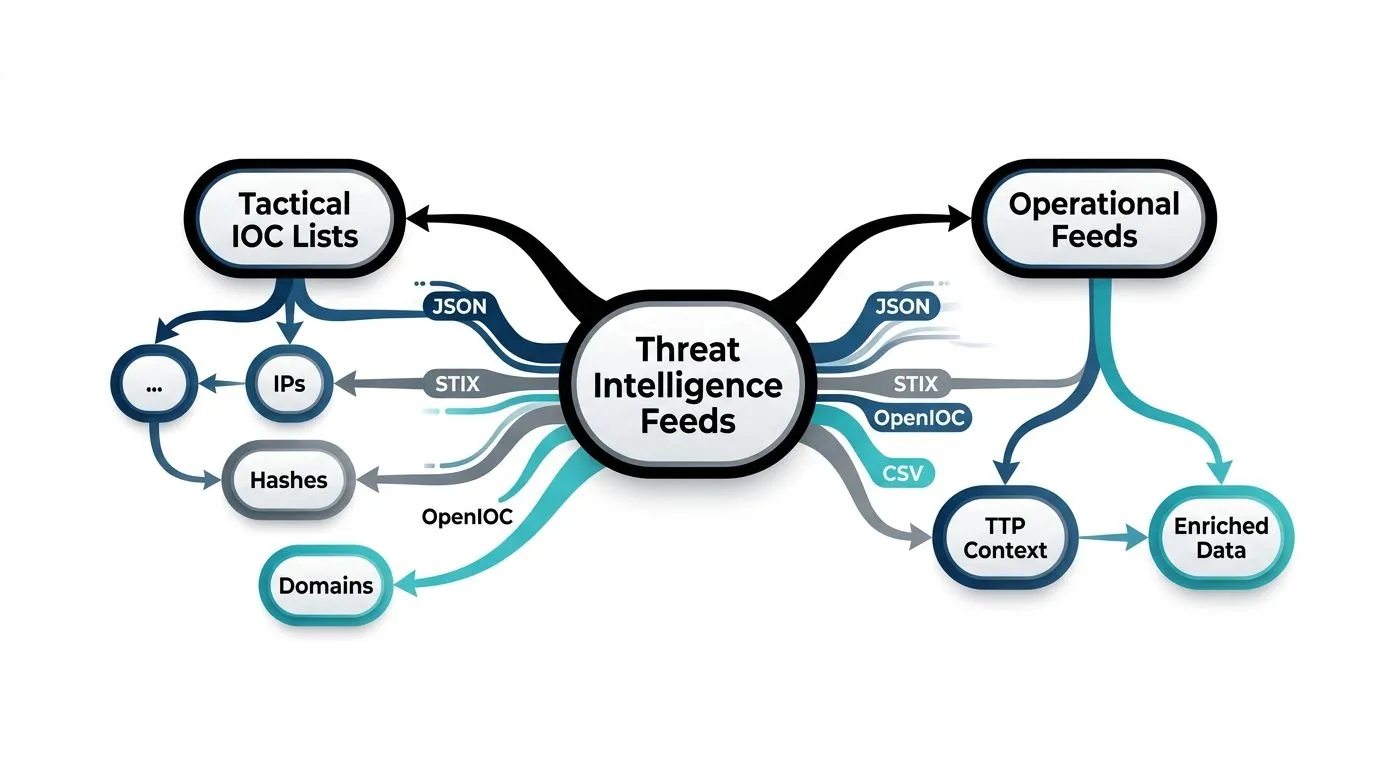
A practical way to classify feeds is by what they help you do.
Tactical IOC feeds are the most common. They contain domains, hashes, URLs, and similar indicators. They’re easy to automate and well suited to SIEM correlation, EDR enrichment, and firewall blocklists. Their weakness is context. A match tells you something touched a suspicious indicator, but not always whether that activity is high priority.
Operational feeds go further. They include TTP tags, campaign labels, malware associations, sector targeting, or actor references. These are more useful for threat hunting, malware research, and building stronger correlation rules because they let analysts connect isolated events into a broader pattern.
Strategic feeds or advisories are less about direct rule matching and more about planning. They may describe adversary focus, industry risk, or vulnerability exploitation trends. They matter to CISOs, risk leaders, and compliance teams, especially when mapping threat activity to regulated environments.
Open source versus commercial feeds
The open-source versus commercial decision isn’t really about free versus paid. It’s about curation, metadata quality, and operational burden.
Open-source feeds often give strong coverage and broad community visibility. They can be valuable for research, detection prototyping, and cost-conscious programs. But teams usually need to do more manual filtering, trust validation, and lifecycle management.
Commercial feeds often provide stronger context, cleaner schemas, and better support for automation. They may include confidence scores, actor mapping, exploit relevance, or specific sector intelligence. That doesn’t mean every commercial feed is good. It means the burden often shifts from the customer doing basic cleanup to the provider doing more of it upstream.
A useful comparison looks like this:
| Feed source | Strength | Tradeoff |
|---|---|---|
| Open-source feed | Broad visibility and low entry cost | More manual validation |
| Commercial feed | Better enrichment and support | Budget and vendor review |
| Industry sharing | Sector relevance | Variable format quality |
| Internal feed | Highest environmental relevance | Limited external coverage |
Common formats security teams actually see
Data format determines how painful integration becomes.
- STIX is a structured way to represent threat information, especially when you want relationships between indicators, malware, campaigns, and actors.
- TAXII is the transport mechanism many platforms use to share STIX data.
- MISP JSON is common in intelligence-sharing communities and often carries rich community context.
- OpenIOC appears in some legacy or specialized workflows.
- CSV and flat text still show up often, especially with simpler IOC lists.
The easiest feed to ingest isn’t always the easiest feed to operationalize. Flat files are simple at the connector layer and expensive at the tuning layer.
For SIEM and XDR teams, the key question isn’t which format is best in theory. It’s which format preserves enough meaning for your detection pipeline without creating constant parser maintenance.
Implementing Ingestion and Enrichment Workflows
The biggest mistake teams make is treating feed ingestion as a one-step import. Pull data in, dump it into the SIEM, and expect better detection. That usually ends with duplicate indicators, stale entries, mismatched fields, and rising alert fatigue.
Threat intelligence feeds operate by ingesting raw data from heterogeneous sources, including honeypots, malware analysis labs, OSINT, and dark web monitoring, then normalizing and enriching it into standardized formats like STIX 2.1 and TAXII 2.0 before automated pipelines convert raw IP addresses or file hashes into actionable alerts. This normalization process is critical because it reduces noise by up to 60% in SIEM environments, according to Cycognito’s explanation of threat intelligence feeds.
For teams thinking about the enrichment layer beyond security-specific tooling, Streamkap’s real-time data enrichment offers a useful way to think about how streaming context changes downstream decisions.
A strong workflow also depends on clean event collection from the rest of the environment. That’s why centralized telemetry matters. Centralized log management gives enrichment and correlation a single place to work from.
A practical ingestion pipeline
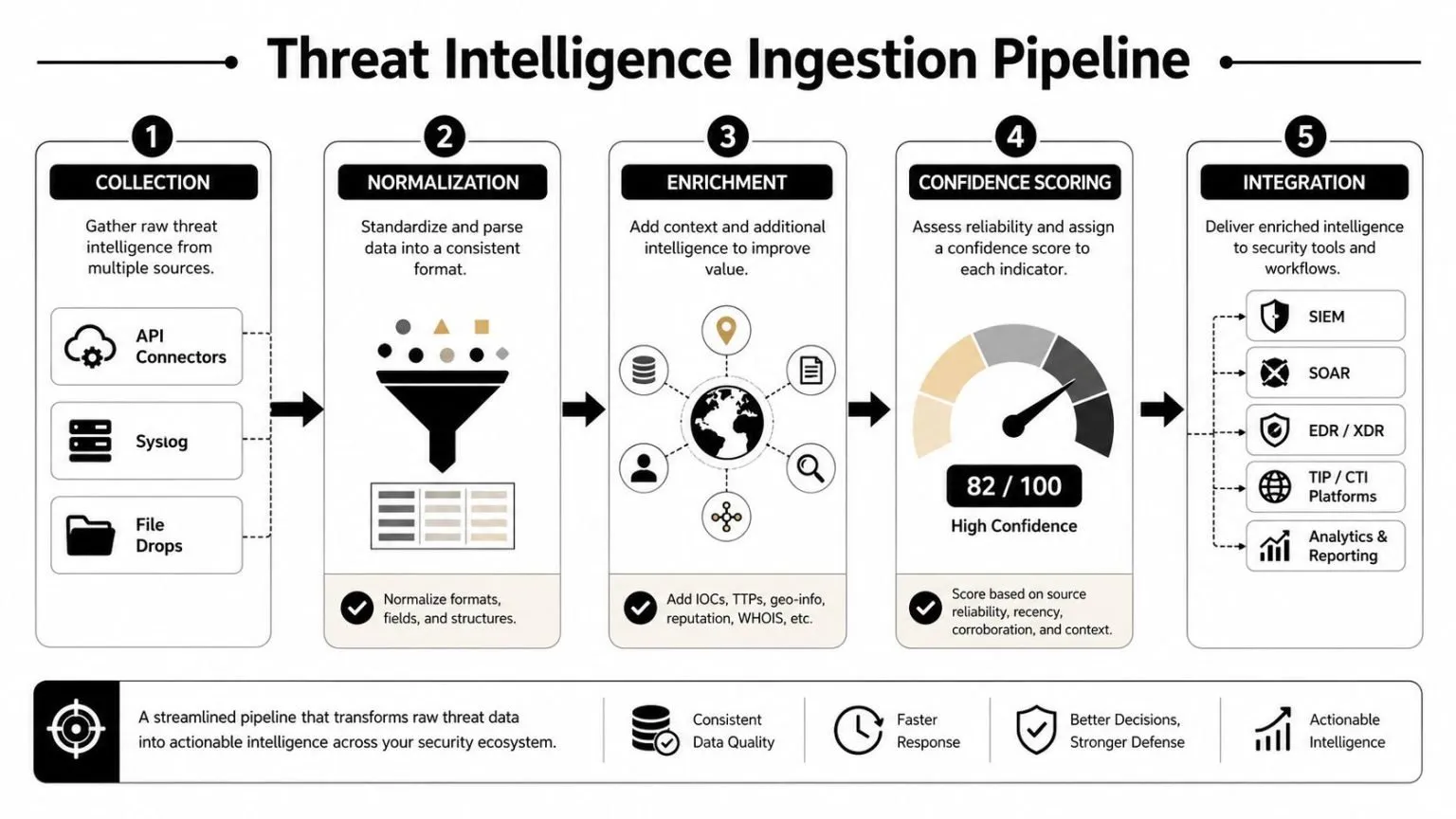
A production-friendly pipeline usually has five stages.
- Collection
Pull feeds through API connectors, TAXII clients, file drops, or scheduled fetchers. At this stage, reliability matters more than elegance. You want retries, source health checks, and clear failure logs. - Normalization
Convert source fields into a common schema. Standardize timestamps, indicator types, confidence labels, and source attribution. Many detection headaches are either prevented or created at this stage. - Enrichment
Add useful context. Link indicators to asset criticality, geography, threat families, business units, exposed services, or prior case history. An indicator seen on a test workstation and the same indicator seen on a domain controller don’t mean the same thing. - Scoring and filtering
Decide what should be actionable now, what should be retained for hunting, and what should be suppressed. Confidence, recency, source reliability, and relevance to your environment should all be considered at this stage. - Integration
Send the curated result into SIEM, XDR, SOAR, ticketing, and response playbooks. Don’t send every raw feed object into every control. Match the output to the control’s purpose.
Where enrichment turns data into context
Enrichment is where a feed stops being just a list.
Suppose the feed says a domain is malicious. Useful, but incomplete. If enrichment adds that the domain is associated with credential phishing, that your finance users have recently accessed related content, and that the indicator belongs to an active campaign affecting your sector, triage changes immediately.
Security teams often enrich with:
- Asset context to identify whether a match involves crown-jewel systems.
- User context such as department or privileged status.
- Threat context including malware family, actor association, or exploit linkage.
- Historical context like whether the indicator triggered before and how prior cases were resolved.
Field note: If enrichment doesn’t affect priority, routing, or response, it’s decoration. Keep only the context that changes action.
Why lifecycle management belongs in the pipeline
Indicators age badly. A malicious IP today may be reassigned later. A domain used briefly in a phishing campaign may go dormant. A hash may stay relevant longer, but even then the context around it changes.
That means ingestion needs expiration logic, review windows, and source-aware retention. Without those controls, yesterday’s useful feed becomes next month’s noisy feed. In open-source SIEM and XDR environments, this matters even more because teams often have more flexibility than guardrails.
A mature workflow treats freshness as part of data quality, not as an afterthought.
Integrating and Tuning Feeds in SIEM XDR with UTMStack Examples
Open-source SIEM and XDR environments are powerful because they let teams shape the workflow around their environment instead of the other way around. They also expose every weak assumption. If your feed quality is poor, your correlation logic is loose, or your enrichment is thin, the platform will faithfully amplify those problems.
A realistic integration example
Take a mid-sized SOC monitoring cloud workloads, endpoints, identity logs, and email telemetry. The team ingests a commercial phishing feed, a community malware hash feed, and an internal watchlist built from prior incidents. In UTMStack, the first step isn’t to enable blanket matching across all sources. It’s to map fields into a schema the platform can correlate consistently.
That mapping usually includes indicator type, source name, confidence, first seen, last seen, expiration, and any contextual tags. If one source labels confidence as “high” and another uses integers or plain text notes, the team has to normalize that before rule logic becomes reliable.
After mapping, analysts create targeted correlation rules. A domain match in web logs might generate enrichment only. The same domain match paired with a suspicious mailbox event or endpoint execution chain might generate a high-priority alert. A hash seen in endpoint telemetry might trigger a containment playbook only when the host is tagged as production or the associated process lineage looks abnormal.
A threat intelligence feed earns its keep not at ingestion time, but at decision time.
How to tune correlation without drowning analysts
Many teams start with “if indicator matches, alert.” That’s understandable and usually wrong. A better model is layered correlation.
Use one rule for simple enrichment. It marks events with feed context and stores the evidence for search. Use another for compound detections. That second rule fires only when the intelligence match appears alongside another suspicious condition such as unusual authentication behavior, suspicious process ancestry, or a critical asset tag.
A useful tuning pattern looks like this:
| Rule pattern | Best use | Risk if overused |
|---|---|---|
| Match only | Fast tagging and hunting pivots | Too many low-value alerts |
| Match plus asset criticality | Prioritized response | Misses lower-tier hosts used for staging |
| Match plus behavior | High-confidence detections | More engineering effort |
| Match plus repeated sightings | Noise control | May delay first-response action |
This tuning model works especially well in XDR because signals from endpoint, identity, cloud, and network sources can support one another. A lone match may mean little. A cross-domain pattern means much more.
Using AI assisted triage carefully
UTMStack includes integrated large language model support for triage and rule assistance. Used well, that can help analysts summarize related alerts, identify obvious overlaps, and speed case review. Used poorly, it can give teams a false sense that the feed itself is accurate.
The right approach is to let AI assist with interpretation, not with blind trust. For example, if a correlation rule joins a domain hit, an endpoint event, and a suspicious mailbox action, the model can summarize the chain and suggest investigative next steps. It shouldn’t be the sole mechanism deciding whether a raw indicator is safe to auto-block.
Treat AI triage as a junior analyst that works fast and needs supervision. It can reduce friction. It shouldn’t replace validation on high-impact actions.
A practical workflow inside UTMStack might look like this:
- Connector stage pulls external feeds and internal watchlists on schedule.
- Normalization stage maps source-specific fields into shared IOC fields.
- Correlation stage joins those fields with logs from endpoints, identity providers, cloud services, and secure email tools.
- Triage stage uses platform automation and AI assistance to cluster related events.
- Response stage opens a case, triggers a playbook, or updates a dashboard depending on confidence and asset impact.
That sequence is especially helpful for regulated teams. In healthcare, a feed match tied to access anomalies around protected systems may deserve immediate escalation under HIPAA-aligned workflows. In finance, GLBA and PCI-sensitive assets may warrant tighter confidence thresholds before automation. In government contractor environments, CMMC-minded teams may prefer stronger evidence chains and audit-friendly case histories over aggressive blocking.
The point isn’t to make every feed action automatic. The point is to make every feed action deliberate.
Evaluating Feeds with Metrics and KPIs
Security teams can tell you which feeds they subscribe to. Fewer can explain which ones consistently improve detection quality. That’s the gap metrics should close.
In 2023, 57.8% of organizations used threat intelligence to prioritize vulnerabilities and exposures, while 57.0% used it to improve SOC and SIEM performance, according to Recorded Future’s state of threat intelligence findings. Those numbers are useful not as proof that any specific feed is good, but as a reminder that feed value should be measured against concrete operational outcomes.
What to measure first
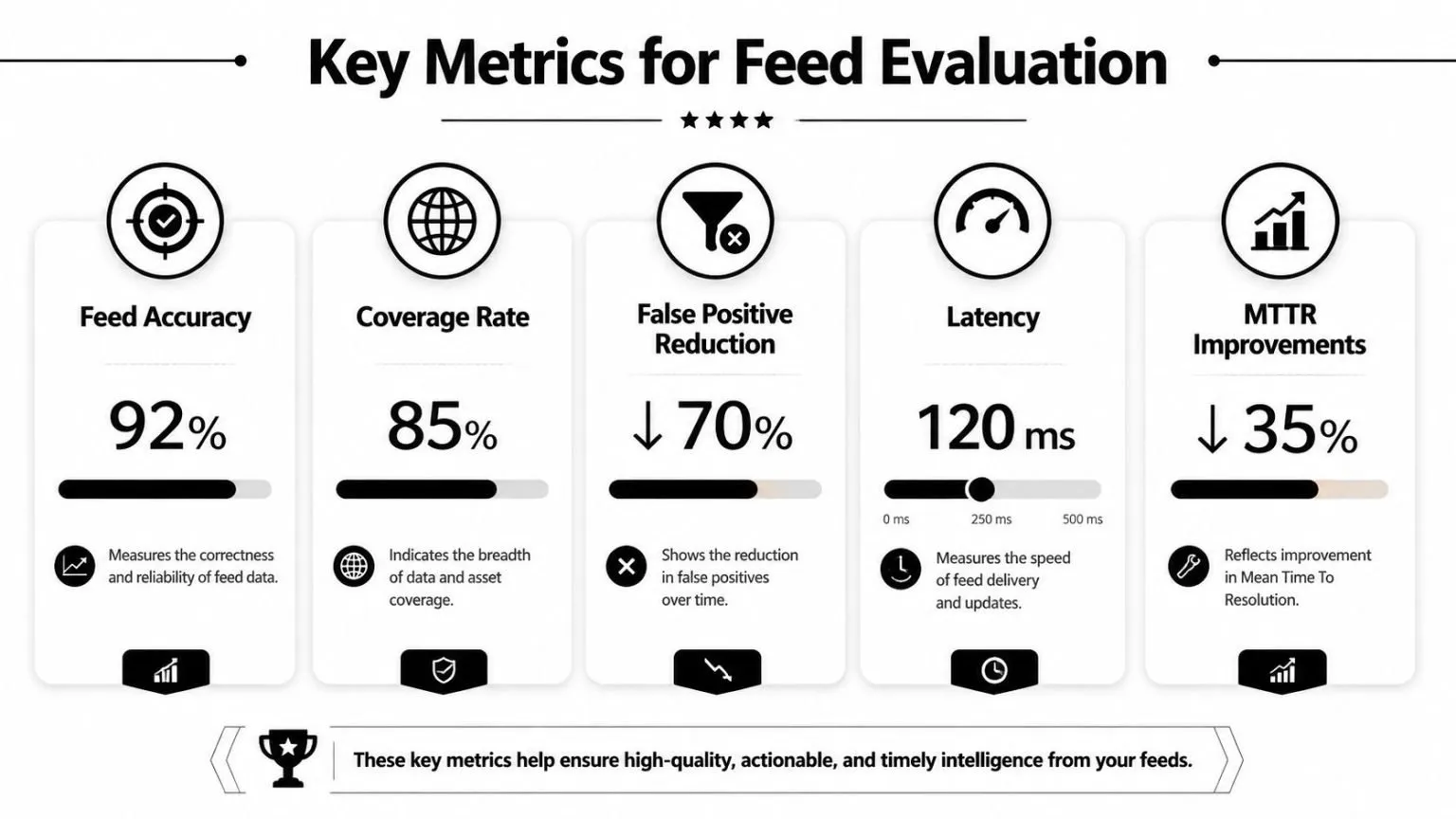
Start with five practical KPIs.
- Feed accuracy means how often a match produces something useful.
- Coverage rate means whether the feed helps across your actual attack surface, not just in one log source.
- False positive reduction asks whether tuning and enrichment are reducing wasted analyst effort.
- Latency measures how quickly fresh intelligence becomes searchable and actionable.
- MTTR improvement asks whether cases influenced by feed context move faster from alert to containment.
Notice what isn’t on the list. Feed volume. More indicators don’t automatically mean better protection.
How to score a feed in practice
A workable evaluation process is simple enough to run every month.
- Sample alerts influenced by the feed.
- Separate enrichment-only matches from cases that changed analyst action.
- Review suppressions and expired indicators.
- Compare performance by source, indicator type, and rule path.
- Retire feeds that create work without improving decisions.
You can also maintain a short scorecard:
| KPI | What good looks like |
|---|---|
| Accuracy | Analysts trust matches often enough to act on them |
| Coverage | Relevant detections appear across key systems |
| Latency | Fresh intelligence reaches detections quickly |
| Noise control | Alert quality improves after filtering and expiry |
| Response value | Cases move faster with less manual look-up |
Good feed metrics focus on analyst decisions, not vendor promises.
If your dashboards can’t show which feed tags appeared in high-value cases, which sources generated repetitive false positives, and which indicator types aged out quickly, you’re not really evaluating the feeds. You’re counting them.
Overcoming Common Challenges and Best Practices
Threat intelligence feeds usually fail in ordinary ways. The indicators are noisy. The metadata is uneven. The expiration logic is weak. The integration looks complete on paper but doesn’t reflect how analysts investigate alerts.
One of the most important operational risks is IOC lifecycle decay. Outdated indicators can trigger false positives because many open-source sources don’t clearly document lifecycle management or confidence scoring for automated blocking, as noted in Doppel’s discussion of threat intelligence feed risks.
The three problems that break most feed programs
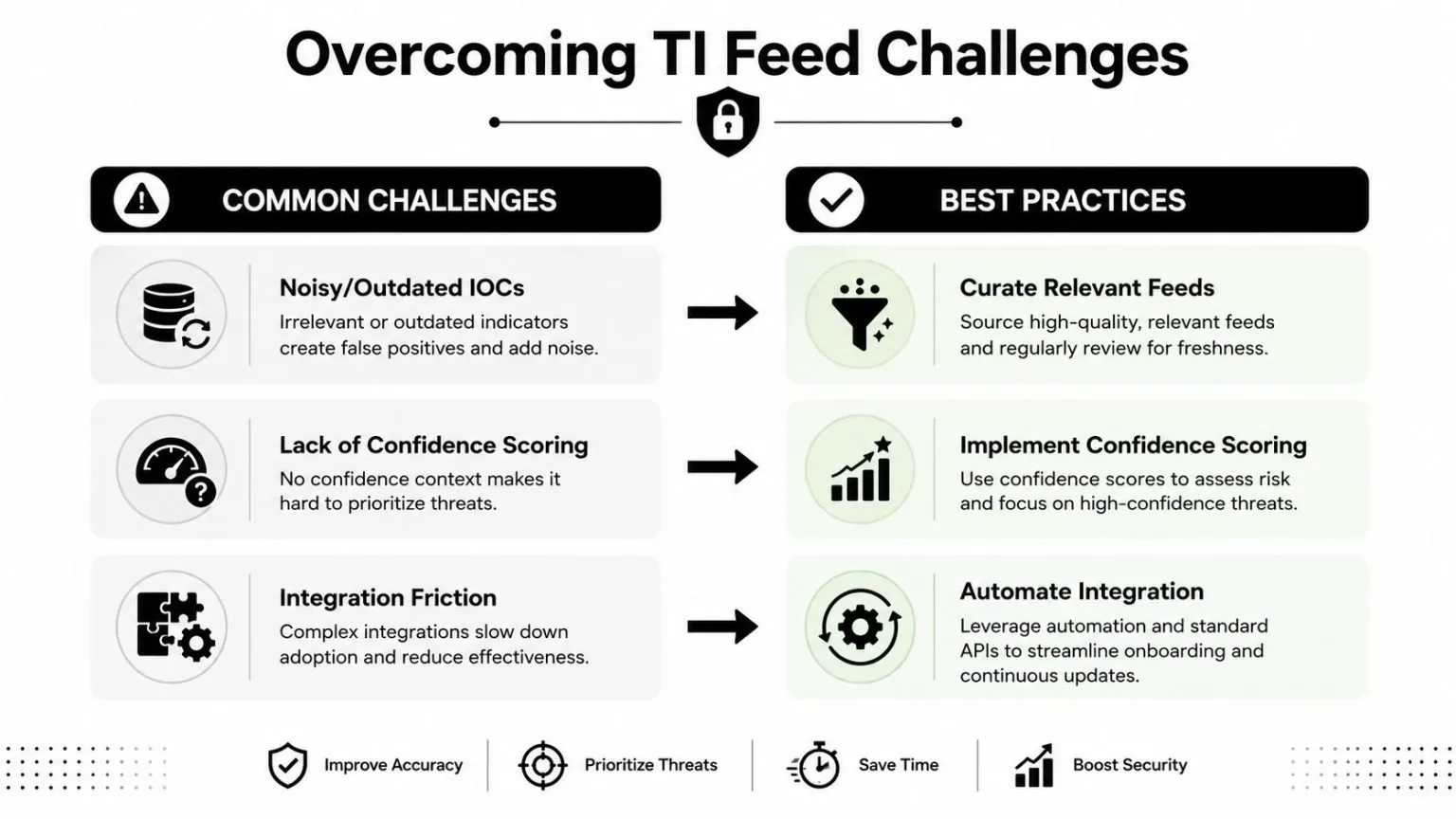
The first problem is stale indicators. Teams ingest them once and keep matching on them forever. That creates recurring low-value hits and eventually conditions analysts to ignore the feed.
The second is missing confidence context. If a source doesn’t tell you how reliable or recent an indicator is, your automation has no guardrails. That is survivable for enrichment. It’s dangerous for blocking.
The third is integration friction. Different schemas, duplicate objects, and parser drift make the feed look more mature than it is. The connection exists, but the operational quality doesn’t.
Best practices that hold up in production
The strongest programs don’t chase maximum volume. They curate for relevance.
- Curate by environment: If your estate is cloud-heavy and identity-centric, favor sources that improve cloud, email, and authentication detections rather than feeding every possible network IOC into the stack.
- Expire aggressively: Tactical indicators should not live indefinitely. Build expiration and review logic into the pipeline.
- Separate use cases: Use some feeds for enrichment only, others for alerting, and a much smaller set for automated blocking.
- Weight by asset criticality: A hit on a sensitive server, payment workflow, or privileged identity should rank differently than a hit on a disposable test asset.
- Feed back analyst outcomes: If analysts repeatedly mark a source as noisy, update suppression logic or retire the source.
A mature team also distinguishes between collection confidence and response confidence. A feed may be credible enough to annotate an event, but not credible enough to trigger a quarantine or firewall block on its own.
The best feed policy is selective trust. Start with enrichment. Promote to detection only after the source proves it helps.
Governance for long term feed quality
Feed quality doesn’t stay fixed. New providers appear, older lists decay, attacker infrastructure changes, and your own environment evolves. Governance keeps the program from drifting.
Set clear ownership for these questions:
- Which team approves a new feed?
- What minimum metadata does it need?
- How long are indicators retained?
- Which use cases allow automation?
- When does a feed get downgraded or removed?
That governance should connect to compliance and audit needs too. If your organization maps detections and evidence to HIPAA, GLBA, PCI, ISO 27001, SOC 2, or CMMC workflows, you need documented logic for why a feed was trusted, how it influenced a decision, and when it was retired. Good governance doesn’t slow security down. It keeps the intelligence layer from becoming an undocumented source of risk.
Conclusion and Next Steps
A threat intelligence feed is only valuable when it improves a real workflow. That can mean better SIEM correlation, cleaner XDR triage, sharper vulnerability prioritization, faster malware investigation, or more defensible response decisions. The mechanics matter. Feed type, format, normalization, enrichment, lifecycle handling, and KPI review all shape whether the result is signal or noise.
Often, the most effective next move is small and specific:
- Pick one feed with a clear use case.
- Normalize it into a common schema.
- Use it for enrichment before full alerting.
- Add expiry and confidence handling early.
- Measure whether it changes analyst decisions.
That approach works better than dumping multiple feeds into production and hoping the platform sorts it out. Security operations improves when intelligence is operationalized carefully, not when it is collected aggressively.
If you’re building an open-source SIEM, SOAR, or XDR program and want a unified way to ingest telemetry, correlate feed data, automate response, and support compliance workflows, UTMStack is worth evaluating. It brings together detection, response, log management, and compliance support in one platform for hybrid environments, which makes it a practical home for turning threat intelligence into day-to-day security operations.