
You’re probably dealing with the same problem most security teams have in 2026. The scanner isn’t the issue anymore. The issue is deciding what deserves action first, who owns remediation, and how any of it maps back to HIPAA, PCI, GLBA, ISO 27001, or CMMC evidence when the auditor shows up.
That’s why shopping for vulnerability management tools has gotten harder, not easier. The market is large, crowded, and still growing. The broader vulnerability management market was valued at about USD 15.9 billion in 2023 and is projected to reach USD 34.7 billion by the end of 2032, with growth driven by the rising frequency and complexity of cyber threats, according to Global Market Insights. Buyers aren’t looking for another dashboard. They’re looking for integration, prioritization, and proof that findings get fixed.
The pressure is operational too. The average window between disclosure and exploit activity has shrunk from 45 days to 15 days over the past decade, according to Gartner data cited by Recorded Future. That changes the buying criteria. Continuous assessment, automation, and tight coupling with SIEM, XDR, ticketing, patching, and SOAR are no longer nice extras.
If you’re comparing top vulnerability management solutions, the useful question isn’t “which scanner finds the most CVEs?” It’s “which platform fits my operating model?” A CISO, an MSSP, a compliance officer, and a SOC lead won’t judge the same tool the same way.
1. UTMStack
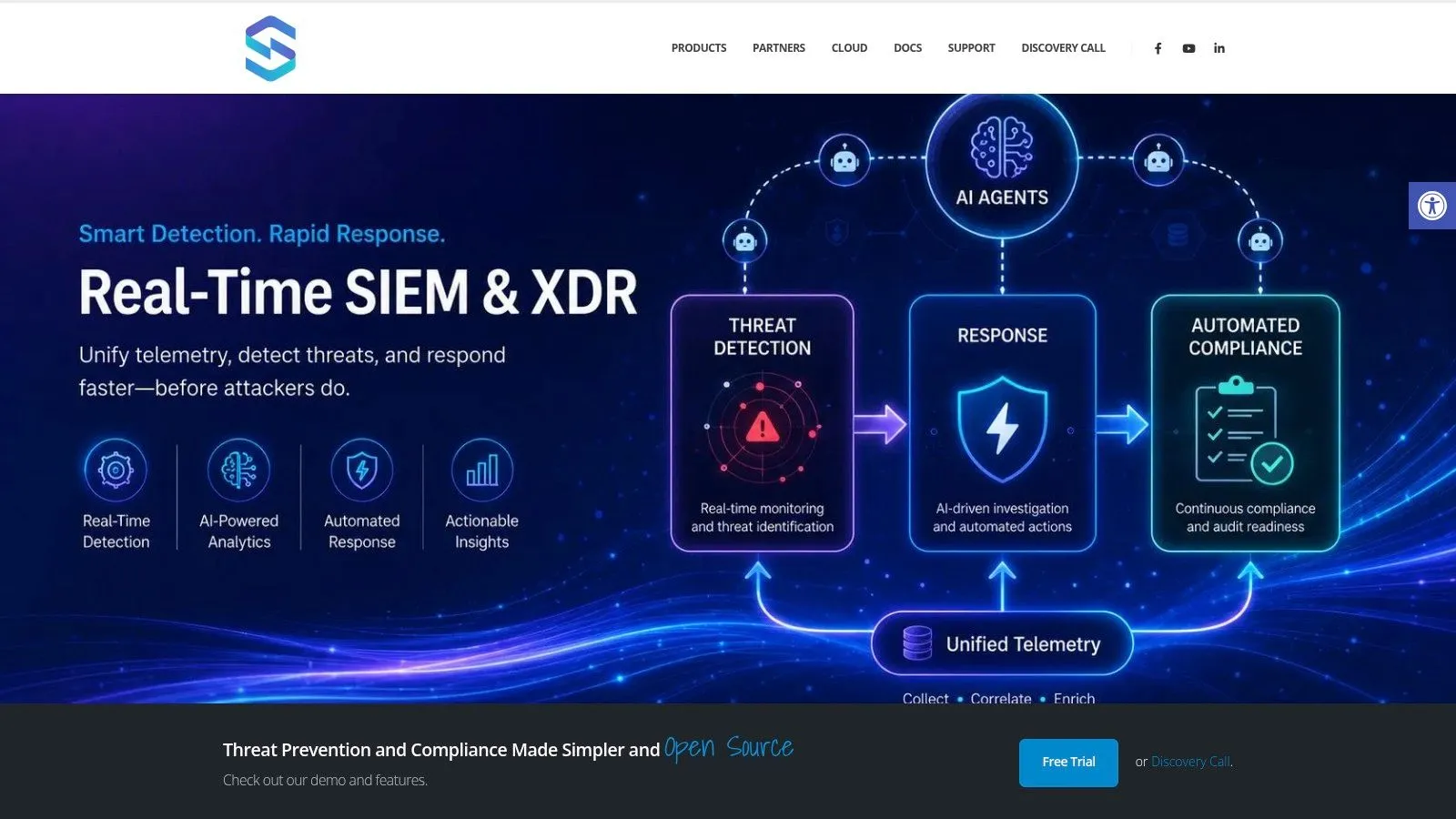
UTMStack is the most interesting option in this list if you’re tired of bolting together separate products for SIEM, SOAR, XDR, log management, vulnerability scanning, and compliance reporting. It’s built as a unified stack for hybrid environments, and that matters because most remediation delays don’t come from missed detection. They come from fragmented ownership across endpoint, cloud, network, and identity teams.
UTMStack’s architecture is what makes it stand out. Its correlation engine works before indexing, which helps reduce noise and control indexing overhead while still supporting real-time detection and response. In practice, that changes analyst workflow. Teams spend less time paging through duplicate alerts and more time moving incidents into a response path that can be automated.
Why UTMStack stands out
The modular stack covers log management, vulnerability scanning, access-rights auditing, endpoint protection/XDR, dark-web monitoring, and file tracking. Data ingestion supports APIs, Syslog, NetFlow, and agents, so it fits mixed estates instead of assuming everything lives in one cloud or one endpoint platform. If you need a practical primer on scanner coverage, UTMStack’s own overview of vulnerability scanning is a useful starting point.
Its compliance angle is stronger than many scanner-first tools. Built-in workflows map detections and evidence to CMMC, HIPAA, SOC 2, ISO 27001, PCI, GDPR, and GLBA. That’s valuable for compliance officers who don’t want to manually collect screenshots from five consoles every quarter.
Practical rule: If your team already runs a SIEM, opens tickets in another platform, handles endpoint context elsewhere, and exports compliance evidence by hand, a unified platform can remove more risk than a scanner upgrade.
There’s also a modern SOC usability angle. Integrated LLM features assist with triage, rule tuning, and false-positive reduction. That won’t replace experienced analysts, but it can shorten the path from raw finding to meaningful action.
Who should choose it
UTMStack fits three personas especially well:
- CISOs in regulated sectors: The built-in compliance mapping helps turn detection and remediation activity into evidence for HIPAA, PCI, GLBA, ISO 27001, SOC 2, and CMMC.
- MSSPs and MSPs: The platform’s breadth supports multi-tenant service delivery better than point products that require a separate console for each function.
- Security architects: It’s a strong option when the primary requirement is integration across SIEM, SOAR, XDR, and vulnerability management, not just another scanner.
The trade-off is straightforward. Powerful open-source platforms need tuning, operational ownership, and staff who understand detection engineering and workflow design. UTMStack also doesn’t publish public pricing, so buyers need a demo, trial, or sales conversation to understand support and deployment costs. Still, if you want vulnerability management tools that function inside a broader detection and response architecture instead of beside it, UTMStack deserves serious consideration.
2. Tenable Vulnerability Management
Tenable Vulnerability Management is the conservative enterprise choice, and that isn’t criticism. A lot of teams want mature scanning, familiar workflows, and broad ecosystem support. Tenable delivers that, especially for organizations that already trust the Nessus lineage.
That heritage matters in the market too. Nessus leads adoption among global businesses at 68%, according to Business Research Insights. That doesn’t automatically make Tenable the best fit for every environment, but it does explain why so many enterprises treat it as the baseline against which everything else gets measured.
Where it fits best
Tenable works well for heterogeneous environments that need continuous assessment across servers, endpoints, and network devices without betting everything on one endpoint vendor or one cloud-native architecture. Its dashboards, analytics, and APIs make it workable for teams that need integration into ITSM, SIEM, and SOAR. If you’re comparing established scanners more broadly, this roundup of vulnerability scanning tools is a useful companion.
For CISOs, the appeal is predictability. Tenable is easy to defend in procurement meetings because most buyers and auditors already know the brand. For security operations teams, the benefit is mature coverage and documented integration paths.
The downsides are familiar too:
- Pricing is quote-based: Budget planning takes vendor engagement.
- The UI can feel dense: Mature platforms often accumulate complexity over time.
- Remediation still depends on your surrounding stack: Discovery is strong, but operational closure usually needs ticketing, patching, and ownership discipline outside the scanner.
Tenable is a strong fit when you want a well-established vulnerability management platform that won’t surprise experienced operators. It’s less compelling if your main pain point is end-to-end remediation orchestration rather than scanning depth.
3. Qualys VMDR with TruRisk
Qualys VMDR with TruRisk usually enters the conversation when a security program has already outgrown point scanners. A common scenario is a global enterprise with internet-facing assets, roaming endpoints, cloud workloads, and audit pressure from several directions at once. In that environment, Qualys appeals to teams that want asset discovery, vulnerability assessment, prioritization, and response tied together in one platform.
Qualys is strongest when asset inventory accuracy matters as much as raw scan coverage. If the CMDB is stale or business units deploy systems outside normal change control, VMDR gives security teams a way to find what exists first and argue about ownership second. That changes the conversation for CISOs, because board reporting becomes less about total findings and more about whether the organization can trust the exposure picture.
TruRisk is part of that appeal. It gives teams a way to rank findings beyond base severity, which helps when patch windows are limited and every queue is already overloaded. Compliance officers also get value here, because the same platform can support control evidence, exception tracking, and audit-oriented reporting without forcing exports into three other tools.
The operational trade-off is real. Qualys covers a lot, but breadth creates administration overhead. Teams still need to tune asset tagging, scanner placement, exclusions, and remediation workflows or they end up with a large backlog that is technically prioritized but still hard to action.
For MSSPs, Qualys can work well in multi-client programs that need consistent assessment and reporting across mixed environments. The challenge is integration discipline. If the service model depends on pushing prioritized findings into a SIEM, SOAR, or ticketing stack, the value comes from how cleanly Qualys fits that process, not from scan data alone. That is also where unified platforms such as UTMStack can matter. They give operators a place to correlate vulnerability context with detections, asset telemetry, and response activity instead of treating VM as a separate reporting lane.
Qualys is a good fit for enterprises that want one platform to support exposure management, remediation coordination, and compliance reporting at scale. It is less attractive for teams that want a lightweight deployment, simple packaging, or fast time to value with minimal tuning.
4. Rapid7 InsightVM
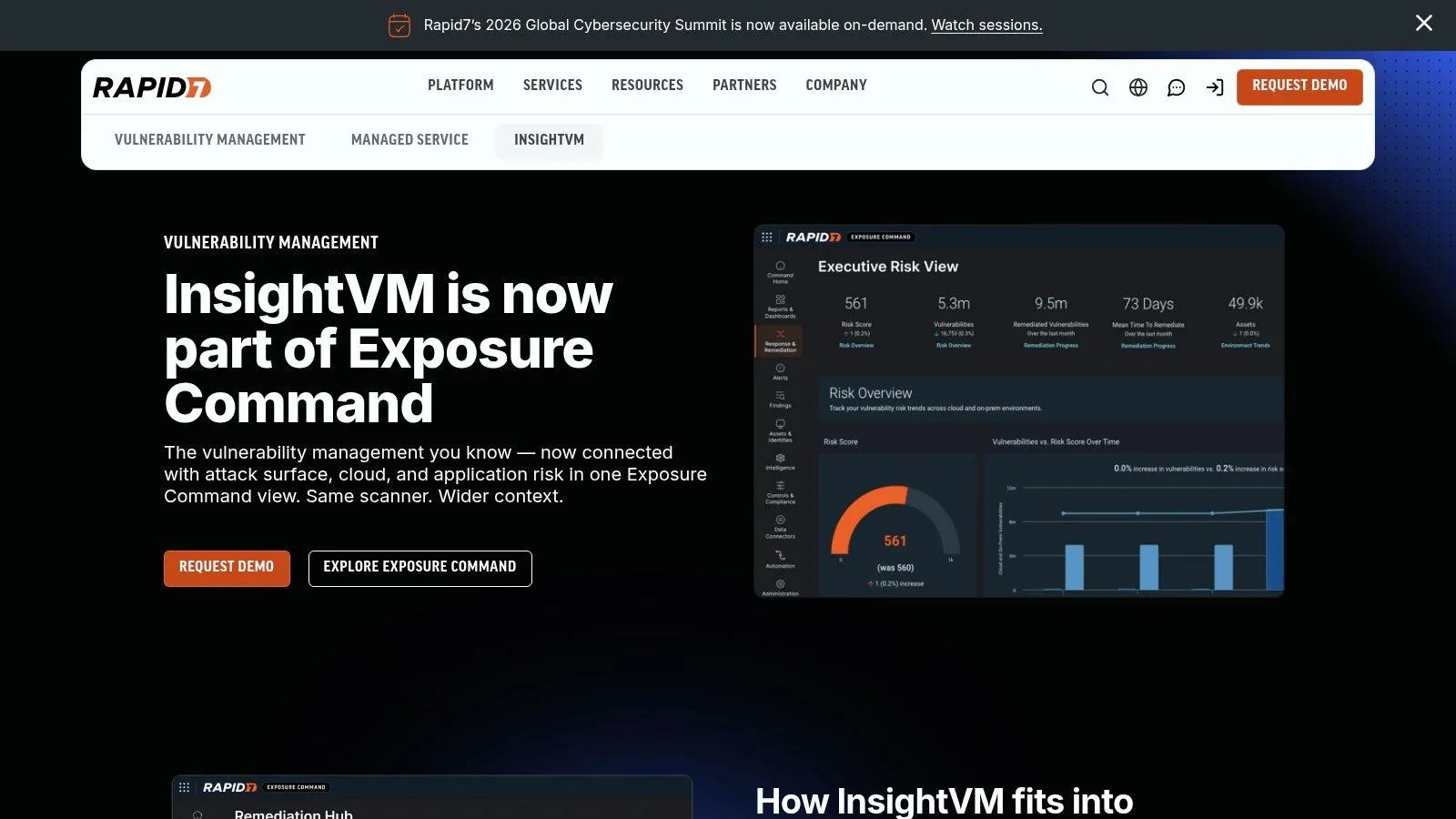
Rapid7 InsightVM works best when the security team cares as much about closing findings as it does about collecting them. That’s where Rapid7 has long had an edge. The product is built around live dashboards, remediation projects, and integration with broader operational workflows rather than treating scanning as the finish line.
The industry’s biggest weakness isn’t always visibility; it’s follow-through. One underserved reality in current vulnerability management is the remediation black hole. Organizations often struggle to move from alert to patch because ownership, ticketing, verification, and closure are split across too many systems, as discussed by CyCognito.
Best fit for remediation-driven teams
InsightVM is a strong fit for teams that already use Jira, ITSM queues, and cross-functional remediation sprints. Its integration with Metasploit intelligence and internet telemetry adds useful context, but a key differentiator is how naturally it supports conversations between security and infrastructure teams.
Rapid7 also tends to be easier to pilot than many quote-only enterprise competitors. That matters for mid-market buyers and MSSPs testing a service offering before standardizing.
A few trade-offs show up in real deployments:
- Remediation workflows can still get messy at scale: Tooling helps, but ownership discipline still matters.
- It’s strongest when paired with the wider Insight platform: Buyers may get more value if they already use adjacent Rapid7 products.
- Segmented networks still require planning: On-prem scan engines solve this, but they add architecture work.
For security leaders who want vulnerability management tools to feed real remediation programs instead of generating static reports, InsightVM is usually on the shortlist for good reason.
5. Microsoft Defender Vulnerability Management
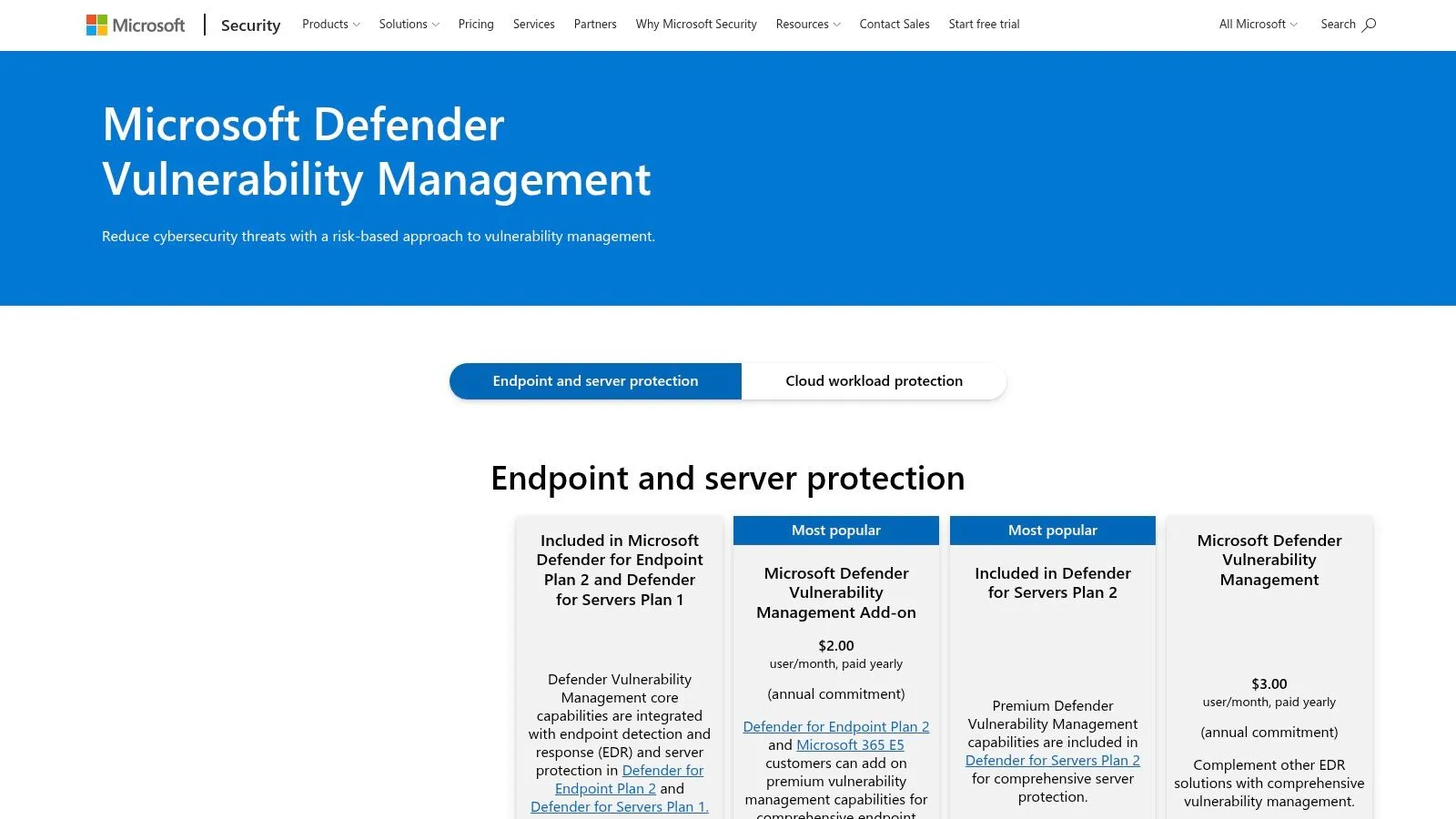
A common scenario looks like this. The SOC already works in Microsoft Defender XDR, identity teams live in Entra, and endpoint operations depend on Defender for Endpoint. In that environment, Microsoft Defender Vulnerability Management usually wins because it adds exposure visibility inside tools the team already uses, instead of forcing another console, another agent, and another integration project.
That matters to different buyers for different reasons. CISOs get tighter alignment between vulnerability data, endpoint telemetry, and identity context. Compliance officers get a clearer path to show remediation status against managed assets. MSSPs can use it effectively for Microsoft-heavy clients, but they also need to be honest about tenant boundaries, reporting expectations, and how much of the customer estate sits inside the Microsoft stack.
Best fit for Microsoft-first security programs
MDVM is strongest when the endpoint estate is already instrumented with Microsoft security controls. Security teams can prioritize weaknesses using device exposure data, see relevant recommendations in the same administrative plane as incident investigation, and hand remediation work to endpoint teams without building a separate scanner workflow from scratch.
The trade-off is coverage depth outside that ecosystem.
- Best visibility comes from Microsoft-controlled telemetry: Windows and Microsoft-managed endpoints are the cleanest fit.
- Heterogeneous environments need extra design work: Linux, macOS, network appliances, cloud-native assets, and third-party applications may require supplementary tooling or process adjustments.
- Service providers need to plan around operations, not just features: Multi-tenant reporting and cross-client standardization are easier in platforms built for broad estate aggregation, including unified approaches such as UTMStack.
MDVM works well as part of an XDR-led operating model. It is less convincing as the only vulnerability management layer for organizations with large non-Microsoft estates. For teams already committed to Microsoft security, though, it can reduce friction, improve analyst context, and keep remediation discussions closer to the systems where security and IT already work.
6. CrowdStrike Falcon Spotlight
A common scenario looks like this. The SOC already runs Falcon on thousands of endpoints, the CISO wants vulnerability data tied to active threat activity, and the IT team has no appetite for standing up another scanning program that will create credential, scheduling, and ownership debates.
CrowdStrike Falcon Spotlight fits that environment well. It uses the Falcon sensor to assess software exposure continuously, which keeps vulnerability triage close to the same console many analysts already use for detection and response.
That matters for more than convenience. For a CISO, Spotlight can reduce tooling sprawl and keep exposure reporting closer to operational reality on managed endpoints. For MSSPs, it works best in customer estates that are already standardized on Falcon, because analyst workflow, telemetry, and response actions stay in one vendor stack. For compliance officers, the value is more limited unless the organization can also prove remediation ownership and exception handling outside the Falcon interface.
Best fit for endpoint-led security operations
Spotlight is strongest in programs where endpoint telemetry is the main source of truth. Analysts can see vulnerable software in the context of host activity, device posture, and threat signals instead of reviewing a separate scanner report that lacks endpoint context.
The trade-off is scope.
Spotlight is less persuasive as the only vulnerability management layer for organizations that need broad coverage across network devices, unmanaged assets, operational technology, or cloud-native workloads. It can tell you a lot about systems with the Falcon agent installed. It tells you much less about the assets that never made it into the agent deployment plan in the first place. That gap matters to compliance teams and service providers that need estate-wide reporting, not just strong endpoint visibility.
Architect’s note: Scan-less assessment cuts operational overhead, but patch ownership, maintenance windows, compensating controls, and exception reviews still determine whether risk actually goes down.
Commercially, Spotlight also makes the most sense as part of a broader Falcon purchase. Teams that already use Falcon for EDR or XDR usually have a cleaner justification because the integration value is immediate. Teams evaluating it as a standalone product should compare that convenience against platforms built to aggregate findings across mixed tools and tenants, including unified approaches such as UTMStack.
If Falcon is already central to security operations, Spotlight is a practical add-on. If the estate is highly heterogeneous, it is usually one component of the program, not the whole answer.
7. Wiz Vulnerability Management
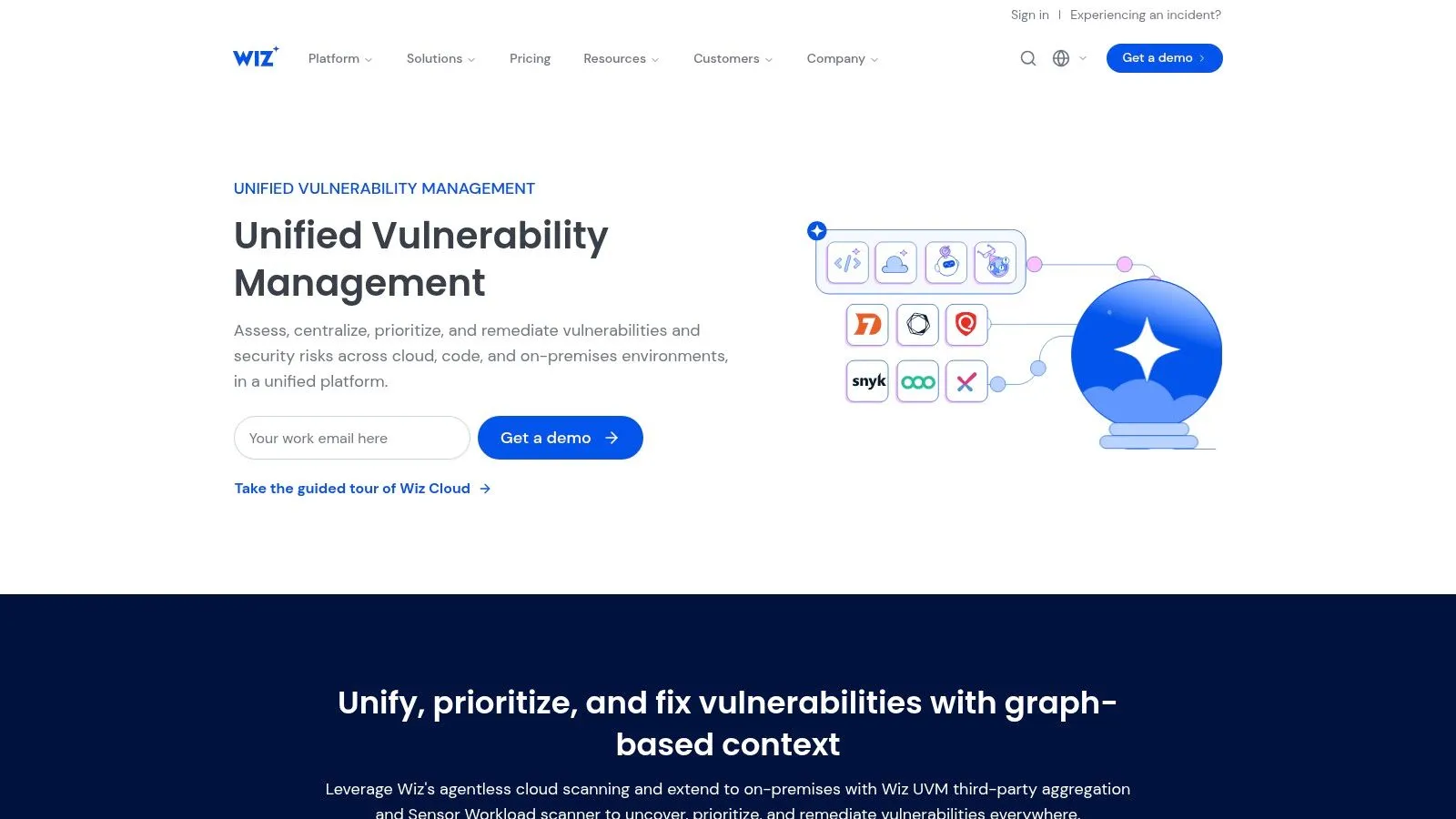
Wiz Vulnerability Management isn’t trying to be a traditional scanner with cloud support. It’s a cloud-native risk platform where vulnerability management is one part of a larger graph-based exposure model. That distinction matters.
For cloud teams, the useful question often isn’t “does this workload have a CVE?” It’s “does this vulnerable workload connect to sensitive data, privileged identities, exposed services, or a realistic attack path?” Wiz is very good at answering that.
Cloud context is the real product
Wiz suits cloud-first organizations that need quick onboarding across AWS, Azure, and GCP. Agentless-first deployment gets teams to visibility quickly, and the graph-based model is helpful for prioritizing what matters in sprawling cloud estates.
This style of prioritization is increasingly important because identity context changes vulnerability severity in practice. A host with a moderate software flaw may become urgent if it also sits on a path to privileged roles or lateral movement. That identity-vulnerability blind spot is one of the biggest gaps in mainstream vulnerability management, as discussed by Vectra AI.
Wiz is especially good for:
- Cloud security leaders: Strong context for attack path and blast-radius analysis.
- DevSecOps teams: Fast onboarding without heavy agent rollouts.
- CISOs with cloud-heavy estates: Better board-level narratives around exposure than a raw CVE list.
The trade-off is scope. Hybrid and on-prem coverage often need extra components or a second product. Wiz is excellent in cloud environments, but it isn’t a full replacement for every traditional enterprise scanning requirement.
8. Orca Security
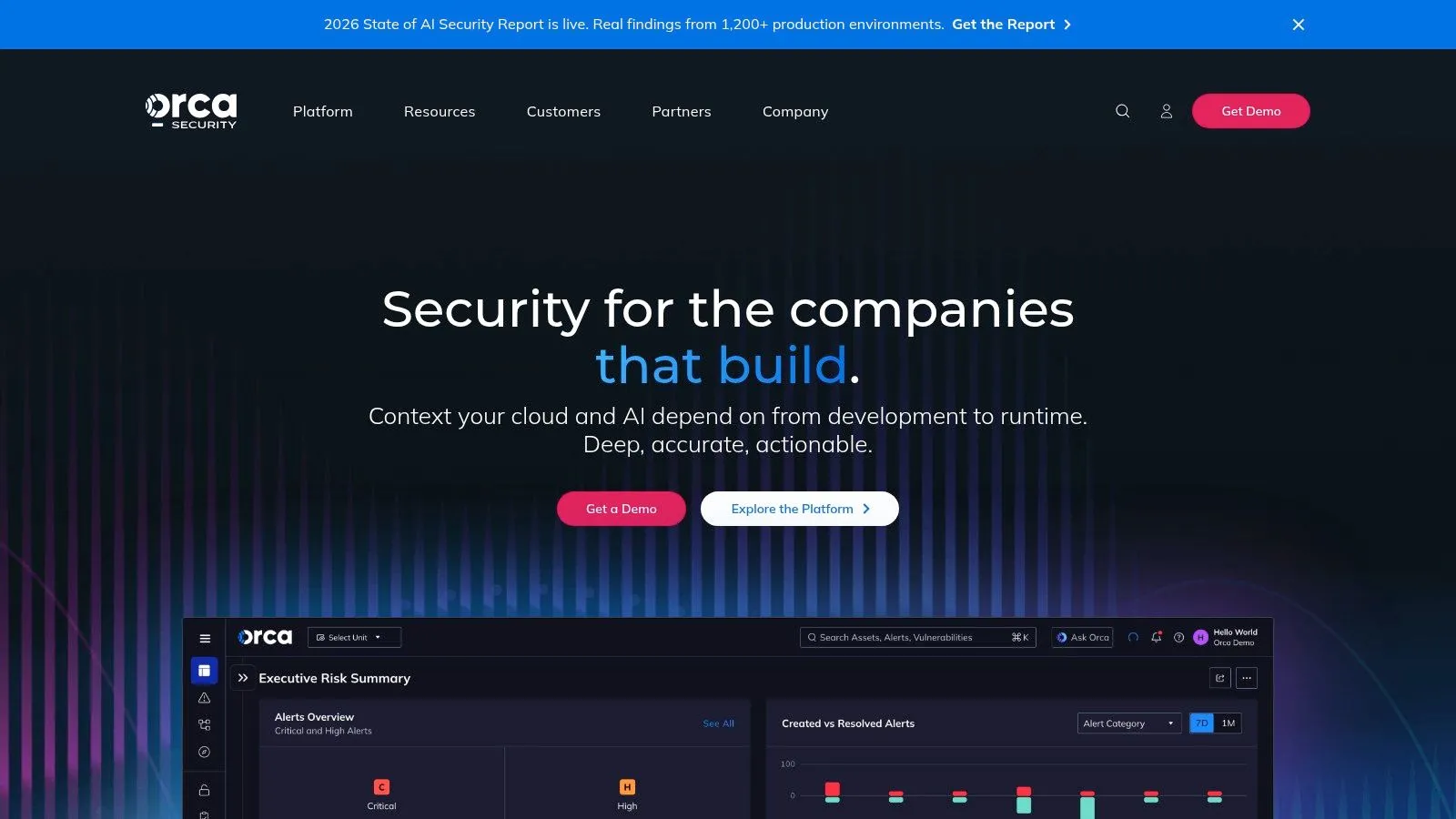
Orca Security appeals to teams that want cloud vulnerability management with as little deployment friction as possible. Agentless coverage across cloud workloads, containers, data stores, and posture issues makes it attractive for organizations that don’t want another large-scale endpoint rollout just to gain visibility.
The product’s strength is context. Orca doesn’t just enumerate vulnerabilities. It tries to show how findings intersect with exposure, privilege, and reachable paths across the cloud estate.
Best for cloud teams that want low friction
That context-first model aligns with where vulnerability management is heading. Effective tools in 2026 need threat intelligence to prioritize risks based on severity so critical threats are handled first, not processed solely by scan volume or schedule, according to Swimlane.
Orca is a good fit for organizations that need cloud coverage fast, especially when the security team has limited patience for long deployment projects. It’s also useful for compliance teams that want posture and vulnerability evidence in the same cloud security workflow.
The trade-offs are easy to state:
- Cloud-first by design: On-prem infrastructure usually needs a different approach.
- Quote-based pricing: Procurement takes a conversation.
- Best value comes from cloud concentration: The more traditional your environment, the less complete the fit.
If your biggest risk concentration sits in public cloud workloads and identities, Orca is one of the cleaner ways to get rapid visibility without agent sprawl.
9. Ivanti Neurons for Risk-Based Vulnerability Management
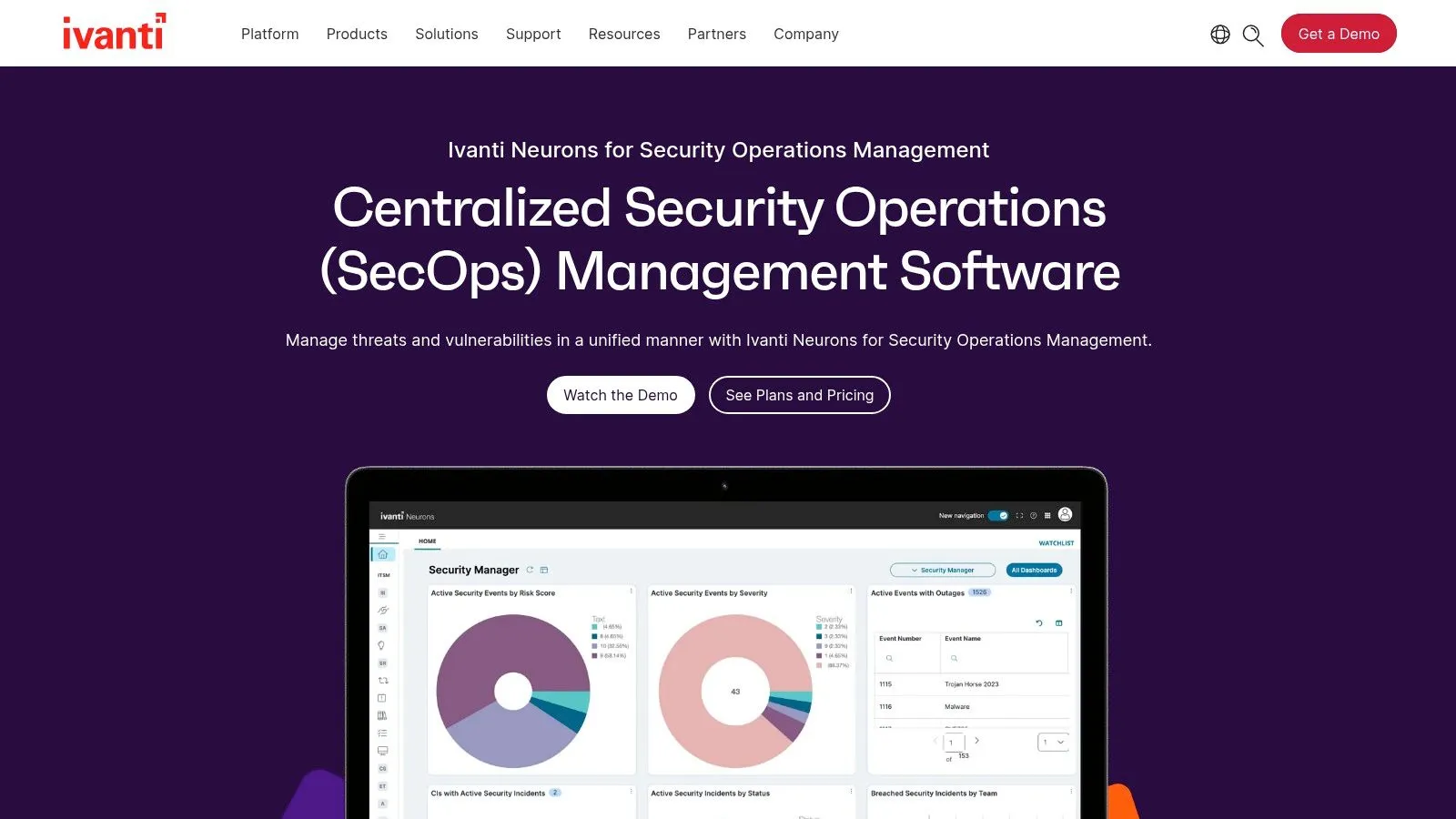
Ivanti Neurons for Risk-Based Vulnerability Management fits environments where vulnerability management has become an integration problem as much as a detection problem. Enterprises with multiple scanners, inherited tooling from acquisitions, or separate IT and security teams often need a system that can normalize findings and route action to the right operational owner.
That distinction matters by persona. A CISO usually wants one defensible risk view instead of three conflicting dashboards. A compliance officer needs evidence that findings were tracked through remediation, not just discovered. An MSSP needs tenant-by-tenant consistency without forcing every customer into the same scanner stack.
Strong fit for fragmented programs that need workflow discipline
Ivanti’s value is less about raw discovery and more about joining data, prioritization, and remediation workflows. The platform becomes more useful when it is connected to Ivanti patching, endpoint management, or service management processes, because then a vulnerability can move from finding to ticket to fix inside a linked operating model.
That is the practical trade-off.
Teams that already run Ivanti in adjacent functions can get real efficiency from that connection. Teams that want a lightweight scanner with simple packaging and minimal architecture work may find it heavier than they need. In a modern SIEM, XDR, and SOAR environment, Ivanti usually plays best as the system that translates fragmented scanner output into action, while a platform such as UTMStack can still serve as the broader analytics and response layer across security telemetry.
Its trade-offs are straightforward:
- Packaging often needs clarification: Buyers should map modules and licensing early.
- Operational alignment drives value: The product works best when IT operations will consume the outputs.
- Internal positioning takes work: The case for Ivanti is consolidation, workflow control, and remediation follow-through, not flashy dashboards.
For mature programs trying to reduce handoff friction between security, IT, and compliance, Ivanti is a credible option. For smaller teams or buyers optimizing for speed of rollout, it can feel like more platform than product.
10. ManageEngine Vulnerability Manager Plus
A common mid-market scenario looks like this: the security lead also owns endpoint tooling, patch coordination sits with IT, and the compliance officer needs evidence that issues were identified and addressed on time. In that environment, ManageEngine Vulnerability Manager Plus makes sense because it keeps scanning, prioritization, and patching close together instead of forcing a small team to stitch together three separate products.
That operating model is the primary selling point.
For CISOs in smaller organizations, the benefit is easier execution. The platform is usually simpler to budget and pilot than larger enterprise suites, which matters when security has to show progress this quarter instead of after a long procurement and integration cycle. For compliance teams, the value is straightforward reporting and clearer remediation tracking. For MSSPs, the story is more mixed. It can work for smaller customer environments, but it is not usually the first choice for providers that need broad multi-tenant scale and deep cross-client workflow control.
The trade-off is clear. ManageEngine is strongest when the program is endpoint and server focused, and when the team wants one product that can move from finding to fix with less architecture work. It is less convincing for organizations that need advanced cloud exposure analysis, identity-centric risk context, or the kind of normalization layer that feeds a larger detection and response program.
That matters in modern security operations.
If a team already runs a SIEM, XDR, or SOAR stack, ManageEngine typically fits as the vulnerability and remediation engine rather than the central analytics layer. A unified platform such as UTMStack can still provide the broader correlation point across logs, alerts, and response workflows, while ManageEngine handles day-to-day vulnerability operations for lean internal teams.
Its practical limits are easy to understand:
- Good fit for budget-conscious teams: Pricing and packaging are usually easier to explain internally.
- Best in IT-led security programs: It works well where endpoint administration and patch ownership already sit close to security.
- Less suited to cloud-first exposure management: Buyers with heavy cloud, container, or identity risk requirements may outgrow it.
For SMBs and mid-sized organizations that need a product people will deploy, maintain, and use, ManageEngine is a credible choice. It is not the broadest platform in this list, but it often matches the staffing reality better than tools built for much larger security programs.
Top 10 Vulnerability Management Tools Comparison
| Product | Focus / Coverage | Core features & unique selling points | Target audience | Pricing & licensing |
|---|---|---|---|---|
| UTMStack | Unified SIEM + SOAR + XDR for hybrid environments | Pre-ingest correlation; LLM-assisted triage; modular stack (logs, vuln scan, XDR, access audit, dark-web, file tracking); 30B+ IOC elements | Regulated orgs and teams seeking an open-source, extensible unified security platform | Open-source / Linux Foundation backed; free trial/discovery call; no public list pricing |
| Tenable Vulnerability Management | Cloud VM for on‑prem, cloud & hybrid assets | Continuous assessment; Nessus research heritage; rich dashboards & APIs | Enterprises standardizing on established VM vendors | Quote-based (no public pricing) |
| Qualys VMDR with TruRisk | End‑to‑end VMDR (discovery → remediation) | TruRisk prioritization; optional patch orchestration; unlimited virtual scanners/agents; strong compliance reporting | Large enterprises with broad estates and compliance needs | Quote-based; complex bundles |
| Rapid7 InsightVM | Cloud‑managed VM with exploit intelligence | Live dashboards & remediation projects; Metasploit telemetry integration; APIs; on‑prem scan engines | Teams valuing easy pilot/scale and Insight platform integration | Entry pricing advertised; scales to enterprise (contact sales) |
| Microsoft Defender Vulnerability Management | Endpoint‑centric VM integrated with Microsoft stack | Built‑in exposure assessment; Microsoft security benchmark reporting; native endpoint/identity integration | Organizations standardized on Microsoft 365/Defender | Included or add‑on within Microsoft licensing (E5/Defender suites); public guidance via MS docs |
| CrowdStrike Falcon Spotlight | Sensor‑driven, scan‑less VM using Falcon telemetry | Continuous real‑time visibility; ExPRT prioritization; rich endpoint context; APIs | Existing CrowdStrike Falcon customers wanting low overhead | Quote-based; typically sold as a Falcon module |
| Wiz Vulnerability Management (CNAPP) | Agentless‑first cloud VM across AWS/Azure/GCP | Agentless discovery; graph‑based risk & attack‑path analysis; broad cloud vulnerability coverage | Cloud‑native orgs seeking fast onboarding and contextual cloud risk | Quote-based; available via cloud marketplaces |
| Orca Security | Agentless cloud security and VM | Agentless scanning; unified risk graph; contextual risk scoring and compliance reporting | Teams needing rapid, low‑friction multi‑cloud visibility | Quote-based (no public pricing) |
| Ivanti Neurons RBVM | Risk‑based VM that aggregates scanners | Vulnerability Risk Score (VRS); consolidates multiple scanner feeds; patch orchestration integrations | Organizations wanting consolidated risk views and automated remediation workflows | Quote-based; packaging varies by bundle |
| ManageEngine Vulnerability Manager Plus | SMB / mid‑market all‑in‑one VM + patching | Built‑in patch management; 850+ third‑party app coverage; clear edition comparison; free edition available | SMBs and resource‑constrained IT/security teams | Transparent tiered pricing and public SKUs; free edition available |
From Data Overload to Strategic Risk Reduction
A familiar scene plays out after every major scan cycle. The dashboard is full, the exposure count is high, and every team asks a different question. The CISO wants to know what could turn into business risk this quarter. The compliance officer wants evidence that control gaps are tracked and closed. The MSSP wants to triage across tenants without burying analysts in duplicate work. The architect wants to know whether the tool can feed SIEM, XDR, SOAR, ticketing, and patch workflows without another brittle integration project.
That is the standard that matters in 2026. Vulnerability management tools are no longer judged only by detection depth. Mature buyers care about prioritization quality, ownership routing, remediation verification, and whether the platform produces reporting that works for executives, auditors, and operations at the same time.
Persona-based evaluation makes product differences clearer. A CISO usually needs risk views that reduce noise and support board-level reporting. A compliance officer needs evidence mapped to frameworks such as PCI-DSS, SOC 2, ISO 27001, HIPAA, and GDPR, preferably without exporting raw findings into spreadsheets. An MSSP needs tenant separation, repeatable workflows, and role controls that hold up across many clients. A security architect needs dependable APIs, asset context, and integration paths that connect vulnerabilities to identity, endpoint, cloud, and network telemetry. AccuKnox makes a similar point in its review of vulnerability management tools.
Tool selection also depends on where operational gravity already sits. Teams that run mature standalone programs may get the most value from Tenable, Qualys, or Rapid7 because those products support deeper VM-specific processes and broad scanner coverage. Organizations standardized on Microsoft or CrowdStrike often gain speed from staying inside that ecosystem, even if some reporting or workflow depth comes with licensing and platform trade-offs. Cloud-heavy teams usually get better context from Wiz or Orca because asset relationships, exposure paths, and cloud misconfigurations matter as much as CVE counts. Smaller IT and security groups may be better served by ManageEngine if they need patching and vulnerability management in one package they can maintain.
Unified operations matter more than raw feature count.
UTMStack is relevant in that model because it places vulnerability management inside a broader SIEM, XDR, and SOAR workflow instead of treating it as a separate console. That changes how findings are handled. A high-risk exposure can be correlated with endpoint activity, identity events, network telemetry, and compliance state before it reaches an analyst queue. For a CISO, that improves risk communication. For a compliance officer, it shortens the path from finding to evidence. For an MSSP, it can reduce context switching and simplify cross-client operations, assuming the multi-tenant controls match the service model.
The strongest programs build a repeatable chain: identify the issue, assign an owner, verify remediation, and preserve evidence. That sounds simple, but it is where many deployments stall. The wrong tool creates handoffs between security, IT, cloud, and compliance that nobody owns cleanly. The right tool fits the way those teams already work, or gives them a practical path to improve it without rebuilding the whole operating model.
Choose the platform your teams can integrate, run, and defend during an audit or an incident. A product that looks strong in a feature matrix still fails if the connectors are weak, the workflows do not map to your owners, or the reporting breaks the moment an executive asks a harder question.