


Your SOC dashboard is full. The endpoint console shows a suspicious process tree. The email gateway flags a phishing message. Your identity tool reports an unusual login. Meanwhile, a cloud workload starts making connections nobody expected. Each alert might matter. None of them, on their own, tells the whole story.
That’s where many security teams get stuck. They’ve bought solid tools, but the tools still behave like separate witnesses in the same investigation. One sees the laptop. Another sees the mailbox. Another sees the account. The analyst has to stitch the incident together by hand while the attacker keeps moving.
If you’ve been asking what is an XDR, the practical answer is simple. It’s an approach designed to connect those scattered clues so your team can detect and respond as one unit instead of five separate consoles.
Introduction and Core Concepts of XDR
A common SOC failure isn’t lack of tooling. It’s lack of connection between tools. An analyst sees malware activity on an endpoint, but the network team has separate visibility into outbound traffic, the identity team has separate logs for account misuse, and the email team has its own phishing queue. If nobody correlates those signals quickly, a small alert becomes a broad incident.
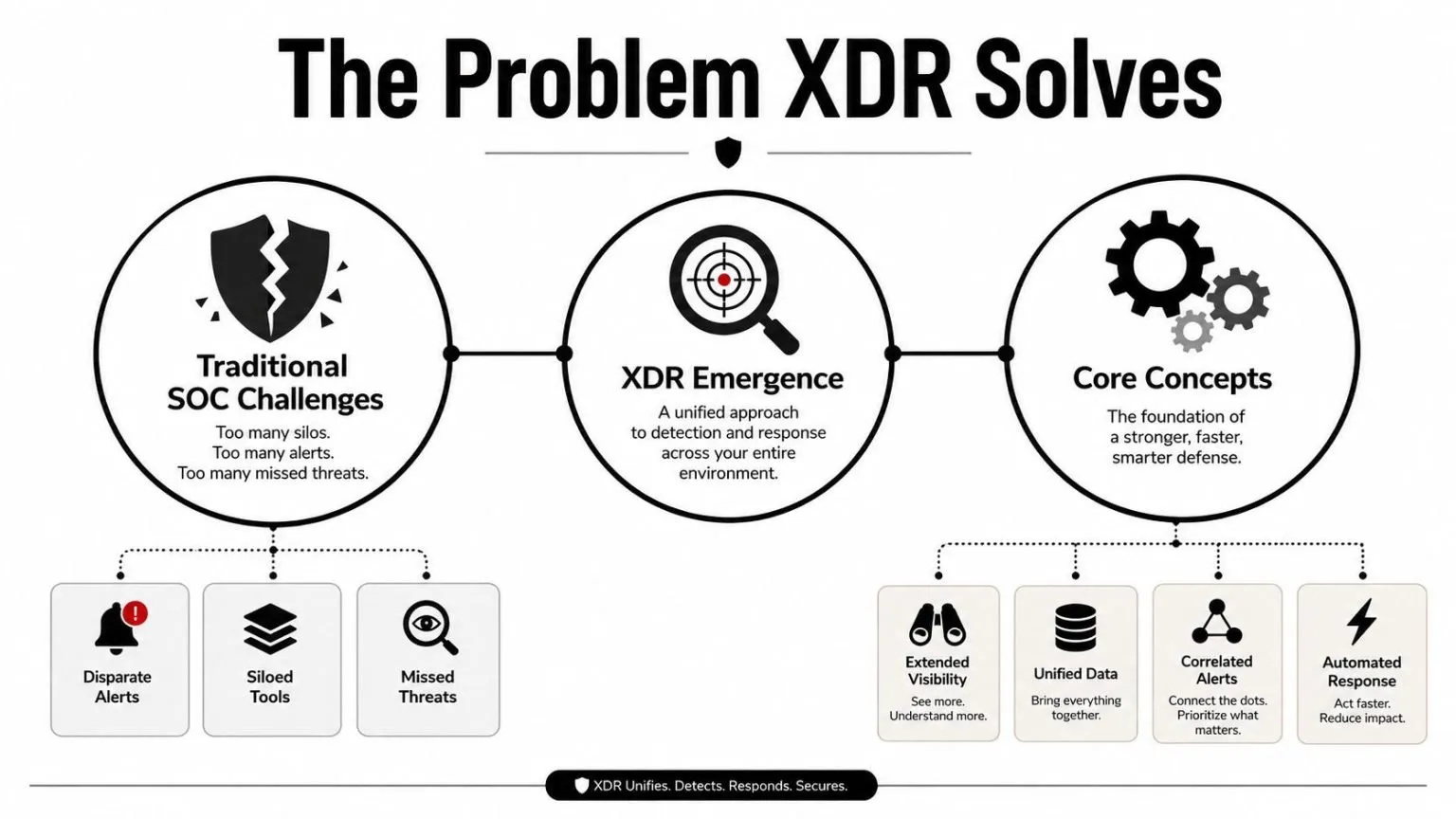
XDR stands for Extended Detection and Response. Gartner defines it as a SaaS-based, vendor-specific security platform that natively integrates multiple security products into a cohesive operations system, shifting security from siloed tools to a holistic view across the technology stack, as described in Google Cloud’s XDR overview.
That definition can sound abstract, so it helps to translate it into plain language. XDR collects telemetry from sources such as endpoint detection, network visibility, email security, identity systems, and cloud security controls. It then correlates those signals so a SOC analyst sees one incident story instead of a pile of disconnected alerts.
Why teams ask for XDR in the first place
Think of EDR as a camera pointed at the laptop. Useful, but narrow. XDR is closer to a control room that pulls in camera feeds, badge-reader logs, mailroom records, and hallway motion sensors, then tells you which events are part of the same break-in.
Practical rule: If your analysts spend more time pivoting across consoles than validating attacker behavior, you don’t just have a detection problem. You have a context problem.
For teams exploring threat detection and response platforms, that context is a core promise. XDR aims to reduce threat dwell time, improve visibility, and coordinate response actions from a central place instead of forcing the SOC to manually reconcile every clue.
XDR Architecture and Data Sources
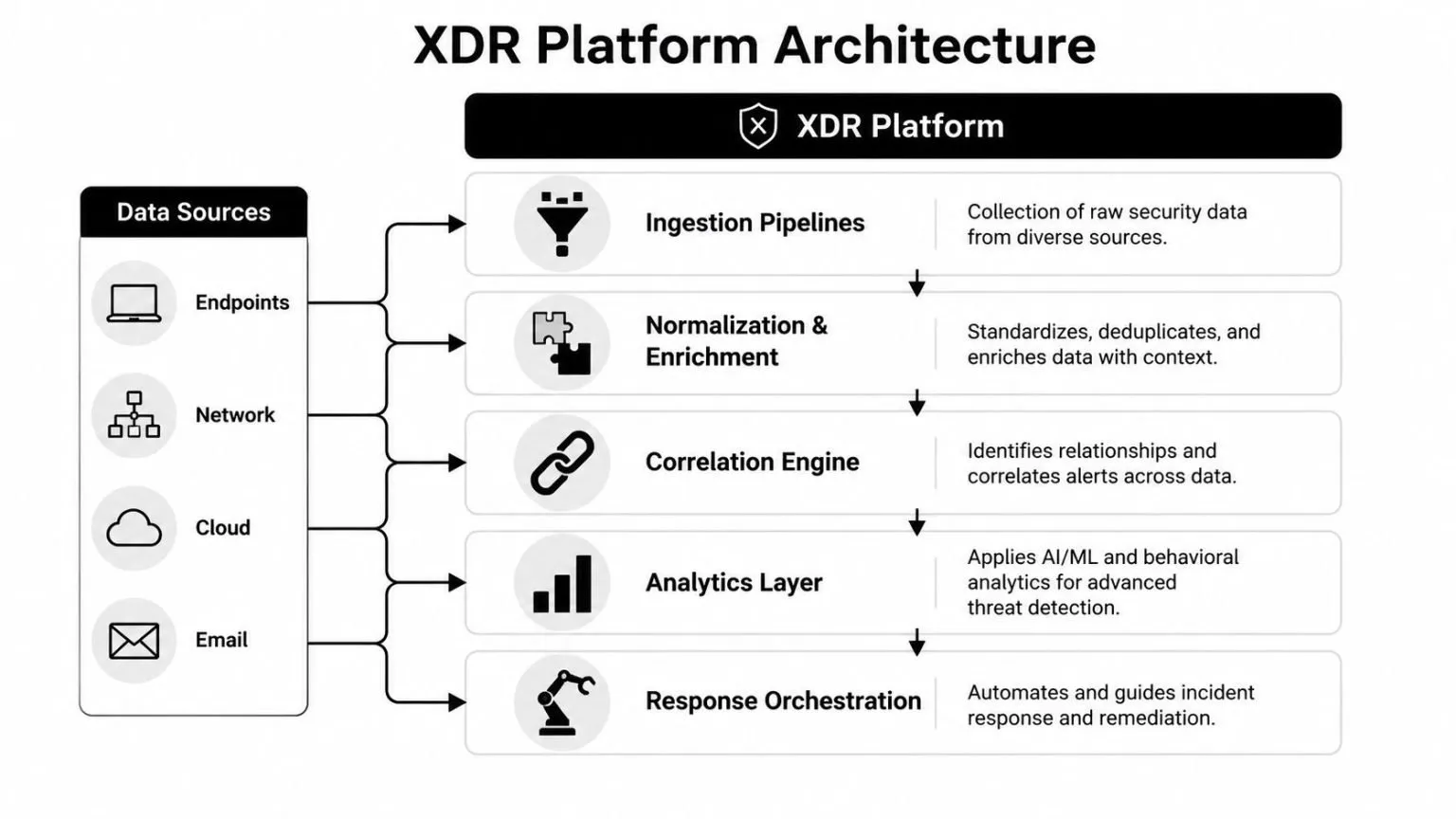
XDR works because it treats security data like a pipeline, not a pile. Raw events come in from different parts of the environment, get cleaned up and enriched, then pass through correlation and analytics before response actions fire. If any one of those stages is weak, the platform becomes noisy or blind.
Why telemetry fusion matters
A phishing campaign is a simple example. The email layer sees a suspicious attachment. The identity system notices a login from an unusual pattern. The endpoint agent detects script execution. The network layer observes lateral movement. Separate tools raise separate alerts. XDR tries to identify them as one attack chain.
Expert analysis notes that XDR often combines concepts such as Network Traffic Analysis (NTA), Network Intrusion Detection Systems (NIDS), and Network Intrusion Prevention Systems (NIPS) to give SOC teams more context while using AI to analyze aggregated logs and alerts in real time, according to the Wikipedia entry on Extended Detection and Response.
Later in the workflow, the architecture becomes easier to visualize as a stack of stages rather than a single feature.

The main layers inside an XDR platform
- Ingestion pipelines
Data arrives from endpoint agents, API integrations, Syslog feeds, cloud platforms, email gateways, and identity providers. In hybrid environments, this matters because one part of the attack may start in SaaS while another lands on an on premises host. - Normalization and enrichment
Raw records don’t arrive in the same format. One source calls a user by email address, another by username, another by internal ID. XDR normalizes those fields and enriches them with context such as asset role, user privilege, or threat intelligence tags. - Correlation engine
The platform links events that would look harmless in isolation. A failed login, a mailbox rule change, and a script launch might be unrelated. Or they may describe the same intrusion path. - Analytics layer
This layer looks for patterns, anomalies, and attack sequences that basic rule matching can miss. It’s especially helpful for dormant malware, internal reconnaissance, and lateral movement that unfolds across more than one domain. - Response orchestration
Once confidence is high enough, the platform can guide or automate actions such as isolating an endpoint, disabling an account, blocking a sender, or opening an incident with the right context attached.
XDR isn’t one magic detector. It’s a system that turns different security signals into one investigation workflow.
Comparing XDR with EDR SIEM and NDR
Security leaders often compare XDR to EDR and ask whether it’s just a rebrand. It isn’t. The more useful question is what each tool is built to observe, and what each one misses when it works alone.
Where each tool fits
EDR focuses on endpoints. It watches processes, files, scripts, persistence techniques, and local response actions. It’s strong when malware lives on a host, but it won’t give full visibility into email-borne compromise, identity abuse, or cloud control-plane activity by itself.
SIEM collects and stores logs from many systems. It’s valuable for investigations, detections, and compliance reporting, especially when teams need long-term searchability across servers, applications, firewalls, and identity tools. But a SIEM often depends on the SOC to build and tune the logic that connects events meaningfully.
NDR watches the network. It’s useful for spotting command-and-control traffic, lateral movement, beaconing, and strange east-west communications. But NDR can struggle to explain who launched the activity, which mailbox started the chain, or what process initiated it on the host.
XDR sits across those layers. It’s less about replacing every product category outright and more about giving the SOC a common place to correlate and act.
For organizations already evaluating endpoint protection platforms, this distinction matters. Buying strong endpoint tooling doesn’t automatically solve cross-domain investigation.
Feature Comparison of XDR EDR SIEM and NDR
| Solution | Detection Scope | Key Data Sources | Response Automation |
|---|---|---|---|
| XDR | Cross-layer detection across multiple security domains | Endpoints, network, email, identity, cloud workloads | Centralized and often guided or automated across connected controls |
| EDR | Endpoint-focused activity and compromise | Endpoint agents, process events, file activity, registry and script behavior | Strong on host isolation and local containment |
| SIEM | Broad log aggregation and analytics | Logs from infrastructure, applications, security devices, identity systems | Usually depends on integrations, rules, and external orchestration |
| NDR | Network-centric threat detection | Network traffic, flow records, packet-derived metadata, sensor output | Usually focused on network actions and analyst-driven investigation |
If your main challenge is malware on laptops, EDR may be enough. If your challenge is attack chains that cross email, identity, cloud, and endpoint layers, XDR is the better fit.
Benefits and Limitations of XDR
The strongest argument for XDR is operational clarity. Instead of asking analysts to manually reconcile alerts across product silos, it gives them a unified incident view. That changes how triage feels in practice. The analyst spends less time assembling evidence and more time deciding what to contain first.
What teams gain
One reason the category gets attention is that many leaders know they need it even if they don’t define it precisely. XDR is recognized as a necessity by 78% of IT leaders, yet only 47% can correctly identify its true definition, according to the ExtraHop findings reported by Business Wire.
That gap matters because teams sometimes buy an “XDR” product expecting a complete SOC operating layer and receive something closer to expanded endpoint tooling. When the definition is fuzzy, project scope gets fuzzy too.
Common benefits include:
- Broader context: incidents become easier to understand because endpoint, network, email, identity, and cloud signals are evaluated together.
- Faster prioritization: the SOC can rank incidents based on a fuller attack chain rather than a single alert type.
- More consistent response: teams can codify actions so the same class of incident gets handled in a repeatable way.
Where teams still struggle
The limitations are just as important.
- Vendor lock-in: many XDR offerings are built around native integration with the vendor’s own products.
- Third-party gaps: when a tool claims “open” integration, the depth of that integration may still be uneven.
- Rule quality: poor tuning can still flood analysts with noise, especially during early deployment.
- Expectation mismatch: some buyers assume XDR eliminates the need for SIEM, NDR, or detection engineering. It usually doesn’t.
Buying XDR doesn’t remove the need for good telemetry hygiene. If the platform ingests bad, incomplete, or poorly mapped data, it will automate confusion faster.
Real-World Use Cases in Hybrid Environments
A good XDR deployment proves its value in messy environments. Most organizations aren’t all-cloud or all-on-premises. They run remote endpoints, SaaS apps, private infrastructure, identity providers, email services, and a mix of security products acquired over time. That’s where XDR becomes practical instead of theoretical.
Lateral movement across cloud and on premises systems
An attacker compromises a workstation through a script-based payload. The endpoint agent sees suspicious execution, but the first serious sign appears elsewhere. The network layer starts observing internal discovery behavior, and a cloud workload logs unusual access attempts from the same user context.
Without XDR, those alerts may sit in different queues. With XDR, the system can correlate the user, host, network path, and cloud activity into one incident. The analyst sees a likely lateral movement sequence instead of four medium-priority notifications.
A SOC team can then contain the host, review identity misuse, and inspect affected workloads in a single workflow.
Phishing that spreads from inbox to identity to endpoint
A user receives a convincing message that bypasses basic filtering. The email gateway flags suspicious characteristics after delivery. Minutes later, the identity provider records abnormal authentication behavior, and the endpoint shows a new browser-based download followed by script execution.
This is a classic multi-vector chain. Email alone doesn’t confirm compromise. Identity alone may look like user error. Endpoint alone may look like commodity malware. XDR joins the sequence and tells the SOC that the mailbox, account, and device are part of the same incident.
A strong XDR use case isn’t “more alerts in one place.” It’s fewer disconnected explanations for the same attacker behavior.
Remote workforce investigations without swivel-chair analysis
In distributed organizations, the network perimeter no longer tells the whole story. Users work from home, connect to SaaS directly, and move between managed and semi-managed environments. Analysts need to understand what happened on the endpoint, in the identity system, and inside cloud applications without physically touching the device.
XDR helps by pulling those signals into one investigation view. The SOC can review timeline data, confirm whether the same user triggered related events, and launch containment steps even when the affected employee is outside the office.
It is in practice that teams first feel the value. Not because the attacks are more exotic, but because the environment is more fragmented.
Implementation Guidance and Success Metrics
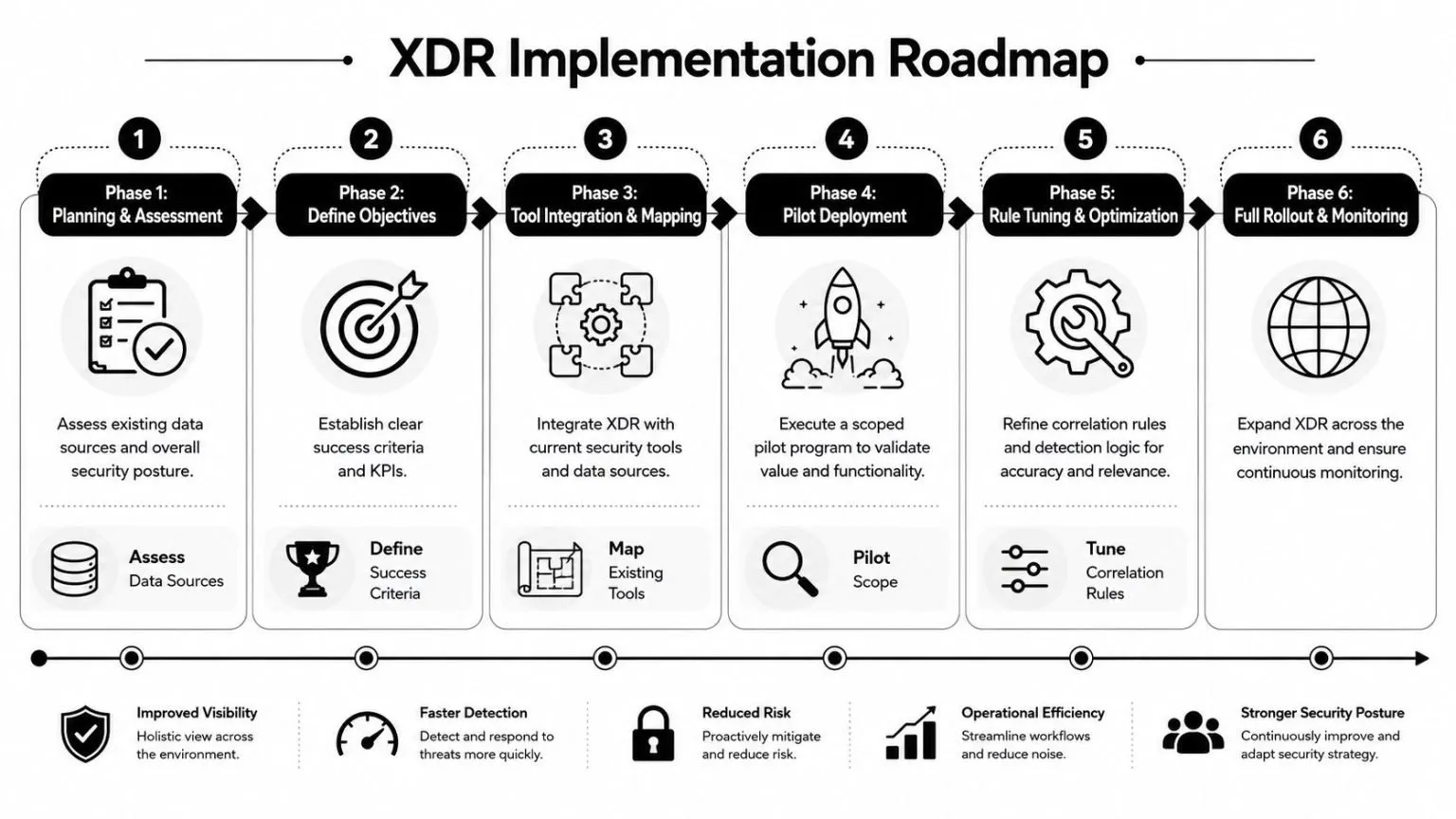
Rolling out XDR goes better when the team treats it as an operational design project, not just a product install. Start with your current telemetry map. Which systems generate useful security events today, and which ones are still blind spots? Most failed deployments happen because the organization connects whatever is easiest first instead of what explains attacker behavior best.
A practical rollout sequence
A workable sequence usually looks like this:
- Inventory the data sources that matter most
Focus on endpoint telemetry, identity events, email signals, cloud audit trails, and network visibility. Don’t chase every source at once. - Pick a narrow pilot scope
Use one business unit, one cloud environment, or one attack path such as phishing-to-endpoint compromise. A focused pilot reveals tuning problems early. - Map fields across tools
Make sure usernames, device identifiers, and asset tags line up. Correlation fails when the same entity appears under different labels. - Tune detections with analysts in the loop
Early rules should be reviewed by the people who triage incidents daily. They’ll spot duplicate logic, bad thresholds, and missing enrichment faster than a procurement checklist ever will. - Define response playbooks before rollout expands
Decide what’s automatic, what needs analyst approval, and what always requires escalation.
What to measure after deployment
You don’t need exotic metrics. You need metrics the SOC can use.
- Mean time to detect: Is the team surfacing suspicious activity earlier in the attack chain?
- Mean time to respond: Are containment actions happening faster once incidents are confirmed?
- Alert volume trend: Is correlation reducing duplicate cases across tools?
- False-positive ratio: Are analysts spending less time dismissing noise?
- Coverage by data source: Which critical domains still aren’t feeding the platform?
For teams that want a modular route rather than a closed stack, UTMStack is one option to evaluate. It combines SIEM, SOAR, and XDR functions in an open-source architecture and ingests data through APIs, Syslog, NetFlow, and agents while supporting rule tuning and response orchestration.
Compliance Considerations and Vendor Evaluation
Security teams in regulated environments rarely buy detection tools for detection alone. They also need evidence, log retention, access visibility, incident records, and reports that map to frameworks such as HIPAA, PCI, CMMC, ISO 27001, and GLBA. XDR helps when it can connect technical events to users, systems, and response actions in a way auditors can follow.
How XDR supports compliance work
Integrated telemetry improves compliance work because controls don’t fail in neat categories. A PCI incident may involve endpoint activity, account abuse, firewall logs, and cloud service events. A HIPAA investigation may need to tie user behavior, workload access, and alert timelines together. XDR supports that workflow by keeping detections and responses tied to a single case narrative.
This is also where open and modular architectures deserve more attention. Most XDR articles ignore modular open-source architectures, yet 78% of mid-market SOC teams cite alert fatigue from disconnected tools as their top pain point, creating a decision gap for cost-constrained organizations seeking unified SIEM and XDR, as noted in CrowdStrike’s XDR overview.
If your team is comparing proprietary suites with more flexible designs, centralized log management capabilities should be part of the evaluation, not an afterthought. Compliance evidence usually depends on how well logs are collected, normalized, retained, and linked to investigations.
Questions to ask before you buy or build
Ask vendors, or your internal platform team, direct questions:
- How open is the ingestion layer? Can it accept APIs, Syslog, NetFlow, and agent data without forcing a full product replacement?
- How customizable is correlation? Can analysts write and tune rules based on your environment, not just vendor presets?
- What does compliance reporting map? Look for evidence workflows, not just generic dashboards.
- How much context survives into the case record? Auditors and incident responders both need traceable timelines.
- What is the operational cost? License cost matters, but so do staffing overhead, integration maintenance, and alert cleanup.
Open-source XDR isn’t automatically better than proprietary XDR. But for some teams, it’s the only realistic path to broad telemetry fusion without expanding license sprawl.
Conclusion and Next Steps
The most useful way to think about XDR is not as another dashboard category, but as a response to a real SOC problem. Attackers don’t stay in one layer, and your defenders can’t afford to investigate in one layer either. When endpoint, identity, email, network, and cloud activity remain disconnected, analysts lose time where they can least afford it.
If you’re still asking what is an XDR, ask a harder follow-up question. Does your current stack help the SOC tell one coherent incident story, or does it force people to reconstruct that story by hand?
Start with an audit of your existing telemetry, alert flows, and response playbooks. Identify the domains where incidents regularly fragment across tools. Then run a pilot that tests correlation quality, analyst workflow, and evidence capture. For many teams, the right decision won’t be “buy the biggest suite.” It’ll be choosing the model, proprietary or open-source, that best fits their environment, staffing, compliance obligations, and integration reality.
If you’re evaluating a unified approach to SIEM, SOAR, XDR, and compliance reporting, UTMStack is worth a look. It provides an open-source platform for centralized telemetry, real-time correlation, automated response, and compliance workflows across hybrid environments.